Queuing for membership reflects Global South's choices









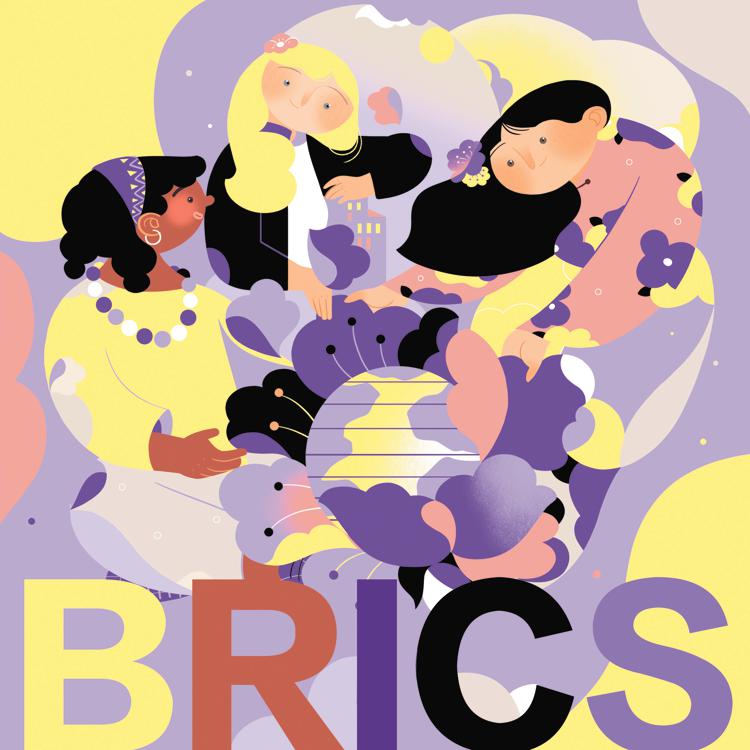
In an era marked by escalating conflicts and disputes, the world is growing increasingly volatile. Amid global uncertainty and heightened tensions, BRICS has emerged as a beacon of hope for the Global South. At the 16th BRICS Summit, to be held from Tuesday to Thursday, a pivotal agenda item will revolve around the potential admission of new members into BRICS. Reportedly, two dozen countries are vying to join BRICS, underscoring its growing significance on the global stage.
In August 2023, the 15th BRICS Summit in Johannesburg, South Africa, made the decision to expand BRICS was made. On Jan 1 this year, Egypt, the United Arab Emirates, Iran and Ethiopia officially became members of the BRICS group. The fifth new member, Saudi Arabia, is yet to formally join the grouping.
But why have so many countries applied to join the grouping?
To begin with, BRICS is a grouping that believes in human values, respects diversity and upholds multilateralism, which is in stark contrast to other blocs' policies. The world yearns for cooperative groupings where people respect each other, live in harmony and share the fruits of development regardless of their religion, race and color, and the language they speak. BRICS is an association that upholds these spirits.
Facing escalating conflicts and tensions, it is thus crucial for the Global South to unite and work together to preserve their sovereignty and territorial integrity. And BRICS, a grouping of developing countries united in their struggle to safeguard their independence, provides them with a platform to do so.
Moreover, BRICS represents emerging and developing economies. The US and Western economies such as the European Union, Japan and Canada, which closely follow the US, are experiencing an economic downturn. In contrast, BRICS is a grouping of emerging economies such as China, Russia, India, Brazil, South Africa, Iran and Egypt, which together make up a significant portion of the world economy.
BRICS stands for human values and is also a civilizational project. When we look at BRICS, we see the acceptance of differences, family values and socialism. Even if there were no threat from the West, BRICS would be a more suitable option for Turkiye.
Unlike certain powers or blocs that subscribe to the notion of clash of civilizations, BRICS member states are as diverse as they can be in terms of their culture, ethnicity and the faith they follow. BRICS has a wide ethnic, cultural and religious spectrum — from Orthodox, Protestants and Catholics to Hindus, and from Muslims, including Sunnis and Shi'ites, to Buddhists and nonbelievers. Also, the grouping includes a socialist country, secular states and Islamic republics. BRICS is a formation based on equal relations. It is a formation where no country shapes the future of the others, interferes in their internal affairs or looks down upon them.
In the case of Turkiye, BRICS is not a dream; it is a realistic project.
BRICS offers many opportunities for the Turkish economy. In the EU, the Customs Union, introduced before Turkiye was made a key strategic partner of the European economic bloc, made Turkish producers uncompetitive. BRICS, alternatively, is a different proposition for Turkiye. If it joins, BRICS will give Turkish producers access to a huge market and low-cost energy. Besides, investors from BRICS countries will find a destination in Turkiye that is much more favorable to business.
Turkiye is already an important partner of BRICS with its strong military and economic potential, and influence in the Turkic states and the Islamic world. Turkiye's place in the world economy can also play an important role in global monetary system reform.
But to join BRICS, Turkiye needs to change its pro-Western foreign policy and build trust with existing BRICS members.
The BRICS Summit will shape the future of not only Global South but also the world.
The author is chairman of Turkish-Chinese Business Development and Friendship Association.
The views don't necessarily reflect those of China Daily.
If you have a specific expertise, or would like to share your thought about our stories, then send us your writings at opinion@chinadaily.com.cn, and comment@chinadaily.com.cn.