Encountering Sanxingdui civilization in NYC









Spanning millennia, the history and mystery of Sanxingdui's ancient civilization is reaching international audiences through modern digital platforms.
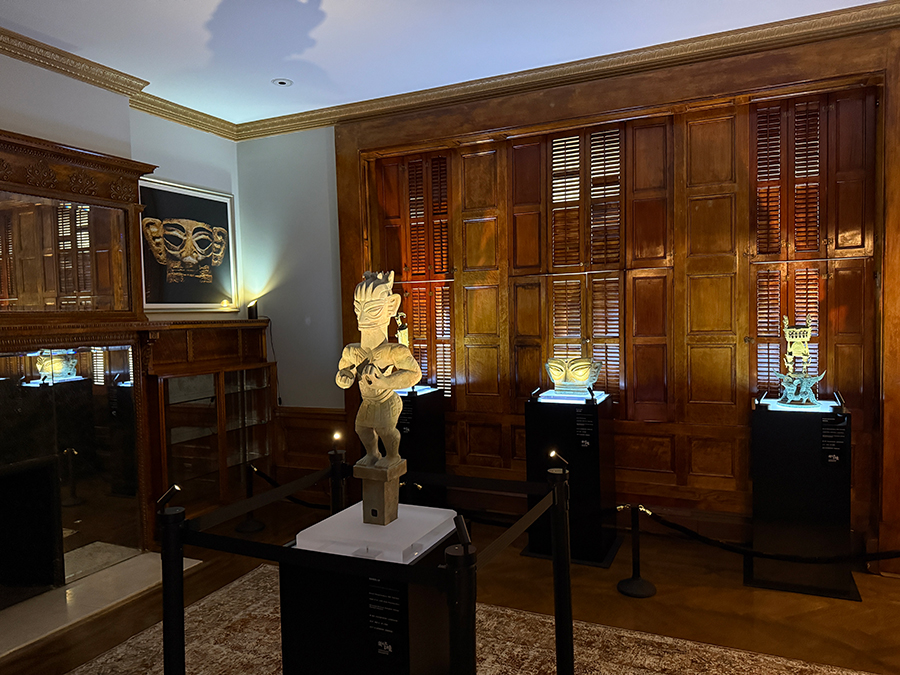
The exhibition Sanxingdui Encounter: A 12K Micro-viewing of National Treasures opened on Saturday at the Memor Museum in New York, offering visitors an opportunity to have an immersive virtual experience of the relics and also see the physical replicas of these treasures.
The display will last until Jan 19.
Sanxingdui, an archaeological site located in modern-day Guanghan, Sichuan province, China, illustrated the civilization of the ancient Shu kingdom, which flourished from around 1700 BC to 1050 BC. Sanxingdui was not discovered until the 1920s and ongoing archaeological efforts continue to reveal new discoveries.
By the end of 2022, fieldwork on six newly uncovered sacrificial pits was nearly complete, yielding a wealth of precious artifacts. Over 4,000 items, including jade, stone and pottery, were unearthed during this phase of excavation. Archaeologists are piecing together the history of the ancient Shu civilization and presenting these findings to the public.
The Shu kingdom, which arose in the Sichuan basin during the Bronze Age, is thought to have developed independently from the Yellow River Valley societies, long regarded as the cradle of Chinese civilization. Its people produced finely crafted bronze, jade, gold and ceramic artifacts, depicting mythical creatures, rulers, gods and shamans with exaggerated features such as bulging eyes and enlarged ears.
"Sanxingdui's rich heritage deserves international attention, with its vast cultural significance needing to be shared with a broader audience," the director of Memor Museum, Willa Ao, told China Daily.
"Sanxingdui's culture is an integral part of Chinese culture, and our goal is to share China's history, culture and civilization with more international audiences in a way that is accessible, understandable, engaging and approachable. We want to present the Sanxingdui relics through a blend of digital and physical experiences," Ao said.
One example Ao gave is a bronze figure, which strikingly resembles the stance of an American fitness coach performing a deadlift. Additionally, the bronze tree is adorned with numerous small hanging artifacts, reminiscent of ornaments used to decorate Christmas trees.
This is not the first time Sanxingdui has made an appearance in New York. Its unearthed bronzes were previously showcased at the Metropolitan Museum of Art in 2002 as part of a broader exhibition on bronze artifacts, but Ao said this time she wanted to provide New Yorkers a younger and interactive way to feel the relics in person through 1:1 replicas from the Sanxingdui Museum's collection, using ultra-high-definition 12k technology, AI interaction and VR immersion, which required three years of preparation.
UHD 12K technology refers to a video resolution of approximately 12,000 pixels across the width of the image, significantly higher than 4K and 8K resolutions.
Among the highlights of the exhibition are bronze masks, ceremonial altars and the renowned gold mask, each offering a glimpse into the sophisticated artistry and spiritual depth of the Shu civilization.
Visitors will have the opportunity to view the famous Bronze Mask with Crown and Protruding Eyes, a rare artifact that provides insight into the ceremonial and spiritual practices of the ancient Shu people.
Also on display is the striking Bronze Head Wearing a Gold Mask, first unearthed in 1986, which illustrates a unique blend of social status and ritual significance.
"Although they are replicas, they remain highly valuable," Ao said. She explained that the replicas were created with permission from the Sanxingdui Museum, using the same materials to faithfully reproduce the original artifacts. They were also transported across the ocean according to the same standards used for authentic relics.
Visitors will be able to explore the relics using VR technology, which brings large artifacts like the Large Standing Man and the Bronze Sacred Tree into the gallery through virtual exploration. The exhibition also employs 12K video capture to document smaller artifacts, delicate bronze bells and bird sculptures, magnifying them for a closer look.
"We use the highest resolution technology to capture every element of the artifacts. With 12K resolution, even the smallest artifacts are magnified, revealing intricate patterns that are invisible to the naked eye in a museum display," Ao said.
"Digitization is not only a crucial method for preserving relics but also an essential tool for their protection," Ao said. "Archaeological work now includes digital methods to gather artifact data, and it's important for us to make use of this. Simply preserving these cultures isn't enough, we must better promote our culture."
Visitors can also use VR experience to view the 3.96-meter-high Bronze Sacred Tree and 2.62-meter-tall Large Standing Man through an interactive experience where, through VR headsets and controllers, visitors can enter a 3D-scanned replica of the Sanxingdui archaeological cabin and immerse themselves in the first-person perspective of archaeologists.
"Visitors will gain a direct understanding of what the archaeological process is really like," the organizers said.
Sanxingdui is an incredibly important archaeological discovery, not just within Chinese archaeology, but within the world of archaeology, Kristen Martucci, the exhibition translator, told China Daily.
Martucci, 26, has been studying Chinese since high school and pursued East Asian studies, particularly ancient Chinese history, at Harvard University. "I'm particularly interested in early Chinese history, so Sanxingdui is certainly part of that," she said.
She primarily helps translate materials into English and curates the exhibition in a way that is approachable for American and international audiences.
"There's never just one perfect translation. Scholars spend months, sometimes years, figuring out the correct interpretation of something. And even then, there's debate," she said, explaining that her work is also a learning process in both Chinese and history while uncovering the "mystery."
"I've never been to the Sanxingdui Museum. I learned about Sanxingdui in my grad school courses, but even for me, seeing these replicas and using this exhibition and VR to experience it — that's new to me, so it's really exciting," she said.