Intangible cultural heritage sees growing consumer appeal










Drawing inspiration from history and tradition, inheritors create contemporary products, Yang Feiyue reports in Jinan.
Delicate wood-framed wall paintings, refrigerator magnets and small decorative table items bearing elements ranging from ancient gardens and chubby babies to auspicious animals never fail to stop passersby at Wang Yan's stand.
The woman is an inheritor from Tianjin Yangliuqing Fine Arts Press (or Yangliuqing painting society), founded in North China's Tianjin in the 1950s.
Wang presented a few creative cultural products based on the craftsmanship of the traditional woodblock paintings that boasts a history of more than 400 years at the 8th China Intangible Cultural Heritage Expo held in Jinan, East China's Shandong province, from Oct 17 to Monday.
"People showed a lot of interest in our vibrant folk art that is characterized by colorful, lively depictions of festive themes and daily life," she says.
The paintings used to record the most fashionable and popular items of folk society in their time and thus are widely considered a good reflection of the culture and history.
They were named a national intangible cultural heritage in 2006.
"Their subjects were very extensive, covering social life, literature and opera history," Wang explains.
To cater to modern customers, Wang and her team at the painting society have toned down the strong hues and scaled down the size of the traditional paintings while applying the craft to items that enliven tea and study rooms today.
"We have approximately 180 commodities on the market now but our society preserves more than 6,000 ancient woodblocks and more than 20,000 colorful drafts," Wang says, adding that most of them have been in static preservation.
Since 2022, the society has launched a project to make better use of these ancient resources.
"The traditional patterns have proved very popular," Wang says.
Wang's team has also experimented and worked on other materials, such as copper, to create the paintings.
"We draw more inspiration from our reserves and come up with more creative culture products to have the traditional culture better integrated with modern life," she adds.
Yangliuqing art was among more than 200 intangible cultural heritage items on display at the Shandong expo hosted by the Ministry of Culture and Tourism and organized by the Shandong culture and tourism department and the Jinan government.
Wang's innovation cause aligns with the theme of the expo that highlighted the integration of intangible cultural heritage with modern life for better protection and inheritance.
The expo aims to fully showcase the achievements of China's intangible cultural heritage protection over the 20 years since it joined the UNESCO Convention for the Safeguarding of the Intangible Cultural Heritage, according to the organizers.
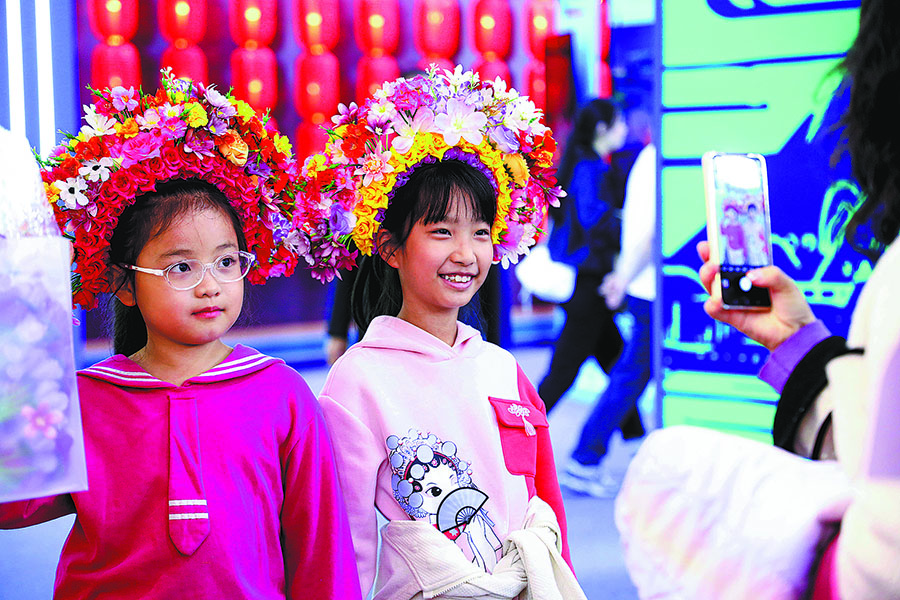
Young women and girls gathered at Huang Liyong's booth during the expo as she arranged polychromatic flowers for a headdress that is part of the women's customs from Xunpu, a coastal village in Quanzhou, Southeast China's Fujian province.
After they got a general idea of how to make them, they wore some readily-made headdresses for photos.
The traditional practices and cultural expressions of the Quanzhou women have been carried forward for more than 800 years and include unique clothing and accessories. They were collectively named a national intangible cultural heritage in 2008.
"It takes about 10 minutes to pull off a flower headdress the traditional way, using multiple tools and layers of different flowers," Huang says.
The headdress features a base of interwoven greenery or fabric onto which various colorful blossoms, such as chrysanthemums, peonies or lilies, are delicately arranged.
"We also style a hair bun, wear hairpins and long wigs," she adds.
To satisfy the rising public interest in the flower headdress, Huang brought in many simplified versions suitable for different hairstyles.
She has noticed increasing interest in her traditions at home and abroad.
As an inheritor of the younger generation, she saw how the headdress was liked by international visitors during a Quanzhou cultural and tourism promotion in Paris earlier this year.
"Although we couldn't understand the language, their surprised expressions and thumbs-up gestures showed they loved our designs," she says.
Huang hopes innovating the traditional art can make things easier for more people to appreciate the local culture.
"It is our way of expressing our love for life and wishes for happiness," she says.