Discovering China's rural charms









During my stay at Tsinghua University as a visiting student, professor Zhao Yuezhi invited me to take part in a three-day event in Jinyun county, Zhejiang province. This event, the 10th Heyang Forum and the Rural, Cultural, and Communication Academic Week, hosted a diverse array of guests, including local residents and some international attendees. This journey marked my inaugural experience on the high-speed train, which proved to be remarkably smooth—even at slower speeds, its motion was imperceptible. After an eight-hour journey at speeds reaching 307 kph, we reached our destination in Jinyun county.
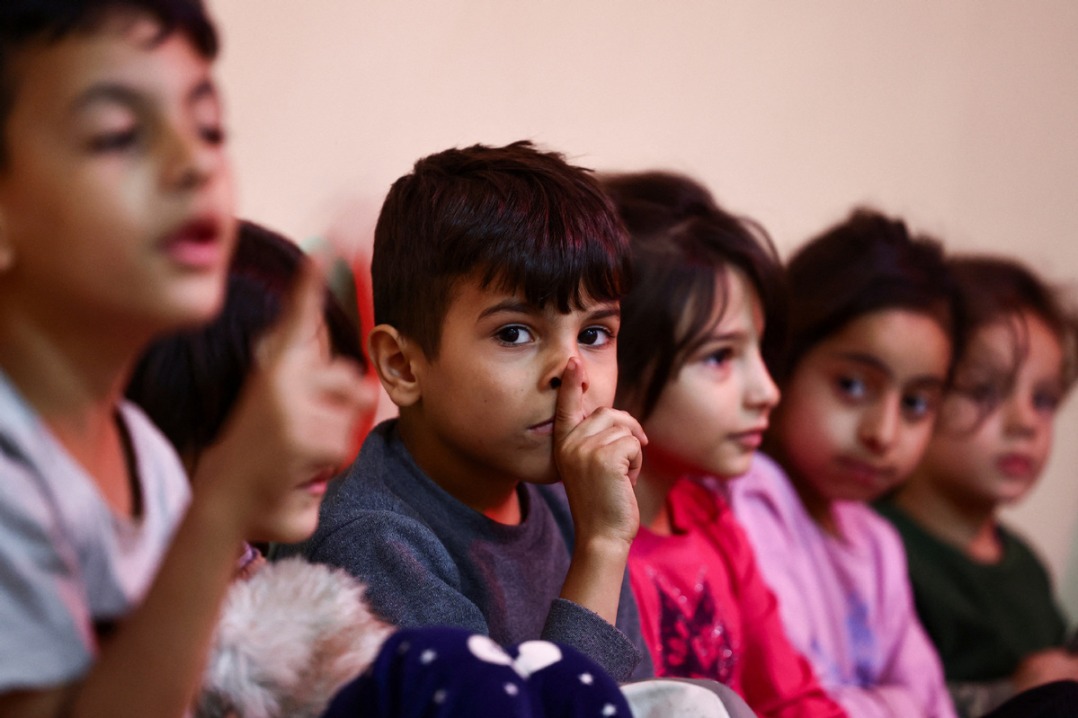
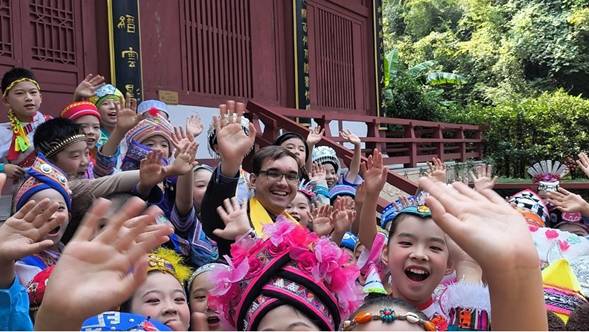
On our first day we visited the Jinyun Xiandu Geopark for the inauguration of the Xuanyuan Huangdi Festival, which comprised nine exquisite ceremonies paying respect and tribute to the Yellow Emperor. Later that day I enjoyed one of the most special moments of my whole stay in China: I personally met, by chance, 56 children singing at the Huangdi temple. Each child was so happy to see me and gladly wanted to take pictures with me, and I was delighted that we could share this wonderful moment. To my surprise, one of the children, a ten-year-old, spoke excellent Spanish after asking about my native language. They were all excited that I came from afar to meet them, and I am grateful to have beautiful photos and memories from that experience.
Next, at Haoxi village, was the traditional Chongyang Festival, also known as the Double Ninth Festival, in honor of the elderly. I was told that it was a local tradition for visiting foreigners to be invited to carry a large paper dragon assembled onto a long chain of 188 wooden boards. Milai and I, as foreign guests, were welcomed and offered yellow dresses similar to every dragon carrier. Many banners in ancient Chinese characters reflects the antiquity of this ceremony that attracts residents from nearby villages and beyond, signifying its importance and culturally cohesive tradition.
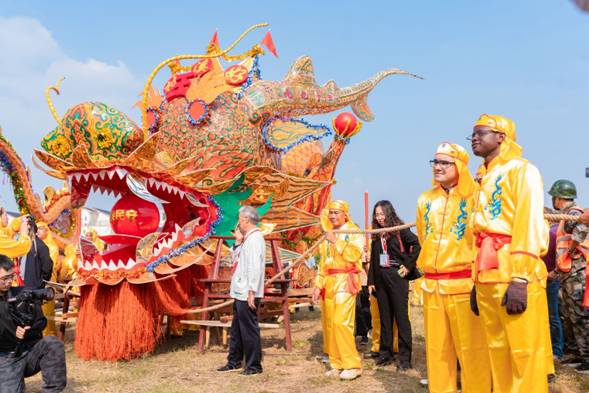
The locals gave us the first row to witness the altar ceremony right from beneath it because we were foreigners appreciating their culture! On the second day at Haoxi, a parade was held, and we were invited again and taken to the best places to watch it. As a foreigner I always felt welcomed by the locals, providing me with the unique opportunity to visit rural China and experience the rich people-to-people diplomacy. Everyone I met was happy to see me, and eager to share their food, culture and traditions with me.
The next day we went to Jianchuan village to see its successful poverty-alleviation policies, like the cleanliness of its waters. Like Haoxi, the local authorities were very welcoming, personally guiding us around the village into one of their major infrastructure solutions: the elevated highway's unused space below the bridges was refurbished with multiple sports facilities. It was a creative way to refurbish unused spaces, representing solutions to adapt infrastructure between living spaces.
Our last day was spent in Heyang village. Many distinguished researchers and authorities presented different perspectives and approaches regarding the urban-rural relationship, development gaps, challenges, achievements, theories and problem solving. I participated in the roundtable "Knowledge practice with the people as the center and the village as the method: China and the world perspective", comparing rural characteristics of Chile with China. The PRC consolidated its red spirit with a green spirit from the beginning, especially because Chinese peasants are considered national heroes, but also because the people's wellbeing has always been a priority. Songs and poems in China celebrate the Chinese countryside and the contributions made by peasants, calling for their respect and awareness of their strategic relevance to the country's development, and national identity.
During the roundtable discussion I highlighted that China today boasts remarkable connectivity and transport infrastructure between its provinces, facilitating communication and cultural exchange among its people, as I confirmed in the villages that I had visited that they never felt isolated from the rest of the country. Chile, by contrast, has a significant lack of connectivity, especially railroads. Also, Chile's rural-urban migration process contributes to a high demographic concentration in the capital city of Santiago, having almost 40 percent of the national population in 2023, but also contributing to its extreme urban sprawl of massive residential buildings, unsanitary urban slums, homelessness, permanent traffic jams and a highly unequal presence of green areas, suggesting an inorganic and unbalanced urban development.
Fortunately, Chilean universities have done great fieldwork regarding rural promotion and revitalization. The University of Chile has been committed to the needs of our country and has engaged with local and rural communities. In particular, the University's Chair in Peasant Agriculture and Nutrition promotes peasant and indigenous family agriculture, warning of its disadvantage against big agriculture, which steers it away from urban markets, productivity-enhancing science, technological innovations and from political centers. This program aims to give a voice to local agricultural groups and ensure that their voices are heard, their problems noticed, their produce and commodities strengthened, and help to protect the traditions of Chile's cultural heritage.
In sum, this journey made me reflect on the kindness of Chinese people, and the different scopes the urban-rural development gap can be approached! Only the long and continuous China road to rural revitalization can explain how so many researchers and authorities in China have remarkable theoretical and fieldwork experience, concluding that many talents worked ambitiously for it. I find this inspiring for the Global South, including Chile, to learn new ways of studying their own rural provinces and agricultural sector, as well as the traditions and its contributions to national identity. Of course, China still has challenges to overcome, but it is also aware of the example it has set, and as such, is open to inviting other countries to see the Chinese experience, inspire a spirit of rural revitalization, problem solving, and always placing the people's needs as the top priority. Therefore, I agree with the saying "If the nation is to be revived, the countryside must be revived", as reform and modernization will be imbalanced and incomplete if the countryside, one of the backbones of food security and national identity, is left behind.
The author, Renzo Burotto Pinochet is currently a visiting student at the School of Journalism and Communication at Tsinghua University from Chile.
The views don't necessarily reflect those of China Daily.
If you have a specific expertise, or would like to share your thought about our stories, then send us your writings at opinion@chinadaily.com.cn, and comment@chinadaily.com.cn.