A journey to the west
Ancient road network takes people on a fascinating route to the past, Huang Zhiling and Peng Chao report.









Yuan Tingdong had a pleasant surprise when he came across the Chinese edition of US writer Hope Justman's Guide to Hiking China's Old Road to Shu, which was published recently by the Sichuan Ethnic Publishing House.
Justman had visited different parts of the shudao, or Shu Roads, 24 times, either alone or with family members or her friends from the United States, since she first stepped on it in 2001.
The world has two ancient paths on the UNESCO's World Heritage List, Camino de Santiago in Spain and the Kumano Kodo in Japan. To Justman, an 82-year-old resident of Philadelphia in the US, China's Shu Roads are as deserving as both to be on the list.
Yuan, 84, a senior researcher in the culture of Sichuan province and neighboring Chongqing municipality, says he highly respects Justman for her knowledge of the Shu Roads, also called Ancient Shu Roads.
"I did not expect a foreign friend to have such an intense love for the Ancient Shu Roads, and therefore hold her in high esteem," says Yuan, the Sichuan-based researcher.
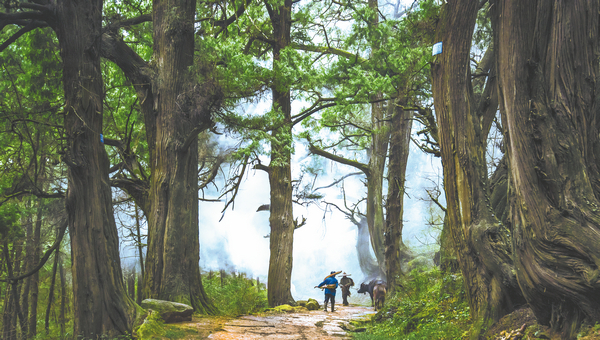
Shu is short for Sichuan and was its ancient name as well. The Ancient Shu Roads are a system spanning more than 1,000 kilometers that connect today's Xi'an, Shaanxi province, and Chengdu, Sichuan province, over the Qinling and Daba mountains. They were built more than 2,000 years ago. The part that is not within Sichuan is also called shudao, which means it is the way to the Shu.
On the northern section of the Ancient Shu Roads are the Chencang, Baoxie, Tangluo, Ziwu and Qishan roads, and on its southern section are the Jinniu, Micang and Lizhi roads.
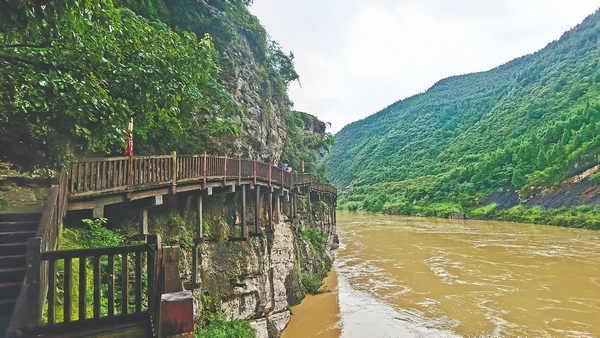
Many Chinese know the Ancient Shu Roads from the works of poet Li Bai of the Tang Dynasty (618-907), a household name in China, who once wrote "the roads to the Shu are harder than climbing the sky". The Ancient Shu Roads were built on mountains so precipitous that Li lamented this feature in his poem, Shu Dao Nan (Hard Is the Road to Shu).
The road to Shu in Li's poem is in the Jinniu Road of the shudao, running from Hanzhong in Shaanxi to Chengdu, more than 600 kilometers in length.
Hailed as a world-class living fossil of ancient land transportation, the Guangyuan section of the Jinniu Road in Sichuan is nearly 260 km long, well-protected and boasts many visitor destinations.
The best-known site is the Jianmenguan, or Jianmen Pass (literally "sword gate pass"), a towering V-shaped mountain pass in Jiange county, Guangyuan. It's said to be the major fortress on the Ancient Shu Roads and is a must-see place while on a trip to Sichuan. The famous quote from the great poet Li — "One man guards the fortress, 10,000 men can't pass" — is inspired by it.
Since 316 BC, some 100 battles have been fought there. Because the pass is so steep, not a single frontal attack has been successful.
During the Three Kingdoms (220-280) period, the Wei (220-265), Shu (221-263) and Wu (222-280) dynasties were entangled in fighting in their attempts to reunify China, leaving countless heroic stories in their wake.
In order to conquer the Shu Dynasty, Deng Ai, a general of the Wei Dynasty, bypassed the precipitous and well-guarded Jianmen Pass in AD 263.
He and some 5,000 soldiers were said to have wrapped up in felt and rolled down a high mountain far from the pass to reach Sichuan.
Zhao Xiaohua, a senior tour guide in Jiange, narrated the story. "Only 2,000 soldiers survived after rolling down. But they managed to force Liu Shan, ruler of the Shu Dynasty, to surrender, as Shu people had lived in peace for too long and didn't want to fight as warriors," Zhao says.
About a 20-minute car ride from the pass is the Cuiyunlang ("green cloud" corridor), a captivating sight on the Shu Roads.