Not the time to spin wheels
Making the pie bigger and helping each other is the way for the EU and China to end their EV dispute









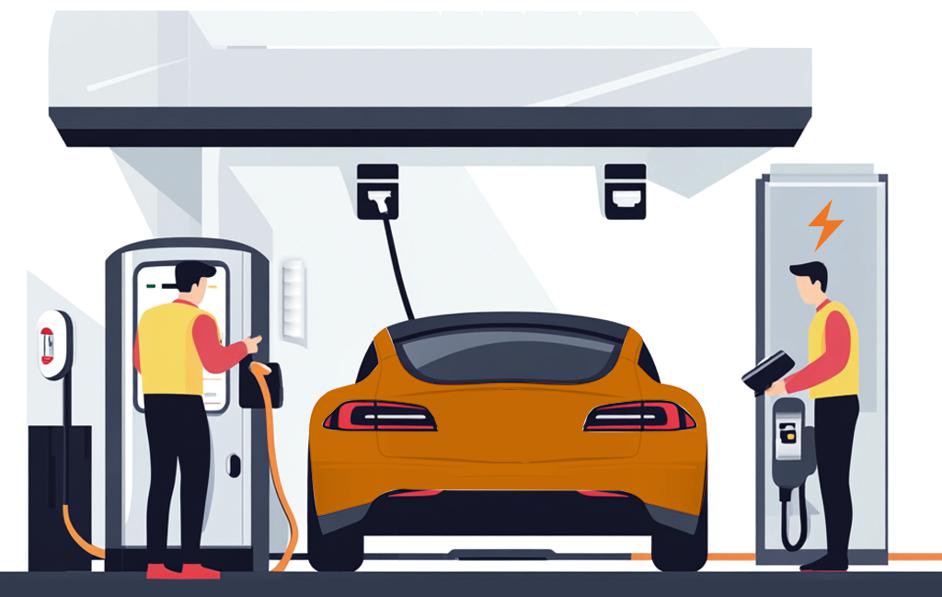
Since the European Commission launched the anti-subsidy investigation into China's electric vehicles in October 2023, how to properly promote the orderly and healthy development of the China-EU EV industry, and how to resolve the potential escalation of trade frictions have been a priority for the two sides. However, the recent series of measures taken by the European Union indicate that it is obviously taking a very tough attitude. Only five EU member states voted against the imposition of tariffs by the European Commission on Oct 4.
The EU claims the tariffs are in response to "unfair subsidies" China has provided to its EV manufacturers and the dumping of its EV "overcapacity" in the European market. But these claims cannot withstand scrutiny.
On the issue of subsidies, the EU side claims that the development of China's EVs completely relies on excessive subsidies. Relevant reports even describe the Chinese manufacturers' electricity, land, labor and financing as the result of government manipulation.
However, China's new quality manufacturing industries, such as EVs, relies on China's complete industrial system, solid industrial supply chain, and transportation, energy and other mature and stable foundations. In fact, China's current EV market has formed a strong competitive environment. The government does not need to support it to have excellent companies stand out. Tesla, BMW and other European and US car companies are also attracted by China's vast market and good business environment.
The so-called overcapacity theory also ignores the basic supply-demand logic of the market economy. According to the China Automobile Association, in 2023, China's new energy vehicle production and sales reached 9.587 million units and 9.495 million units, a year-on-year increase of 35.8 percent and 37.9 percent, respectively, showing that the overall development of China's EV market is healthy, and the claim that it is relying on the export of products to maintain a balance is untenable. Even with annual sales of 30.09 million cars in China, the current market share of NEVs in China is only 31.6 percent, which means that China still has plenty of market potential to tap.
China's NEV exports in 2023 reached 1,584,800 units, of which 438,000 EVs were exported to the EU, accounting for only 27.6 percent of new energy vehicle exports and 4.5 percent of NEV production. Therefore, the so-called reliance on the EU market or foreign exports to absorb production capacity is undoubtedly ignoring the reality of the booming development of China's local EV ecology, distorting and misreading the logic of free trade and the market economy, and creating excuses for politically driven protectionist practices. If exports of a country's products are the basis for excess capacity, then this argument is to deny the basic principle of the market economy to vote with its feet and buy and sell voluntarily.
According to the European Automobile Manufacturers' Association, in 2023, China imported 11,500 electric vehicles from the EU. Does this data prove that the EU vigorously supports the electric vehicle industry with subsidies and it needs the Chinese market to digest its "overcapacity"?
Objectively speaking, in recent years, China's exports of EVs to the EU have grown rapidly. In 2023, China's EV exports to Germany, Spain and the Netherlands increased by 55.36 percent, 127.27 percent and 261.81 percent respectively, which has been a huge psychological blow to the EU, which regards cars as its own industrial advantage.
The advantages of China's EV industry are its comprehensive technological advantages, economies of scale and mature markets rather than just competitive prices. High tariffs in the EU will narrow profits and cannot completely eliminate the competitive advantages of Chinese products in all aspects. Therefore, the EU's attempt to raise the threshold of its local market to force China to give in, make concessions, and even change its industrial development system and trajectory in accordance with EU requirements, will not succeed.
However, the negative signs of economic and trade politicization and security shown by the EU on the issue of EVs are likely to pose systemic challenges to the sustainable development of China-EU economic and trade relations.
In the context of today's global turbulence, making the pie bigger and helping each other is the way to tide over the crisis. Beggar-thy-neighbor approaches and a zero-sum game mentality will not bring about a win-win situation.
Through communication and consultations on competitiveness and industrial policies, China and the EU should be able to reach a consensus on the most basic concepts and standards, build a framework and platform for discussing industrial policies and subsidies, explore common interests and sensitive boundaries through consultations at all levels, and eliminate the negative situation in which contradictions and disputes continue to rise. Recently, the new members of the European Commission have formally confirmed that the division of labor reflects the EU's tendency to pay more attention to the research and development and shape industrial policy, and also provides an opportunity for China and the EU to build industrial and competition policy dialogue.

The author is an associate research fellow at the Institute of European Studies at the China Institutes of Contemporary International Relations. The author contributed this article to China Watch, a think tank powered by China Daily. The views don't necessarily reflect those of China Daily.
Contact the editor at editor@chinawatch.cn.