Robots no more science fiction in real life









I first learned about robots while reading a science fiction story more than 50 years ago. But I first saw what they looked like in Western movies, which began screened in China after the launch of reform and opening-up more than four decades ago.
The robots in Western movies had human-like metal bodies, moved slowly like zombies and spoke in a metallic voice. To me, they looked rather funny, although they had little to do with the Chinese people who, at the time, still relied on bicycles for commuting, hoes and sickles for farming and outdated machines for industrial production. I couldn't imagine even in my wildest dream that one day we could be surrounded by robots that would make our lives more convenient, or frustrating as experienced by some.
Today, it is more than likely that you would be welcomed by a "robot assistant" when walking into a bank, a robot that would tell you which window to go to for withdrawing or depositing money or for some other purposes. In some parks, robots, following you, may ask you to buy an ice cream or soft drink. The way robots speak reminds me of the little match girl in Hans Christian Andersen's story of the same name, prompting us to open our wallets.
On dialing the after-sales phone number of big companies to lodge a complaint or inquire about something, you are more likely than not to hear the little match girl-like voice, making us wonder if the robot in the park has changed its job. But soon you will realize that you are talking with another robot with the same beautiful voice.
Order a pickup meal from your hotel room, and you will be greeted by a message on your phone screen within half an hour, telling you that a "deliveryman" is waiting outside with your order. On opening the door, instead of a human being, you are met by a 1-meter-tall robot telling you to collect your lunch while it is still warm.
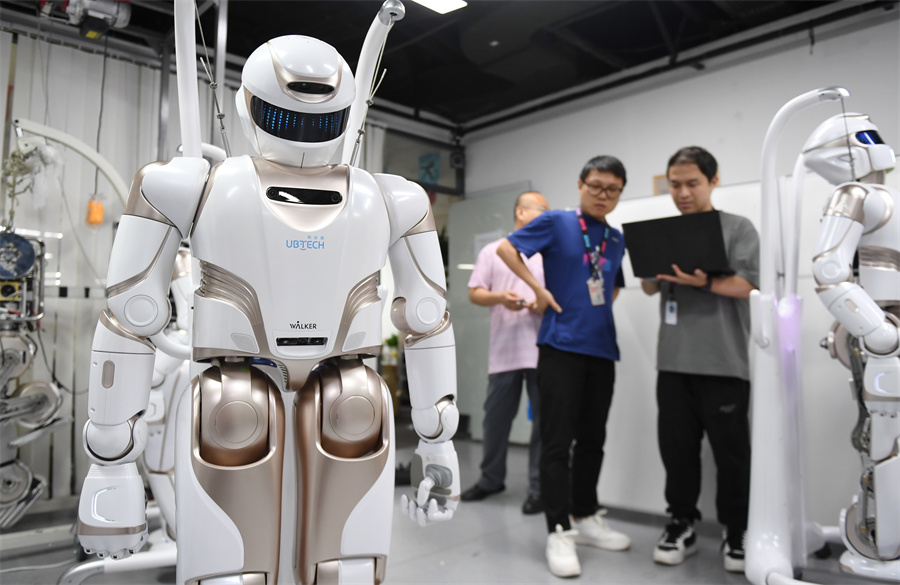
The above-mentioned robots are usually classified as service robots. In thousands of factories in China, on the other hand, more than 2 million industrial robots are working day and night, making all kinds of products for consumers across the world.
Statistics show China has become the world's biggest user of industrial robots, employing more than 2 million such robots — about 5 million industrial robots are in service around the world now. About half a million industrial robots are "born" across the world each year, with more than half of them either "born" in or migrating to China.
When my wife recently bought an adjustable multi-functioning hospital bed for my bed-ridden mother-in-law, a sentence in the instructions section said the bed was welded by robots. Products made by robots have come to symbolize quality and high standard.
Compared with their industrial brothers, the service robots still have a long way to go before being accepted by broader society. They are yet to be openly accepted not because they are less smart than their industrial brothers but because they have to directly deal with us human beings whose desire and expectation can never be satisfied.
Although the output of service robots far outnumbers that of robots working in industries — 6.45 million service robots were produced in China in 2022 — robot often evoke complaints from users that they are not intelligent enough, difficult to communicate with or incapable of taking care of individual demands.
I would suggest we adopt a more tolerant attitude toward robots after having witnessed their development over the decades. I believe that, if given more time, they will create more miracles. The central authorities have made the development of robots a priority and with the blessings of artificial intelligence and 5G technologies, I believe robots have a brighter future in China.
A recent report said that a high-tech company in Guangzhou is progressing well with its research on robots that specialize in taking care of bed-ridden elderly people. Believe it or not, in one or two decades, one may find oneself lying on a sickbed, attended by a robot.
The author is former deputy editor-in-chief of China Daily.