Green agriculture for rural vitalization









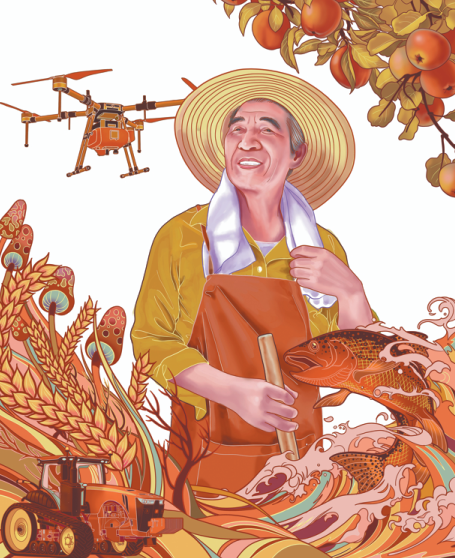
The 20th National Congress of the Communist Party of China and the third plenary session of the 20th CPC Central Committee have made it clear that technological innovation is the core driver of rural vitalization and modernizing agriculture. Innovation helps to improve production efficiency and promote industrial upgrading in rural areas, and the development of eco-friendly (or green) agriculture helps protect the environment and resources.
Technological innovation can reduce the use of resources and cut carbon emissions while boosting integrated production and promoting rural vitalization.
The development of eco-friendly or green agriculture is necessary for China to enhance its agricultural competitiveness, foster a new development philosophy, and reform the supply side of the agricultural sector. The development of green agriculture is also important to ensure China's grain resource and ecology security, and people's well-being.
China is at a pivotal stage of transforming its agricultural development model to one that emphasizes both quantity and quality, and ensures all-factor productivity and ecological preservation. Hence, the country should accelerate the upgrading of agriculture, which can be achieved by promoting green agriculture.
As climate change and environmental protection pose challenges to agriculture, the traditional agricultural production mode can hardly ensure grain security.
By promoting green agricultural production, marked by the use of organic fertilizers, bio-pesticides and water-saving irrigation modes, green agriculture can effectively reduce resource consumption and carbon emissions while improving soil quality. Green agricultural practices can also help mitigate risks and ensure stable production output even under extreme weather conditions, by using crop varieties that can survive in droughts and floods, and resist pest attacks.
Green agriculture can also overcome the strains of resource shortage and environmental problems. True, the agricultural revolution represented by the inputs of improved seeds, fertilizers, pesticides, and irrigation has made significant contributions to increasing agricultural productivity and addressing the global food supply challenge. But in doing so, it has caused pollution, consumed huge amounts of resources and created some food safety risks.
With laws and regulations implemented to prevent waste and destruction of natural resources, there is an urgent need for stabilizing the ecosystem by upgrading the agricultural sector. The development of green agriculture lays emphasis on recycling of resources — using straw and wastes produced by livestock and poultry as manures, increasing the recycling rate of some resources, reducing the amount of waste, and better protecting arable land.
An apt example of how green agricultural practices can better protect the environment and ecology can be found in the work of the China-Sri Lanka joint laboratory. Established at Guizhou University, as a project under the Belt and Road Initiative, the laboratory's research is focused on using eco-friendly methods to prevent and control diseases and pests in tea cultivation. To reduce the high risks associated with and the low efficiency and high residue rate of traditional pesticides in tea gardens in both China and Sri Lanka, the laboratory has been conducting research on critical technologies to reduce the use of chemical pesticides, and use eco-friendly means to control pests in tea gardens.
By promoting green agricultural practices and adopting eco-friendly technologies, we can improve productivity, increase the added value of products, and boost their market competitiveness. Such practices can also drive the development of agricultural product processing and eco-tourism, increasing farmers' incomes. By reducing the use of chemical fertilizers and pesticides, green agriculture provides consumers with safe and healthy farm food products.
Green agriculture also emphasizes the importance of resource recycling and ecological preservation, promoting sustainable productivity. With policy support, technology promotion and market guidance, green agriculture can improve overall agricultural efficiency and facilitate the transition toward high-quality and sustainable development.
Despite the challenges, green agriculture can be further developed with the help of government policy support and guidance.
The author is an academician of the Chinese Academy of Engineering, and president of Guizhou University, and a deputy to the 14th National People's Congress. The views don't necessarily reflect those of China Daily.
If you have a specific expertise, or would like to share your thought about our stories, then send us your writings at opinion@chinadaily.com.cn, and comment@chinadaily.com.cn.