Reform needed to boost research applications









Generally speaking, a strong supply capacity is an important prerequisite for economic development. Likewise, the stronger the nation's capacity for innovation, the more solid its foundation for realizing Chinese modernization and the greater its momentum for progress. For universities, the two key drivers of innovation are the successful application of scientific and technological achievements in industry, and the cultivation of top-tier talent.

However, challenges remain, including the low commercialization rate of research results into industrial and commercial applications, as well as an insufficient pipeline of high-caliber talent. In order to promote the transformation of scientific and technological advancements into real-world industry applications — and to develop top talent into a new driving force for productivity — it is essential to implement the "three musts and two changes".
The "three musts" primarily focus on the commercialization of technological achievements. In general, scientific and technological research in universities tend to have a relatively low level of maturity (only about 7 percent reach the engineering stage), and the path to industrialization is often lengthy. Therefore, establishing a comprehensive, end-to-end public transformation platform is necessary. This platform should cover key stages such as proof-of-concept validation, pilot-scale testing and investment transfer. This involves creating a centralized institution to oversee the entire transformation process, appointing dedicated personnel for each stage, as well as ensuring that there are sufficient resources allocated throughout.
State-owned enterprises are often reluctant to invest in university-led scientific research due to the low commercialization rate of outcomes — currently only about 30 percent. To address this challenge, it is crucial to foster greater risk tolerance, which can encourage these enterprises to prioritize building an innovation-oriented ecosystem and promoting industrial advancement rather than focusing purely on asset preservation and financial returns. They should be incentivized to allocate funds toward early-stage, small-scale investments and cutting-edge technologies.
Improving the commercialization rate of scientific and technological achievements requires starting at the source. The value of conversion contracts serve as a key metric for assessing the quality of research outcomes. Although China has been making progress in this area, a significant gap remains between Chinese universities and leading global institutions.
High-value and interdisciplinary research, though challenging, is highly sought after by industries and investors, and can often lead to higher commercialization rates. However, such research is inherently risky and deters participation. Without proper support and guidance, few researchers can sustain long-term engagement in these fields. Therefore, the integration of high-value and interdisciplinary research into the 15th Five-Year Plan (2026-30) is crucial.
Additionally, both central and local governments, along with universities, should strengthen support for scientific and technological innovation by launching more targeted funding projects to boost the commercialization rate of research achievements.
Of the "two changes", one focuses on the cultivation of top talent. This requires a shift from the traditional training model toward a more "dynamic" and "competitive" approach. To develop world-class talent, China must nurture individuals who can transform their creative potential into concrete and groundbreaking innovations.
This requires reshaping the educational framework through the innovation chain and developing a "dynamic" training plan that allows students to grow through "competitive" practices. Specifically, students should be given autonomy to tailor their learning paths dynamically based on their innovation needs, which includes making use of micro-classes and modular short courses. Universities should offer more courses centered on innovation, organize more entrepreneurship competitions, replace standard answers with creative solutions, and assess students' performances based on their innovative contributions.
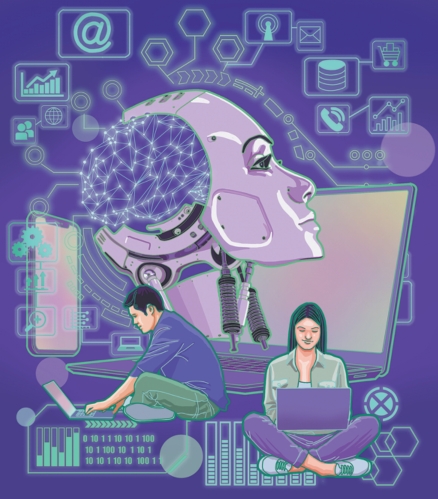
The second "change" involves reforming the AI-driven teaching model. We must transition from an AI-only approach to an AI+HI(Human Intelligence) model. While AI has significantly increased teaching efficiency and course effectiveness, the indispensable role of teachers in education must not be overlooked. AI is both a revolutionary tool and a catalyst for transformation, but the core of this revolution still remains rooted in human involvement.
Therefore, it is crucial to reinforce the role of teachers by encouraging them to continuously update their AI knowledge and fully embrace their initiative and creativity.
The author is president of Shanghai Jiao Tong University, an academician at the Chinese Academy of Sciences and a deputy to the 14th National People's Congress. The views don't necessarily reflect those of China Daily.
If you have a specific expertise, or would like to share your thought about our stories, then send us your writings at opinion@chinadaily.com.cn, and comment@chinadaily.com.cn.