Reshape AI education to boost development










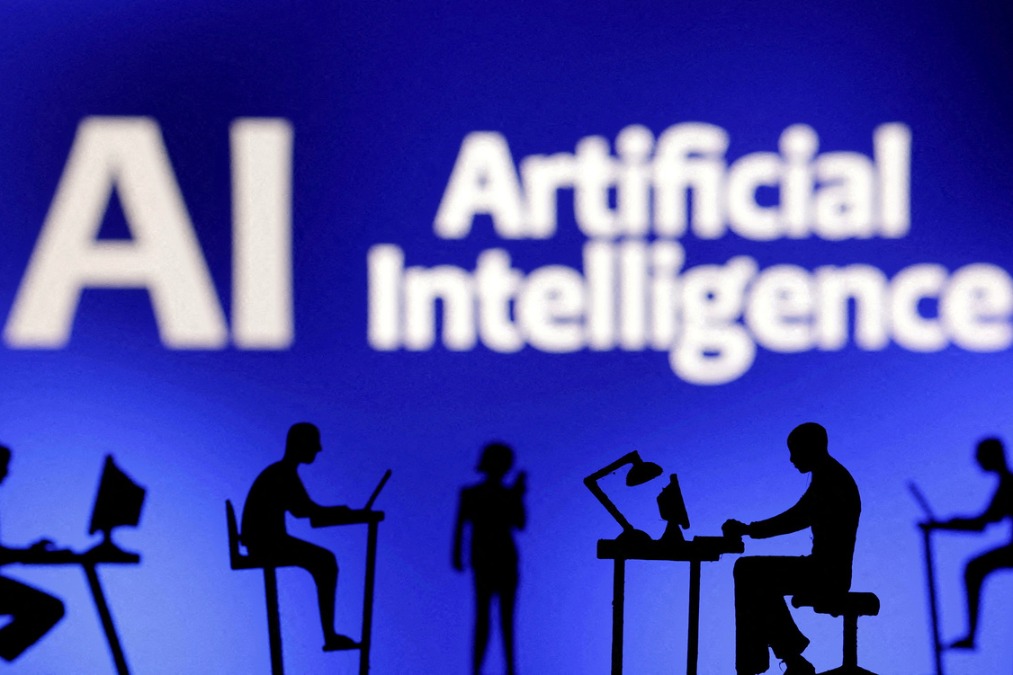
This year's Government Work Report has proposed the continued advancement of the "AI plus" initiative, so as to better integrate digital technology with manufacturing and market advantages. The rapid development of artificial intelligence technology is reshaping the global competitive landscape.

In the era of AI, traditional disciplinary boundaries are rapidly dissolving, making multi- and inter-disciplinary talent cultivation crucial. For example, Massachusetts Institute of Technology's "new engineering education transformation" program and Stanford University's "human-centered AI" initiative focus on restructuring talent development frameworks. China, too, is advancing comprehensive higher education reforms in line with the "AI plus" strategy across various industries to build a uniquely Chinese AI academic system.
Chongqing University has, in recent years, deepened new engineering education reforms, lifting the barriers between disciplines to integrate AI into traditional engineering fields such as mechanical, electrical, civil, materials and energy engineering. It has introduced courses such as "Fundamentals of AI" to strengthen students' mathematical foundation, and incorporated machine-learning into specialized subjects.
Although China has made significant progress in AI applications, there are still gaps in core areas such as fundamental algorithms and high-end chips. Overcoming these challenges requires activating endogenous innovation through systemic reforms. Hence, a "scenario-driven basic research support mechanism" should be established, turning common challenges facing smart city development, intelligent manufacturing, and smart healthcare into fundamental research problems in order to form a dual-cycle system of "demand-driven research" and "theory-driven application".
To achieve this, universities should collaborate with leading enterprises to conduct organized scientific research to clear "bottlenecks" hindering the development of technologies such as AI chips and autonomous driving algorithms. The model of deep industry-academia-research collaboration will ensure universities, as key drivers of fundamental research, uphold academic integrity and respect research principles, while adjusting research paradigms, organizational models, and evaluation systems will help provide long-term support for groundbreaking innovations.
For example, DeepSeek fosters an open-source ecosystem where global developers collaborate, accelerating technological iterations and lowering R&D barriers. The Chongqing University has introduced a fully integrated DeepSeek system, focusing on six key management objectives: scale, development, efficiency, effectiveness, quality, and risk control.
The Chongqing University is collaborating with companies such as Changan Auto and Seres to develop smart cockpits and "vehicle-road-cloud" coordination platforms. By thoroughly analyzing manufacturing mechanisms and integrating production data with physical models, the university is providing intelligent solutions that combine generality with industry specificity, accelerating the development and digital transformation of the new energy vehicle industry.
More strategically, the university is spearheading the Jialing River Laboratory, which focuses on "Digital Intelligence plus Equipment" and serves as a high-level research platform for concept verification and R&D testing. By integrating innovation chains, industrial chains, financial chains and talent chains, the lab aims to clear cross-disciplinary innovation bottlenecks, reduce the R&D cycle, and enhance testing capabilities. This holistic approach connects the entire research ecosystem, from AI infrastructure and key components to core systems, ensuring seamless alignment between innovation supply and industrial demand.
To drive the real economy forward, universities should act both as accelerators of industrial upgrading and anchors for fundamental research, helping industries climb the global value chain. But the ecosystem development faces challenges, with the biggest being overcoming technological monopolies and industry barriers.
Take NVIDIA's CUDA ecosystem for example. Its strength lies not only in hardware performance but also in the maturity of its software tool chain. To break such barriers, China should accelerate the development of self-sufficient software tool chains and critical datasets in specialized applications, creating a full-stack AI ecosystem encompassing foundational hardware, core algorithms and application data.
Furthermore, Chinese universities should participate in global AI governance with a more inclusive mindset, integrating Eastern wisdom into the development of AI ethics and standards, and contributing Chinese solutions to address global problems. By fostering a diverse and inclusive regulatory framework, China can play a pivotal role in shaping AI's impact on societies.
The author is president of Chongqing University, an academician at the Chinese Academy of Engineering and a deputy to the 14th National People's Congress.The views don't necessarily reflect those of China Daily.
If you have a specific expertise, or would like to share your thought about our stories, then send us your writings at opinion@chinadaily.com.cn, and comment@chinadaily.com.cn.