Carriers of history and tradition










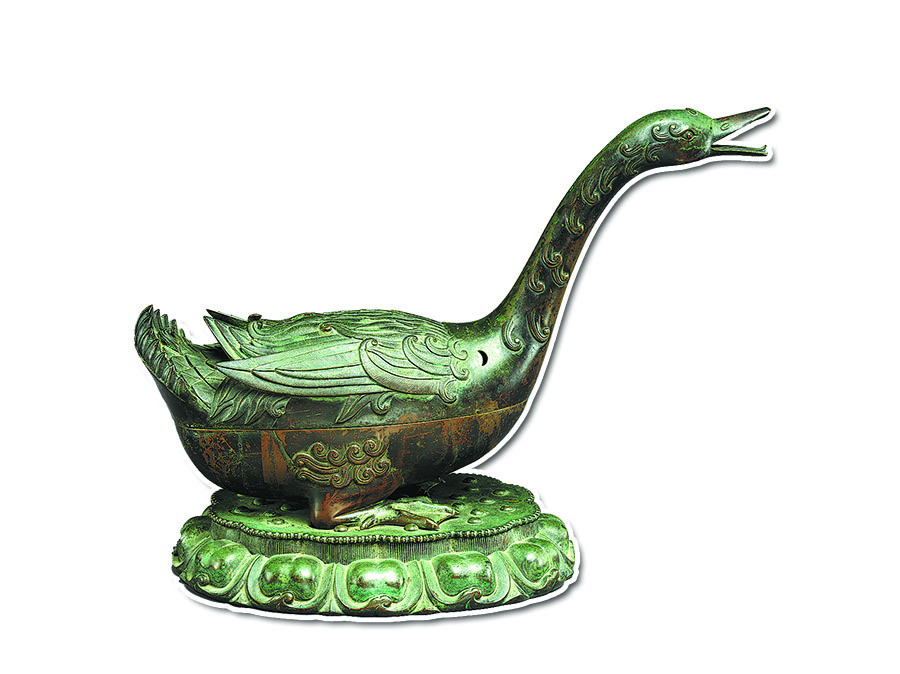
For example, he points to three goose-shaped bronze incense burners from The Met, displayed alongside a Ming Dynasty painting by Chen Hongshou, Lady Reclining Over an Incense Cage, from the Shanghai Museum.
"This pairing vividly illustrates the refined lifestyle of the mid-17th century," Lu says. "By placing these pieces side by side, viewers first encounter the bronze incense burners shaped like ducks or geese.
"Through them, we can understand how they were used — observe the hollow interior and the space for burning incense, which was intricately designed in the form of a duck."
Incense burners in the shape of geese or ducks were among the most popular archaic designs from the Song Dynasty onward. Known as xiangya (incense ducks), they frequently appeared in literature that captured the elegance of the era.
Lu says that the Shanghai Museum's painting reveals how the incense ducks were depicted in art and in the cultural expressions of the time.
"Chinese poetry often mentions 'incense ducks'. But what exactly were they? By examining the physical artifacts preserved in The Met's collection, we can see how these references come to life, forming a dialogue between literature, painting and material culture.
"The collaboration between the Shanghai Museum and The Met has elevated the exhibition to new heights in both breadth and depth," Lu says, adding that together, the bronzes and artwork tell a comprehensive tale for visitors.
Another example, two apparently identical vases, actually highlights a form of cultural appreciation, according to Lu.
Upon closer inspection, one vase is revealed as a piece from the imperial workshop during the reign of Emperor Qianlong of the Qing Dynasty, and is made of parcel-gilt copper alloy and bears the Qianlong hallmark. The second, as indicated by the hallmark on its base, is a 19th-century French copy, produced by Parisian tableware makers.
"The latter was copied after the French collector bought the original back to Paris and invited artisans to see this inspiration from China," Lu says.
He adds that French companies were so inspired by the Chinese bronze that they made an exact, almost identical copy of the original, even down to the parcel building.
"This is the power of culture and the power of art. That's why I have placed these two pieces together, and you can see a really good combination," he explains.