


The Great Wall of man and nature









Nowhere in the Hexi Corridor does a traveler feel closer to those who came before him than at Yumen Pass. Located about 90 kilometers northwest of Dunhuang, it marks the corridor's westernmost end — a threshold laden with both historical and emotional weight.
For those departing, this was the final farewell to familiar soil, a place for lingering glances before vanishing into the unknown. For those arriving, it was a gateway of hope — the desert and its hardships behind them, and ahead, the vibrant trading hub of Dunhuang, beckoning like a promise fulfilled.
Once surrounded on three sides by water — a strategic choice for its location — the pass now consists of only a rectangular fortress with crumbling rammed-earth walls that blend seamlessly into the surrounding Gobi.
However, as an outpost of the Han Dynasty (206 BC-AD 220), this UNESCO World Heritage Site still warrants a long journey. In Chinese, yumen means "jade gate". Raw jade once traveled through the corridor, part of the ancient Silk Road, to workshops where it was transformed into exquisite ritual and ornamental pieces. Not just jade, the techniques of metalworking and chariot-building also traversed this route, long before Zhang Qian's landmark journey.
"The pass is a physical reminder, a monument to connection that we are still seeking to revive and enhance today," says Li Yongping, a senior researcher at the Gansu Provincial Museum.
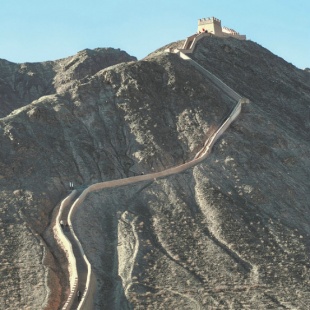
To connect worlds, one had to protect them. The Han emperors understood this, and the Great Wall was built over 11,000 kilometers to safeguard against those who might disrupt the network of communication. Remaining segments of this meandering wall can be found only a few kilometers away.
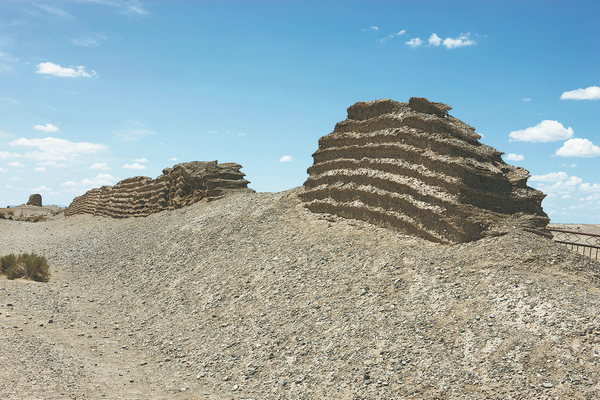
Constructed with alternating layers of sandstone and indigenous plants like desert reed and red willow, the walls bordered fields of fine sand, designed to capture footprints — and with them, the movements of enemy troops. (Red willow sticks are still used today — not for defense, but to skewer mutton and beef for the region's beloved barbecue.)
Interestingly, long before humans walked the Earth, Mother Nature had begun carving her own Great Wall in the Gobi, with wind as her chisel. In what is now the Dunhuang Yardang (Yadan in Chinese) National Geopark — "Yardang" refers to land formations sculpted by relentless desert winds — whistling gusts have shaped silent, jagged turrets of stratified sandstone since time immemorial.
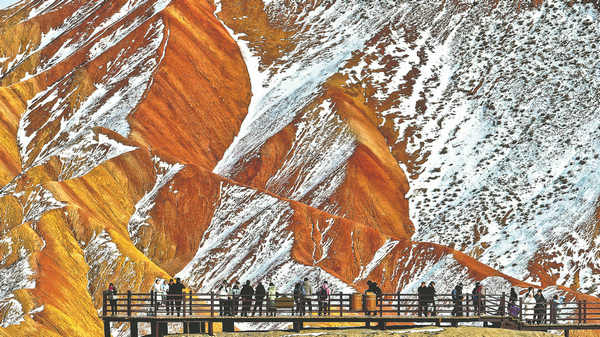
This land once lay beneath the ocean until collision between the Indian plate and the Eurasian plate — beginning around 50 million years ago — thrust it upward. The same tectonic forces were responsible for raising the Qilian Mountains and for lifting vast stretches of land in Zhangye, another oasis town, exposing the latter's ancient seabeds and their layered sedimentary rocks.
In the 1920s and '30s, a group of Chinese geologists studied the landform in Zhangye, before naming it "Danxia", or "the red afterglow", indicating the landscape's dominant rusty red hue produced by iron oxide. The Zhangye National Geopark is home to the "Colorful Danxia", where red serves as the backdrop to a striking palette shaped by minerals — iron sulfide creating yellow hues and high concentrations of chloride and iron silicate producing shades of green and blue.