Buddha's gaze into eternity
Son's devotion shines down for centuries in a grotto that still fascinates, Zhao Xu and Ma Jingna report.










How would a son of a great filial piety honor his devoutly Buddhist mother after her passing? Juqu Mengxun (368-433), the second ruler of Northern Liang — a dynasty that partially or entirely controlled the Hexi Corridor between 397 and 439 — answered this by carving Buddhist caves into mountain cliffs, before filling them with statues and covering their walls in sacred art.
He chose Tianti Mountain for this purpose. Less than several kilometers from his power center Wuwei, then known as Liangzhou, this secluded outcrop of the Qilian Mountains was a place of solitude, suited for little but meditation.
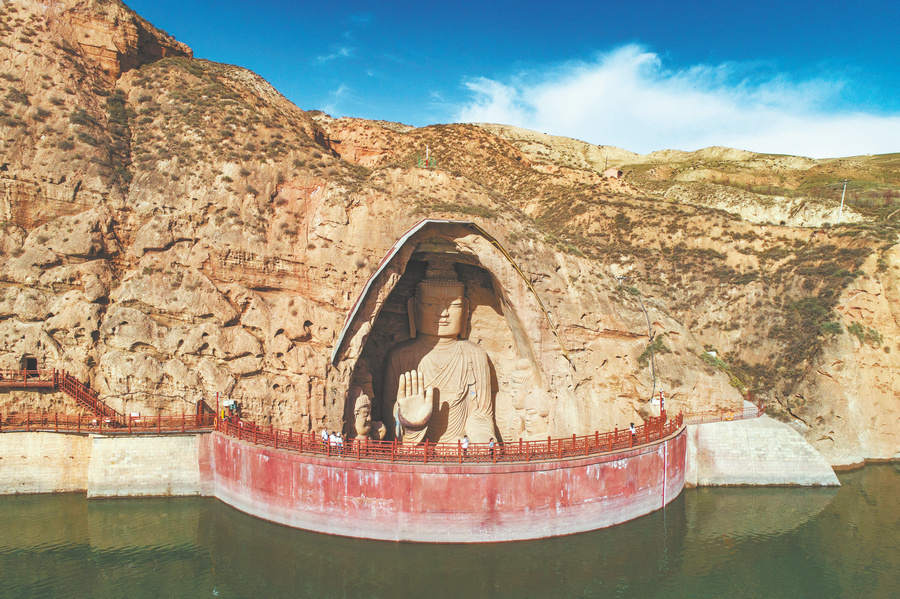
While the exact cave resulting from the king's devotion to his mother remains unknown, it is certain that this place became a center of grotto carving, a practice that flourished for centuries to come. An early spring visit, just an hour's drive from Wuwei's city center, brings visitors face-to-face with a magnificent reflection of the legacy: a massive south-facing, 30-meter-high sandstone statue of Shakyamuni Buddha dated to the Tang Dynasty (618-907).
Carved into the sandstone cliff — a process eased by the rock's softness — the Buddha gazes over the vast whiteness of an ice-covered reservoir in winter and its emerald expanse in summer. A serene smile graces his face as he rests his left hand on his knee and raises his right palm outward in a gesture said to have prevented the mountain opposite from advancing.
Though sandstone succumbs easily to the chisel, it erodes quickly in rain. The survival of this Buddha and its grottoes, like many in the region, including the famed Mogao Grottoes in Dunhuang, is due to the area's arid climate.
To conserve water for agriculture, a reservoir was built in 1958 that once reached the cliffside, submerging the Buddha's knees. Although a dam was later added to hold back the water, the statues and frescoes relocated from smaller caves — there are 17 existing ones — before the reservoir's construction never returned and can now only be seen in museums, including the Gansu Provincial Museum and Wuwei Museum.
Those are treasures that have earned the site its rightful place in all Chinese Buddhist grottoes, says Bao Rui, an on-site guide.