Rural digitalization helps promote common prosperity










Over the past decade, a digital revolution has swept through China's rural areas, promoting common prosperity. Once isolated, village residents today are tapping into e-commerce and smart technologies to boost their incomes and improve their livelihoods.
From online marketplaces that connect farmers even in remote areas with consumers across the country to high-tech tools boosting agricultural productivity, digital innovation is narrowing the urban-rural divide and transforming rural economies.
The central government has put rural digitalization at the core of its agricultural modernization and rural development policies. In 2013, the government launched the "Broadband China "initiative to extend broadband internet across the country by 2020, laying the foundation for the digital transformation of rural areas. Building on this, the "Internet Plus" action plan of 2015 outlined policies for integrating digital technologies with agriculture and rural industries, and the 13th Five-Year Plan (2016-20) emphasized rural e-commerce, big data and broadband expansion as key development pillars.
Policy momentum further accelerated with the rural vitalization policy in 2017, making technological innovation essential to rural rejuvenation.
The "Smart Agriculture Action Plan (2024-28)"was introduced to digitalize the entire agricultural value chain, from field cultivation to market sales, with the aim of reducing costs and boosting productivity. Thanks to such sustained efforts, rural digital infrastructure has improved dramatically.
Central to rural digital transformation are China's e-commerce giants such as Alibaba and Pinduoduo, and emerging platforms like Douyin. These digital marketplaces have vastly improved rural market access, allowing farmers and village entrepreneurs to directly engage with urban consumers nationwide, and earn higher profits.
Beyond traditional e-commerce sites, shortvideo and livestream platforms like Douyin (China's TikTok) have become powerful new engines of rural commerce. Through engaging videos and real-time broadcasts, farmers can showcase everything from freshly harvested produce to handcrafted goods, connecting directly with consumers and bypassing middlemen.
Overall, rural e-commerce has become a driver of efficiency. Annual online retail sales in rural areas skyrocketed from just 180 billion yuan ($24.76 billion) in 2014 to 2.49 trillion yuan in 2023, increasing by another 8.3 percent year-on-year in the first three quarters of 2024, outpacing growth in many urban markets.
In one World Bank study of "Taobao villages" (e-commerce hubs that offer services from online marketing and mobile payments to logistics support), households operating online shops earned on average 80 percent more than their neighbors. By successfully connecting "small farmers to big markets", e-commerce is not only cutting costs but directly boosting farmers' prosperity.
The integration of digital technology on the farm is also transforming agricultural productivity. Smart farming tools, including drones, the internet of things (IoT) sensors and artificial intelligence, are reshaping traditional farm practices.
IoT-based irrigation systems track soil moisture in real time to optimize water use, and AI algorithms help predict pest outbreaks or price trends, enabling farmers to make data-driven decisions. Regions like Henan and Heilongjiang provinces have extensively adopted these smart agriculture techniques, using live data analytics to manage crops more effectively.
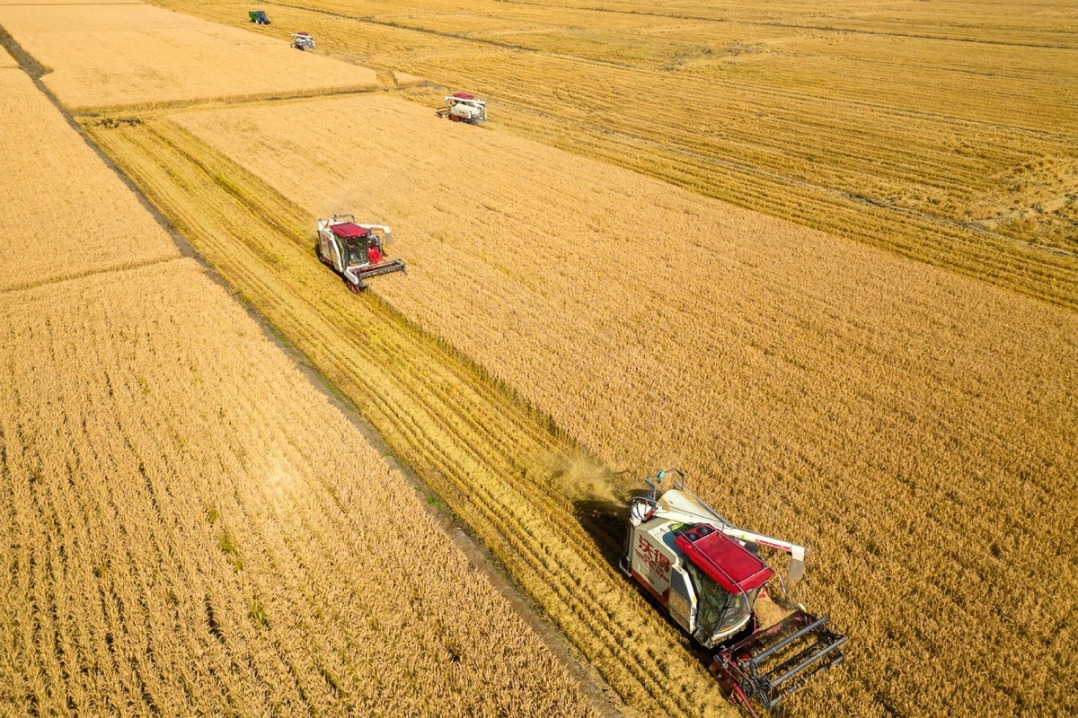
Through a mobile app, officials can see the location of each machine and the progress of harvesting in each county. If an area is forecast to get rain — a major threat to ripe grain — the system can immediately dispatch additional harvesters to that location to speed up collection and safeguard the crop.
By preventing losses and reducing inefficiency, such innovations helped China's grain output reach a record 1.4 trillion jin (700 million metric tons) in 2024, the 10th consecutive year of production above 1.3 trillion jin.
China's sustained investment in rural digital infrastructure, e-commerce ecosystems, and smart farming technology has delivered tangible economic gains, dramatically lifting rural incomes and overall prosperity.
The shift toward online business and tech-enabled agriculture has cultivated vibrant village economies, creating millions of new jobs and encouraging many young migrant workers to return home to start businesses.
Digital empowerment has also become a cornerstone of China's poverty alleviation and rural revitalization efforts. E-commerce, in particular, has become a powerful tool for further improving formerly impoverished regions.
Equally important, digital technology is improving public services and governance in rural China. Programs to boost farmers' digital literacy and technical skills are expanding, enabling more rural residents to harness e-commerce and smart farming tools. The government's sustained efforts to digitalize the countryside are indeed promoting common prosperity.
Wei Longbao is a Qiushi distinguished professor and director of the Institute of Food and Agribusiness Management, Zhejiang University; and Xu Wangfang is a doctoral candidate at the School of Public Affairs, Zhejiang University. The views don't necessarily reflect those of China Daily.
If you have a specific expertise, or would like to share your thought about our stories, then send us your writings at opinion@chinadaily.com.cn, and comment@chinadaily.com.cn.