Promoting global common development through Chinese modernization










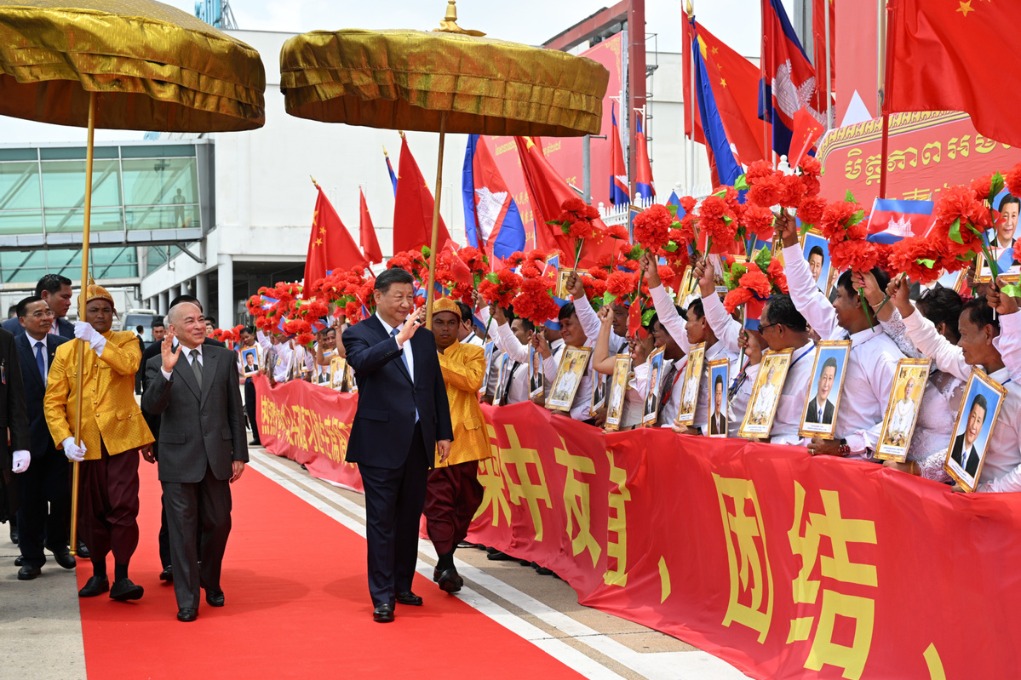
The recent fruitful exchanges at the leadership level between China and ASEAN countries send a hopeful signal, that is, upholding regional and international cooperation and defending multilateralism, not unilateralism.
Modernization is an important pathway to realize China-ASEAN cooperation and serves as a source of strength for Asia to unite and address challenges. This visit will not only promote deeper regional economic and trade development but will also help unite ASEAN and Asian countries to collectively respond to external challenges and play a vital role as a stabilizer and engine for the global economy.
The defining feature of Chinese modernization is its path of peaceful development. China seeks to strengthen cooperation with countries around the world, including ASEAN nations, to help them achieve their own modernization.
As the rotating chair of ASEAN this year, Malaysia, located in the center of the Southeast Asian Peninsula and controlling the Strait of Malacca, is a key hub of the Belt and Road Initiative. China is actively collaborating with Malaysia to jointly develop port infrastructure for rail-sea intermodal transport and advance the New International Land-Sea Trade Corridor.
Chinese modernization is first reflected in the modernization of infrastructure. By connecting countries through hard infrastructure, China leverages its manufacturing prowess to become the country with the world's largest network of high-speed railways and highways. This connectivity enhances people's livelihoods and generates positive spillover effects.
The China-Laos Railway, which has already been completed and opened, has transformed Laos from a landlocked country to a land-linked one. The Jakarta-Bandung High-Speed Railway has improved transportation efficiency in populous countries, and the China-Thailand Railway is accelerating construction.
China is not only building the East Coast Rail Link with Malaysia, connecting Malaysia's underdeveloped eastern region to the developed western region, but is also using this rail link to connect China, Laos, Thailand, and Singapore, establishing the China-Indochina Peninsula Economic Corridor. Furthermore, China and Vietnam are accelerating their railway development, with the dream of a Trans-Asian Railway network connecting nations closer to reality. These interconnected railway infrastructures will link Southeast Asia's nearly 700 million people with China's 1.4 billion people, promoting regional economic integration.
Chinese modernization is also prominently reflected in the modernization of economic trade, achieving "soft connectivity" with other nations through rules and standards. ASEAN has replaced the European Union and the United States as China's largest trade partner for five consecutive years, and China has been ASEAN's largest trade partner for 15 years. The trade volume between China and ASEAN is expected to exceed $1 trillion this year. Particularly with the implementation of the China-ASEAN Free Trade Area 3.0, regional economic integration will accelerate.
Chinese modernization is manifested in the industrial modernization, achieving deep integration of industrial chains and supply chains with other countries. Innovation-driven development is the fundamental driving force behind China's industrial growth.
With technological innovation leading industrial innovation, China is accelerating the development of new quality productive forces. China's exports mainly consist of electromechanical products, and "new three items" have long replaced the "old three items". Thus, China supports Malaysia's proposal for inclusive and sustainable development during its ASEAN Chairmanship.
Strengthening connectivity between China and Malaysia will help improve regional and global transport networks and supply chain efficiency, promote the construction of standard networks, and stimulate trade, investment, and economic growth. The development potential of China-Malaysia cooperation is particularly evident in emerging industries, with artificial intelligence serving as a catalyst for innovation-driven development.
China and ASEAN are deepening modernization cooperation, with both China and Malaysia remaining steadfast supporters, builders, and defenders of multilateralism.
Modernization is both a development goal and a development path. It is an economic phenomenon, but more importantly, a path of civilization. Tariff barriers are a form of economic coercion, exploiting other nations for self-benefit, and focusing solely on national interests. This approach oppresses developing and underdeveloped countries, reflecting a backward step in civilization and a clear sign of the decline in a nation's modernization strength.
By pursuing a path of peaceful development, Chinese modernization offers a model for developing countries, helping them achieve modernization through an open, inclusive, equitable, balanced, and mutually beneficial approach to economic globalization.
The author is a researcher at Chongyang Institute for Financial Studies of Renmin University of China. The views don't necessarily reflect those of China Daily.
If you have a specific expertise, or would like to share your thought about our stories, then send us your writings at opinion@chinadaily.com.cn, and comment@chinadaily.com.cn.