China's diversified trade injects stability in global economy









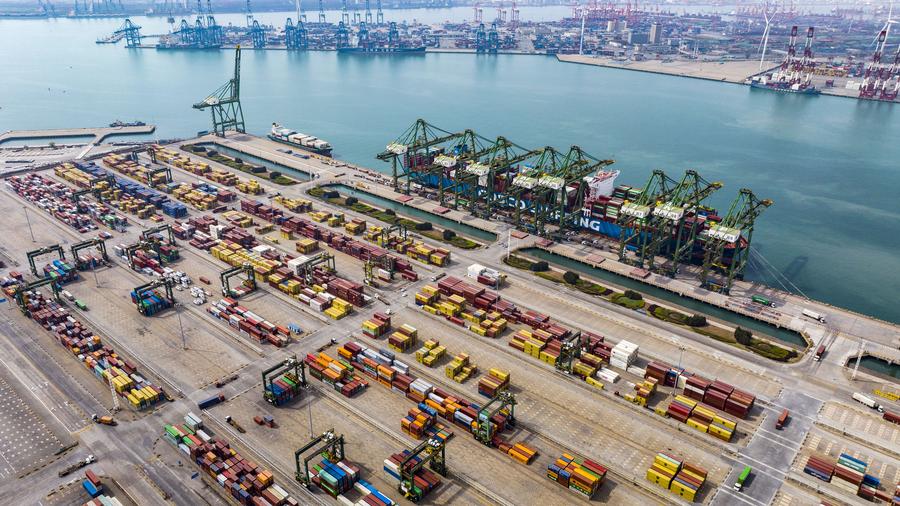
China's foreign trade has once again demonstrated remarkable resilience in the first quarter of 2025. Total imports and exports reached 10.3 trillion yuan ($1.4 trillion), a year-on-year increase of 1.3 percent. In a global economy still grappling with inflation, weak demand, and geopolitical headwinds, this growth is not merely a domestic achievement — it is a stabilizing force for the world.
The details tell a compelling story. Imports fell by 6 percent to 4.17 trillion yuan, largely due to a sharp drop in global commodity prices, including those of iron ore, coal, crude oil, and soybeans. Yet even in decline, China played a pivotal role: its steady demand for these goods offered crucial support to struggling exporters and global suppliers. Meanwhile, exports surged by 6.9 percent to 6.13 trillion yuan, underscoring China's continued capacity to serve as a vital engine of global growth.
This performance is not just the result of an increase in orders for Chinese exports in anticipation of the US administration's punitive tariffs. Since early 2023, China's quarterly exports have consistently topped the 10-trillion-yuan mark. From the post-pandemic rebound to today's trajectory, Chinese exports have offered the world not only goods but a sense of certainty. Thanks to its fully integrated manufacturing system, China is uniquely positioned to deliver high-quality, cost-effective consumer electronics, household appliances, and key components — products increasingly essential in the age of artificial intelligence and digital transformation.
This momentum is not limited to State-owned enterprises. Private companies are proving equally agile and indispensable. In the first quarter, they accounted for 56.8 percent of total trade, with imports and exports reaching 5.85 trillion yuan. Their success stems from sharp market instincts and the ability to quickly adapt to global shifts. These companies are not merely participants in global trade; they are innovators, broadening product lines and diversifying partnerships, making China's trade ecosystem more resilient and responsive.
Foreign-invested enterprises, too, remain integral to the story. Since the 1970s, multinationals have looked to China as a hub of efficiency and coordination. Today, that appeal is undiminished. With a massive domestic market, improved business conditions, and strong intellectual property protections, China continues to attract global players. In the first quarter, FIEs contributed 2.99 trillion yuan to trade, nearly 29 percent of the national total. Their dominance in high-value sectors — such as electronics, pharmaceuticals, and medical equipment — speaks to the innovation and vitality they inject into the Chinese economy.
The benefits of China's trade extend far beyond its borders. For developing economies, stronger ties with China offer predictability in an unpredictable world. Trade with the Belt and Road partner countries accounted for 51.1 percent of China's total trade, growing faster than the national average. With the Association of Southeast Asian Nations remaining China's top trading partner, bilateral trade reached 16.6 percent of the national total. Institutional frameworks such as the China-ASEAN Free Trade Area and the Regional Comprehensive Economic Partnership have nurtured deep integration across markets and supply chains. The result? A more interconnected, less fragile regional economy.
Europe, too, remains a crucial partner. Despite challenges ranging from Brexit to energy shocks and industrial policy competition, China-EU trade hit 1.3 trillion yuan in the first quarter. European exports to China — such as passenger cars, cosmetics, and luxury handbags — retain strong momentum, while Chinese exports of industrial robots and advanced machinery to Europe rose by 81.9 percent and 11.7 percent, respectively. The growing sophistication of Chinese manufacturing is complementing, not replacing, Europe's high-end markets.
But while there is much to celebrate, China is not blind to the risks. Chief among them: the rise of unilateralism and protectionism. The aggressive tariff policies of the US administration and efforts to pressure partners into accepting unfair trade terms threaten to fragment the global trading system. Should these policies be fully enacted, the repercussions will be felt far beyond Washington. The world's supply chains will need reconfiguration — and for many countries, deeper engagement with China is becoming the logical, even necessary, choice.

China, for its part, is ready. Major international expos — from the China Import and Export Fair to the China International Consumer Products Expo — are creating fresh opportunities for global businesses to rediscover and re-evaluate the Chinese market. And projects under the Belt and Road Initiative — from the China-Europe Railway Express to the Digital and Green Silk Roads — are accelerating trade connectivity and market integration.
With a push toward digital trade, green growth, and cross-border e-commerce, China is not just playing catchup; it is setting new rules of engagement. These innovations are not for China's benefit alone. They are designed to expand access to technology, drive down global costs, and enhance the resilience of global commerce.
China's trade today is more than just an economic metric. It is a signpost of where the world should go — toward deeper cooperation, smarter supply chains, and more inclusive prosperity.
The author is deputy director and research fellow at the Institute of American and Oceania Study at the Chinese Academy of International Trade and Economic Cooperation, Ministry of Commerce.
The views don't necessarily reflect those of China Daily.
If you have a specific expertise, or would like to share your thought about our stories, then send us your writings at opinion@chinadaily.com.cn, and comment@chinadaily.com.cn.