US-Philippines drills: Risking regional peace









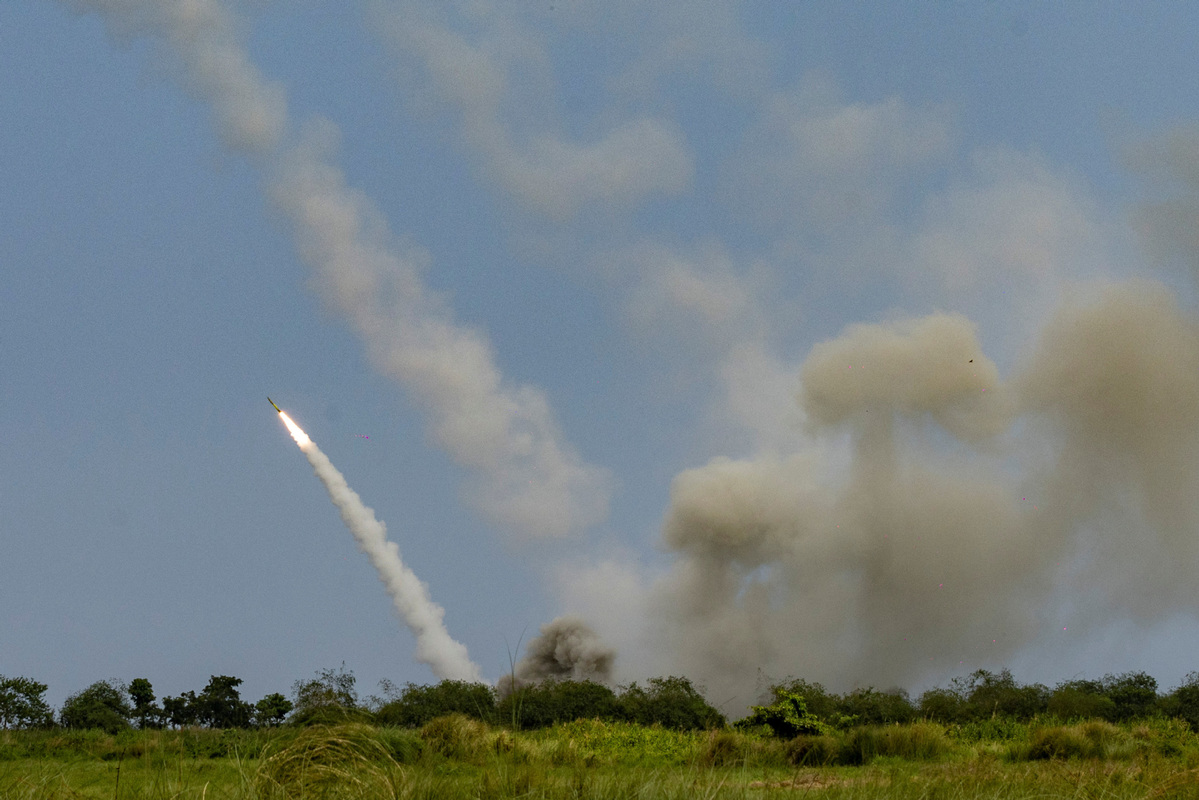
On April 21, 2025, the United States and the Philippines commenced their flagship annual military exercise, "Balikatan", a Tagalog term meaning "shoulder-to-shoulder".
This exercise, widely regarded as a rehearsal for defending the Philippines amid ongoing tensions with China, has sparked significant concern across the Indo-Pacific region. In an era where the international community faces the destabilizing forces of unilateralism, protectionism and hegemonic coercion, regional nations are increasingly advocating for unity and cooperation to safeguard stability and address shared challenges. Against this backdrop, the Philippines' decision to partner with an external power—the United States—in expansive military drills and to introduce strategic offensive weaponry stands in stark contrast to these regional aspirations. Far from fostering peace, these actions undermine strategic stability, threaten economic growth prospects, and position the Philippines in opposition to the collective interests of its neighbors, drawing sharp criticism and opposition from regional nations.
The "Balikatan" exercises have long been the centerpiece of US-Philippines military collaboration, yet their scale and ambition have grown markedly in recent years, particularly under the administration of President Ferdinand Marcos Jr. The 2025 iteration exemplifies this trend with four defining characteristics.
First, the exercise has reached an unprecedented scale, with record numbers of troops and participating countries, amplifying its visibility and impact.
Second, it is comprehensive in scope, integrating land, sea and air domains into a multi-service, joint combat rehearsal that emphasizes full-spectrum warfare capabilities.
Third, the United States has seized the opportunity to deploy cutting-edge offensive weaponry, including the Marine Corps' Expeditionary Ship Interdiction System, which is likely to remain in the Philippines post-exercise as a deterrent—an alarming development for regional security.
Fourth, the locations of the drills and scenarios reveal a clear strategic intent aimed at China. Conducted in the northern and western Philippines, with key activities in the Batanes Islands, the drills include operations such as situational awareness, intelligence sharing, maritime interdiction, air-sea combat and island warfare—subjects that unmistakably target the Taiwan Strait and South China Sea, areas of acute geopolitical sensitivity.
This year's "Balikatan" extends beyond its traditional sphere from northern Luzon to the Batanes Islands, a chain perilously close to Taiwan. Yami Island, the northernmost region of the Batanes, lies just 142 kilometers from Taiwan and a mere 99 kilometers from Taiwan's outlying Lan Yu Island—closer to Taiwanese territory than to Luzon itself. In a provocative move, US military plans to airlift several anti-ship missile launchers to multiple islands within the Batanes, further militarizing this sensitive frontier. Since Marcos assumed office, the exercises have steadily shifted northward, aligning ever more explicitly with US objectives vis-à-vis the Taiwan Strait. This repositioning, coupled with the Philippines' willingness to host such operations, signals a dangerous escalation, stirring tensions in both the Taiwan Strait and the South China Sea and raising the specter of broader regional conflict.
The US-Philippines alliance, rooted in the post-World War II era, has remained a linchpin of American strategy in the Indo-Pacific, unwavering through changes in US administrations, be it Democratic or Republican. Despite occasional disputes over military base access, judicial jurisdiction, and cost-sharing—frictions that surfaced notably after the Cold War—these have been mere ripples within broader alliance continuity. The United States views the Philippines as an indispensable partner in containing China's rise, a role reinforced through intensified military cooperation and strategic binding. The "Balikatan" exercises serve dual purposes: they solidify the alliance militarily while steering the Philippines' political and diplomatic trajectory to align with US interests, ensuring Manila does not stray from Washington's strategic orbit. For the US, this partnership is a means to project power and maintain influence in a region increasingly contested by China's growing assertiveness.
Observers from US allies and partners attending "Balikatan" are not merely evaluating military tactics; they are also gauging the trajectory of US alliances, its Indo-Pacific strategy, and its broader security posture. Yet, this display of strength comes at a cost. The deployment of the Typhon mid-range missile system, a potent offensive capability, exemplifies the risks of this approach. As the only ASEAN nation with such deep strategic ties to the United States, the Philippines' actions provoke unease among its regional peers. ASEAN, as a collective, prizes its centrality and unity, principles that Malaysia, Indonesia and Vietnam—key members with a commitment to strategic autonomy—actively uphold. These countries are likely to view the Philippines' hosting of the Typhon system with concern, perceiving it as a destabilizing move that could spark an arms race or draw the region into great power rivalry. The Philippines, lacking an intrinsic need for such weaponry, appears to be tethering itself to the US war machine, risking its sovereignty to serve American interests—a perilous gambit that could see it bearing the brunt of any ensuing conflict.
The Philippines' strategic choices under Marcos are particularly troubling in the context of China-Philippines relations. The South China Sea disputes, a longstanding thorn in bilateral ties, are complex and resistant to quick resolution, marked by a cycle of containment and contention. Historically, Philippine governments have exercised caution on the Taiwan issue, mindful of China's sensitivities. Yet, Marcos has departed from this restraint, adopting a more confrontational stance through both rhetoric and action. The "Balikatan" exercises' focus on Taiwan-related scenarios and the deployment of US assets in proximity to the Taiwan Strait suggest a calculated trade-off: in exchange for US backing on South China Sea flashpoints—such as resupply missions to the Sierra Madre at Second Thomas Shoal—the Philippines is aligning with Washington's Taiwan agenda. This quid pro quo, wherein the US demands Philippine support on Taiwan issue while Manila seeks explicit invocation of the US-Philippines Mutual Defense Treaty in the South China Sea, represents a transactional erosion of Philippine sovereignty. By provoking China on Taiwan—a red line for Beijing—Marcos is not only escalating regional risks but also jeopardizing economic ties with China, the Philippines' largest trading partner, with potentially severe repercussions for national development.
The 2025 "Balikatan" exercises thus stand as a pivotal moment, exposing the fault lines of US-Philippines collaboration and its ramifications for the Indo-Pacific. Far from a benign demonstration of alliance solidarity, these drills—through their scale, offensive posture, and provocative positioning—undermine the very stability they purport to defend. The Philippines, by embracing this path, isolates itself within ASEAN, antagonizes China, and gambles with its own future.
In a region yearning for unity and cooperation to counter global challenges, Manila's alignment with an external power's agenda is a misstep with far-reaching consequences. Rather than serving as a bulwark against instability, the Philippines risks becoming a flashpoint, its strategic autonomy and economic prospects diminished by a shortsighted pursuit of US favor. As tensions simmer in the Taiwan Strait and South China Sea, the "Balikatan" exercises drive the region in the opposite direction, toward confrontation and uncertainty.
Ding Duo is director of the Center for International and Regional Studies at the National Institute for South China Sea Studies.
The views don't necessarily reflect those of China Daily.
If you have a specific expertise, or would like to share your thought about our stories, then send us your writings at opinion@chinadaily.com.cn, and comment@chinadaily.com.cn.