China Travel Guide: Shanxi









The video game phenomenon Black Myth: Wukong sparked a tourism boom in North China's Shanxi province in 2024. Here are some popular tourist destinations and signature foods in Shanxi.
Yungang Grottoes
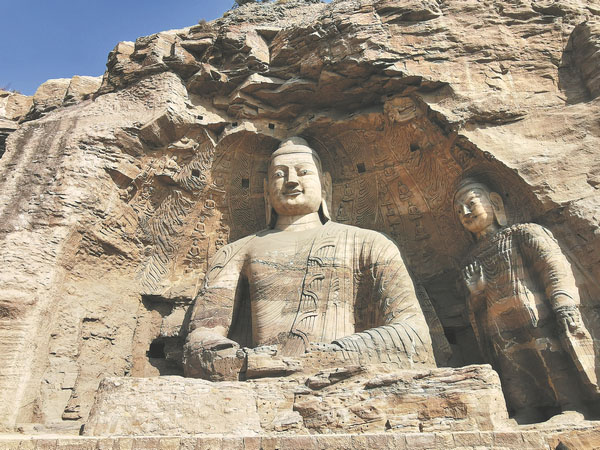
At the southern foot of Wuzhou Mountain, 16 kilometers west of Datong city in Shanxi province, built into the mountainside and stretching 1 kilometer east to west sit the Yungang Grottoes.
With 252 caves and 51,000 statues inside a carved area of 18,000 square meters, the Yungang Grottoes stand as an outstanding achievement in fifth and sixth century Buddhist cave art.
The Five Caves, with their strict unity of layout and design, were created by Tan Yao and remain masterpieces of Chinese Buddhist art's first peak period.
The Yungang Grottoes were added to the World Cultural Heritage List in December 2001.
Sakyamuni Pagoda
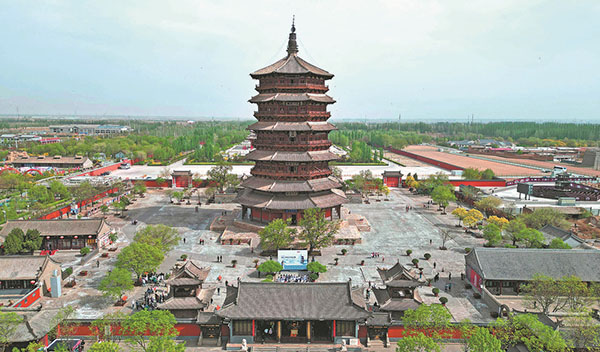
The Sakyamuni Pagoda the Fogong Temple in Yingxian county, Shanxi province, was built during the Liao Dynasty (916-1125) and is the oldest and tallest wooden architectural structure in China.
It stands 67.31 meters high and has a base measuring 30.27 meters in diameter, with nine stories, five of them in use.
The octagonal pagoda, which is made entirely of wooden parts joined by innumerable mortises and tenons, was built with a complicated structure of brackets, without using any nails.
The external pillars of each story have beam frames set on the external pillars of the layer below, about half a pillar inward, giving the tower a graceful contour. The pagoda is well proportioned and presents a splendid sight.
During a renovation in 1974, a number of sutras were found, some hand-written and others block printed. They are important materials for the study of religion and printing technology of the Liao Dynasty (1271-1368), as well as the political, economic and cultural developments of the dynasty.
This pagoda has somehow survived the natural and human vicissitudes of history for 950 years.
Historical records show the pagoda has remained sound despite earthquakes and fires, such as a large earthquake lasting for seven days during the Yuan Dynasty (1271-1368) and a magnitude-9 earthquake during the Ming Dynasty (1368-1644). In 1926, when warlords were fighting with each other over Shanxi, the pagoda was hit by 200 artillery shells, leaving many holes. It was even set on fire several times, but the fires surprisingly died out by themselves and the pagoda stood firm.
Many other wooden towers in China have been destroyed by fire during thunderstorms and areas around them have been struck by lightning, but Yingxian is lightning-proof as well as quake- and fire-proof. In the 1950s, two objects 100 meters from the tower were hit by lightning, but the tower stood firm.
Guangsheng Temple
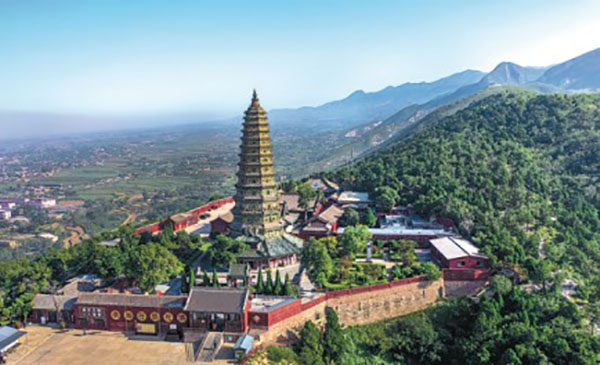
The Guangsheng Temple is a temple complex comprising the upper monastery, the lower monastery and the Water God Temple on the slope and at foot of the Huoshan Mountain in Zhaocheng township in Hongtong county of Linfen city, Shanxi province.
Construction of the Guangsheng Temple is said to have begun more than 1,800 years ago during the Eastern Han Dynasty (25-220), making it among the earliest Buddhist temples in China.
The temple was reconstructed several times after facing destruction by wars and natural disasters during various historical periods. Most of the structures and relics we can see now were built and created during the Yuan (1271-1368) and Ming (1368-1644) dynasties.
Tourists to Guangsheng should not miss the "three treasures" of the temple: the Feihong (flying rainbow) Pagoda, the Buddhist sutras called Zhaocheng's Collection and its murals.
The Feihong Pagoda is a 13-story, 47.31-meter-tall octagonal pyramid-shaped tower. Written records show this pagoda was built in 1527 during the Ming Dynasty. As the multicolored glazed walls and roofs can sometimes turn the sunlight into colorful, rainbow-like reflections, the structure is called Feihong Pagoda, or Flying Rainbow Pagoda.
Since its construction in 1527, the pagoda has survived two severe earthquakes that measured above 8.0 on the Richter scale.
On Aug 29, 2018, London-based World Record Certification recognized it as "the tallest multicolored glazed pagoda in the world".
The Zhaocheng's Collection of Buddhist sutras in the temple is among the most precious Buddhist sutra copies in China. It was printed during the Yuan Dynasty and it took 24 years for a great number of monks and craftsmen to engrave woodblocks for printing.
There are several precious Yuan Dynasty murals in the temple complex, including the paintings on the four walls of the Water God Temple and the painting on the gable wall in front of the Great Hall of Sakyamuni Buddha in the lower monastery.