China emerges as global biodiversity champion










China has consolidated its position as a global leader in biodiversity conservation by taking bold and effective actions. From better protecting endangered species and ecosystems to helping shape landmark global environmental, including biodiversity, agreements, China's achievements underscore its unwavering commitment to the United Nations Convention on Biological Diversity and its vision of building an ecological civilization.
Central to China's success is its pivotal role in uniting more than 190 parties to adopt the Kunming-Montreal Global Biodiversity Framework during the 2022 UN Biodiversity Conference. This groundbreaking agreement set the ambitious target of protecting 30 percent of the planet's land and oceans by 2030, marking a milestone in global environmental and ecological governance.
The framework's importance lies in its integrated approach, which goes beyond traditional conservation practices to add new dimensions such as biodiversity recovery, sustainable production and consumption, and climate change governance into the scope of action, aligned with China's "harmony with nature" philosophy.
Domestically, China's "ecological conservation redlines (ECRs)", a groundbreaking spatial planning mechanism, have emerged as a transformative model for balancing ecological protection and sustainable development, demarcating more than 30 percent of its terrestrial territory as ecologically critical zones. The ECRs' emphasis on real-time monitoring via satellite remote sensing and AI-driven governance platforms sets a new standard for transparency and enforcement, narrowing the gaps in global ecological conservation. It not only propels China's progress toward the 30x30 target but also positions the country as a leader in redefining ecological governance.
Besides, China has transformed its ecological commitments into tangible outcomes through large-scale, science-driven initiatives. The Natural Forest Protection Program, launched in 1998, has safeguarded extensive natural forest areas. By banning commercial logging in key regions and launching reforestation campaigns, the program has reversed deforestation trends, reduced soil erosion and lowered annual desertification rates. These efforts have not only restored habitats for endangered species such as the giant panda and crested ibis but also enhanced carbon sequestration, contributing to climate mitigation.
Complementing these efforts, the Grain for Green Program has restored substantial landscapes since 1999 to their original state, creating vast green corridors reconnecting fragmented ecosystems. And recent shifts toward planting mixed-species forests — replacing monoculture plantations — have boosted biodiversity while improving soil fertility and water retention in pilot regions.
China's protected area system now covers 18 percent of its land and protects more than 90 percent of terrestrial ecosystem types, which include protected areas for flagship species such as the giant panda in collaboration with World Wide Fund for Nature (WWF). The Northeast China Tiger and Leopard National Park exemplifies this success: The number of Amur tigers increased to 70 in 2023, up 50 percent since 2020, while Amur leopards — once teetering on extinction — now number 80.
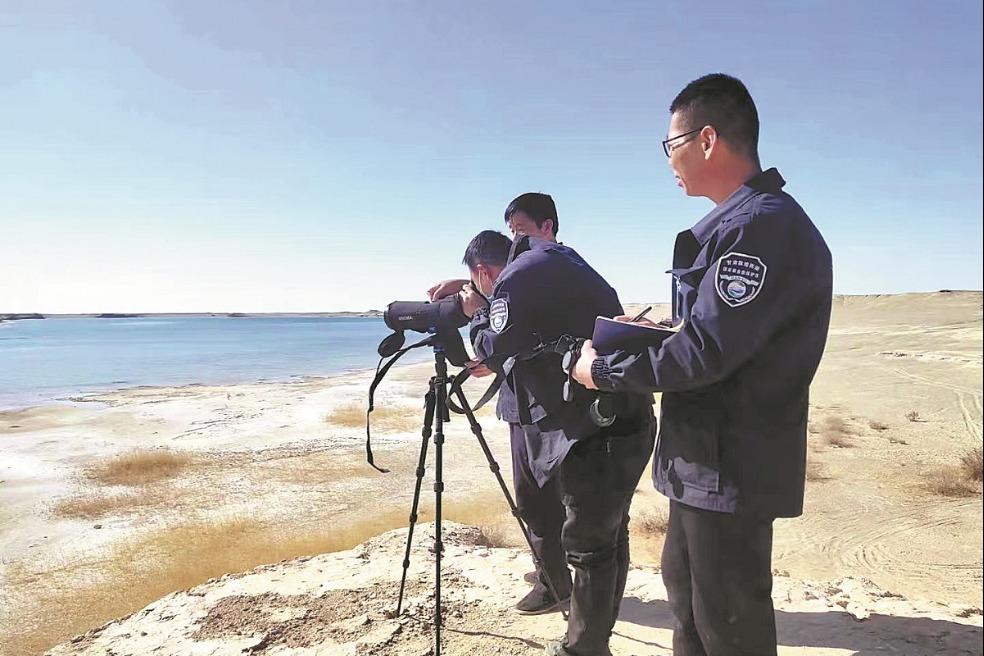
In the Sanjiangyuan National Park, the "Water Tower of Asia", the Tibetan antelope population has rebounded, prompting the International Union for Conservation of Nature to downgrade their status from "endangered" to "near threatened". This revival is attributed to habitat restoration, anti-poaching patrolling teams, and community-led conservation programs that incentivize herders to protect wildlife.
China has made great strides in addressing agricultural issues, one of the primary reasons for the loss of biodiversity, by leveraging comprehensive policies and effective practices. The country has drastically reduced pesticide and fertilizer use, with pesticide use decreasing by 31.4 percent from 2013 to 2021 and fertilizer use peaking in 2015. China is now the world's fourth-largest organic agriculture producer.
As the world's largest importer of agricultural products, China has been engaging in the conservation of global tropical rainforests by improving the transparency and sustainability of its supply chains in partnership with international organizations such as the WWF. These efforts align with global biodiversity targets, demonstrating China's commitment to balancing agricultural productivity with ecological health.
Globally, China's Kunming Biodiversity Fund, backed by an initial pledge of 1.5 billion yuan ($207.86 million), has become a cornerstone of South-South cooperation. It has approved or set aside in 2024 a total of $202 million for 40 projects in 41 countries and 36 percent of the total resources have been programed for LDCs (Least Developed Countries) and SIDS (Small Island Developing States). China has launched the Global Biodiversity Framework Action Initiative, too, expediting the implementation of the GBF worldwide.
As the 2030 deadline for global biodiversity targets approaches, China's vision of ecological civilization — prioritizing harmony between humans and nature — stands as a beacon of hope. From restoring forests that buffer against climate disasters to helping revive once endangered species' populations, China's contributions to global environmental protection and biodiversity conservation demonstrate that environmental stewardship and sustainable development are not competing goals but mutually reinforcing imperatives. In an era of escalating ecological crises, China's story shows that collective action, guided by policy and a scientific approach, can forge a path toward a thriving planet.
The author is the priority project coordinator for Policy Advocacy and Green Finance at the WWF, China.
The views don't necessarily reflect those of China Daily.
If you have a specific expertise, or would like to share your thought about our stories, then send us your writings at opinion@chinadaily.com.cn, and comment@chinadaily.com.cn.