Lace hub's global dominance unthreads tangled US tariff policy
Zhejiang-made dress puts manufacturing base in spotlight










Spinning a yarn
The lace industry began in Yutang village and gradually expanded across Mabu town.
After China's reform and opening-up in 1978, several villagers who had worked elsewhere had discovered that lace production was a profitable business, said Huang Shenglin, Party secretary of Yutang.
They imported a few lace-making machines and started small home-based operations. Initially, the tight profit margins and limited product range failed to attract many villagers. But as the market grew and more lucrative lace styles became popular in places like Guangzhou, Guangdong province, and Wenzhou, profits surged. One lace-making machine could produce up to 1,000 yuan worth of lace per day — drawing many to the industry. Production rapidly increased, and lace manufacturing flourished throughout the village in the 1980s.
"At night, when the machines started clattering in our quiet countryside, the nearby villages were all curious. Once they heard it was profitable, they scrambled to find equipment and sales channels. That's how it all grew," Huang said.
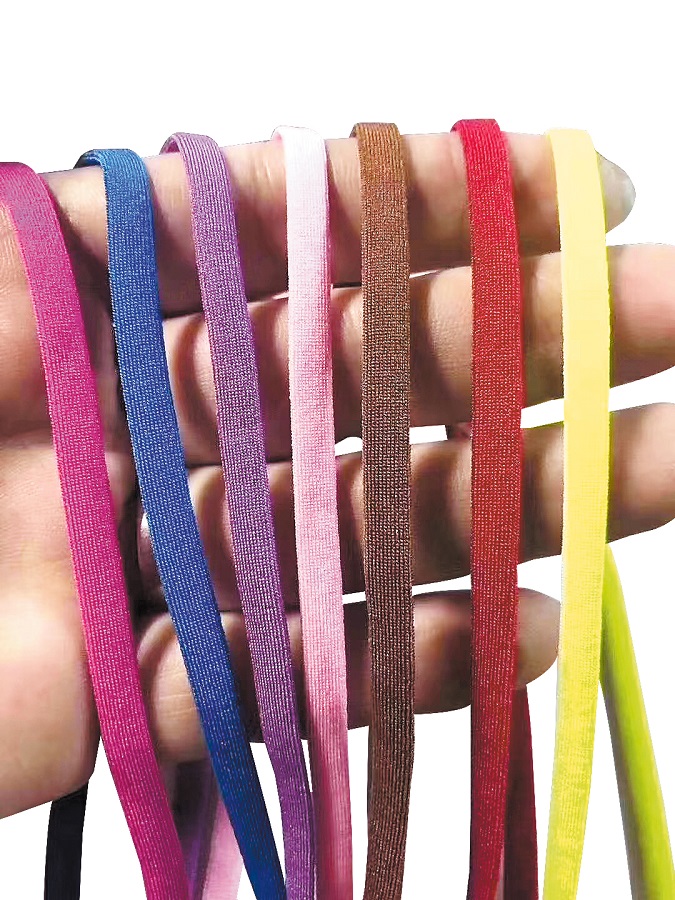
By the 1990s, the household workshops in Yutang began using the lace machines to produce yarn as well, selling it in Pingyang's market and tapping into a new segment. Turning yarn into lace requires additional materials such as metallic threads, sequins and beads.
Today, over 90 percent of the income of Yutang's 300-plus households is tied to lace and yarn. At its peak, Mabu — with a population of 44,000 — hosted more than 7,000 lace workshops.
"We can make any lace design in our workshops — even the kind on the dress worn by the White House press secretary," said Huang. "You just take the sample to a machinery factory and tell them what kind of product you want to make. They'll design a machine capable of producing it."
Huang's family owns 70 to 80 lace-making machines, capable of producing tens of thousands of meters of lace in a single day. However, most machines sit idle — not due to a lack of capacity, but because of insufficient order volume.
Hu explained that lace is a labor-intensive industry. Most products are exported via foreign trade companies, primarily to India and Malaysia, with little direct exports to the United States.
"Lace has low added value, low markup and low profit," he said. "In the overall apparel manufacturing process, lace is like MSG — it's a decorative seasoning. It's not easy to export directly, and the volume of direct exports is small."
Despite the hurdles, how does a piece of lace produced in Mabu make its way to the United States?
"After production, our lace is sold in wholesale fabric markets in Guangzhou and Yiwu, or through e-commerce platforms," said Chen Zhiren, the general manager of Wenzhou Huaweimei Lace & Ribbon Co, the town's largest lace enterprise.
"Domestic garment factories then purchase these materials based on orders from global brands, sew them onto garments, and export under license to markets like the US."
About 80 percent of lace in Yiwu's small commodity market in Zhejiang and Guangzhou's Zhongda Fabric Market originates from Mabu town.
"Half of our products are sold domestically, and the other half are exported — primarily to South America, where we account for 20 to 30 percent of the market," said Chen.
"Most exports are handled through trade firms, though we also do some direct exporting. For South America alone, we export 7 million to 8 million yuan worth each year, about 30 to 40 percent of our total output."
Founded in 2006, Huaweimei began in three residential units with a dozen machines and quickly reached 5 million yuan in output value in its first year — enough to be considered a sizable enterprise at the time. Today, it operates more than 200 lace machines and 700 to 800 yarn machines, producing over 100 million yuan in combined annual value at a 30,000-square-meter facility.
The showroom at Huaweimei displays over 800 types of lace, including a red dress trimmed with black lace, similar to the one worn by Leavitt. The lace wholesales for 13 yuan per meter, and the amount used in the dress Leavitt wore costs only a few yuan — but even that is considered "expensive" by industry standards.
"Our raw materials — nylon, spandex, polypropylene, polyester and rayon — are all sourced externally. Our regular lace sells from a few cents to a few yuan per meter, with the highest around 3 to 4 yuan," Chen said.