Duty of care
China has taken on the mantle of defender of the international trading order









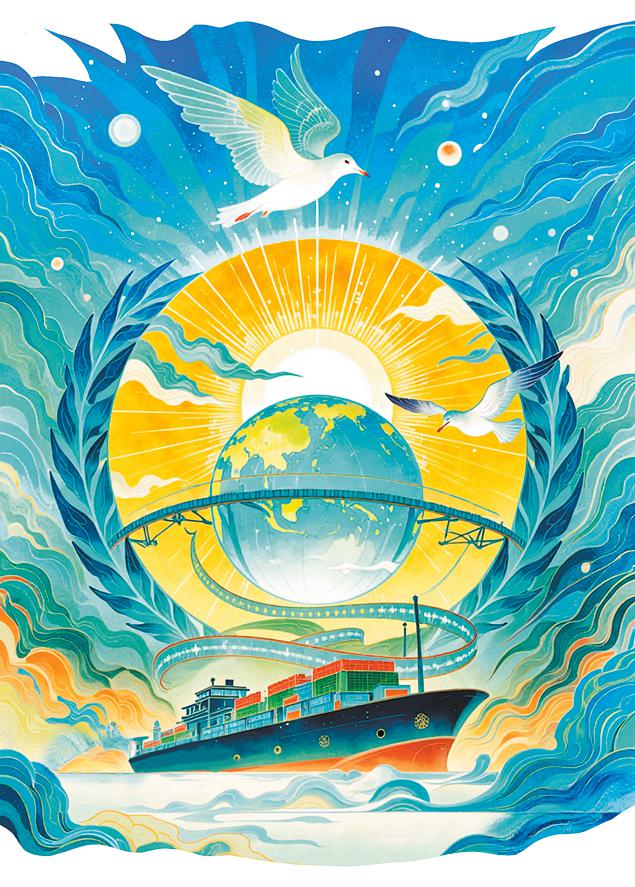
This year marks the 80th anniversaries of the end of World War II and the establishment of the United Nations. The UN Charter was the first of a series of significant international documents that created the basic rules governing contemporary international relations and laid the foundation for the current international order. Therefore, it is concerning that the US administration, by withdrawing from important international agreements and organizations such as the Paris Agreement and the World Health Organization, and by announcing tariffs on imports from practically all states worldwide, appears to be disrupting this order — an arrangement that has served the world, including the United States itself, so well for eight decades.
In May, European states marked Victory in Europe Day with grand commemorative events to encourage people to learn from history. French President Emmanuel Macron led a televised tribute to honor the war dead. In the United Kingdom, King Charles III watched a Royal Air Force flypast and attended a thanksgiving service. In Berlin, President Frank-Walter Steinmeier thanked the Western Allies and the Red Army for liberating Germany. He described the fact that even the US, which did so much to create and shape the post-war order, "is turning its back on it" as a shock on an entirely new scale and spoke of a double epochal shift: conflict in Europe and the US' break with its values.
Referring to the contribution of major states to the victory in World War II, Chinese Foreign Minister Wang Yi rightly emphasized that we "should work together to safeguard the post-war international order", and "oppose any attempt or action to deny, distort or revise the history of World War II". The same is true of the subsequent construction of the post-war order. It is therefore apposite to recall that, of the victors over foreign aggression, China, the US, the UK and France were all founding members of the UN. While the Soviet Union was also a founding member, Russia only took the Soviet Union's seat in 1991. Germany and Japan were initially not UN members: Japan only joined in 1956; the Federal Republic of Germany and the German Democratic Republic joined in 1973. All these states have therefore different perceptions of their participation in the construction of the current world order.
The unraveling of an order constructed over decades in only about 100 days is indeed part of the major changes unseen in a century to which President Xi Jinping has frequently referred. The institutions of the rules-based order and their norms are in danger of becoming increasingly irrelevant. The US' allies and also countries in the Global South are rethinking their positions in the world, adjusting to a situation where global power appears to be redistributed. However, the current geopolitical situation remains shrouded in uncertainty: while there is much discussion about a new multipolar world, the outcome is still unclear.
Or is it? While members of NATO and the EU flinch at the US administration's attack on globalization, many recognize that China, by appealing to the World Trade Organization, took on the mantle of a defender of the rules-based international trading order. They are aware that, as the WTO stated, the tariff war started by the US carries wider implications that could severely damage the global economic outlook. It is therefore no surprise that, for many, China — the major trading partner of some 150 countries and regions worldwide — becomes a more reliable partner and promoter of true multilateralism.
At the Munich Security Conference in February, US Vice-President JD Vance shocked European countries by telling them that "what I worry about is the threat from within, the retreat of Europe from some of its most fundamental values". At the same conference, Chinese Foreign Minister Wang soberly called for an equal and orderly multipolar world, in which "China will surely be a factor of certainty… and strive to be a steadfast constructive force in a changing world … Major countries must take the lead in honoring their words and upholding rule of law". He emphasized China's willingness to collaborate with Europe to enhance strategic communication and guide the world toward a future of peace and security.
Many countries in Europe, East Asia and the Global South are now reconsidering their potential partners for security, trade and scientific cooperation. Some still perceive profound differences between the Chinese system and their own political order. Others are increasingly wary of basing their security, investments or trade on the US where an idiosyncratic administration can change the rules overnight, and they appreciate the approach taken by China. However, still others warn that China's offers of cooperation should be treated with caution.
Much will depend on whether China can properly address the concerns of these countries regarding some of its policies. China will have to convince its major trading partners to set aside their differences regarding its trade practices and occasional worries about its so-called overcapacity. It must reassure the world that the Belt and Road Initiative is indeed a major long-term plan facilitating connectivity and fostering common prosperity. Besides, it should persuade Europeans that its commitment to the purposes and principles of the UN Charter is steadfast and unwavering.
China's success in demonstrating this to the international community would create a genuine opportunity to safeguard the post-war international order, uphold the authority and status of the UN, and encourage all nations to abide by the purposes and principles of the UN Charter.

The author is a former member of the German Foreign Service, an advisory professor at Tongji University and a visiting scholar at the Center for Cultural Studies on Science and Technology in China at Technical University of Berlin. The author contributed this article to China Watch, a think tank powered by China Daily. The views do not necessarily reflect those of China Daily.
Contact the editor at editor@chinawatch.cn.