China's ancient dreams make for modern space triumphs









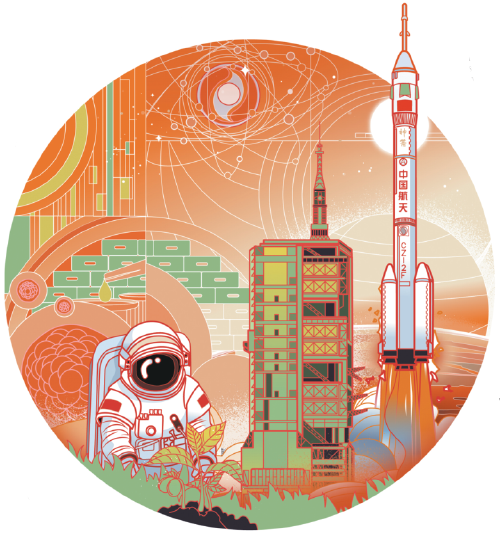
The flowing celestial robes in Dunhuang murals, featuring flying goddesses, and the legendary attempt by Wan Hu to reach outer space during the early Ming Dynasty (1368-1644) – these are enduring symbols of the Chinese nation's millennia-spanning poetic yearning for the cosmos.
Today, each stride in China's space program continues this profound narrative, translating ancient imagination into modern reality through cutting-edge technology. At its heart, China's space endeavor embodies a distinctive blend of ambition and cultural romance.
This distinct character springs from an unyielding drive to explore. It is the purest expression of humanity's quest to understand the universe and push scientific boundaries. From the first Chinese manned space flight in 2003, to the first Chinese spacewalk, by Zhai Zhigang, in 2008, to the Chang'e-5 and Chang'e-6 missions retrieving precious lunar samples, to the Zhurong rover imprinting China's presence on Mars – these milestones showcase not just technological prowess, but the fundamental human spirit of curiosity and courage.
Each journey into the deep void seeks answers to humanity's oldest questions: "Where do we come from? Where are we going?" This relentless pursuit echoes the philosophical stargazing of ancient sages, forming a romantic continuum across time.
This character is forged in the crucible of relentless effort and self-reliance. It is the tangible result of generations of space workers dedicating themselves day and night to the mission. By merging personal aspirations with national goals, they cultivated the defining spirits of China's space journey: the "two bombs, one satellite" spirit, the manned spaceflight spirit, the lunar Exploration spirit, and the BeiDou spirit of the new era.
Their perseverance embodies the ancient resolve: "The road ahead is long and arduous; I will search relentlessly." This human dimension – the sweat, sacrifice and unwavering dedication – infuses the cold mechanics of rocketry with profound warmth and meaning.
This distinctiveness shines through in the deliberate echo of ancient culture. The very names of China's spacecraft transform them into cultural emissaries. The Chang'e lunar probes (Chang'e is a well-known mythical figure, a goddess said to reside on the moon), the Tianwen Mars mission (Tianwen means "questions for the heaven"), the Yutu lunar rover (Yutu means "jade rabbit", the pet of Chang'e in mythology), the Zhurong Mars rover (Zhurong is also a mythical figure from ancient times associated with fire), the Xihe solar observatory (Xihe, the sun goddess in ancient Chinese mythology), and the Shenzhou spacecraft (Shenzhou means "divine vessel") – these are not mere labels, but vessels carrying millennia of myth and national aspiration into the modern space age. Where rich tradition intersects with advanced technology, we witness not just scientific progress, but the vibrant rekindling of cultural confidence.
Ultimately, this unique approach serves as a powerful national catalyst. It nurtures the spirit of exploration, inspiring youth to look skyward and dream, while igniting society's passion for innovation. It reminds us that technological advancement is not merely cold data; it is humanity's grandest expression of its place in the cosmos. As China reaches for the stars, it writes a compelling chapter in the human story, defined by this fusion of ancient vision and modern capability.
Since 2012, increased importance has been attached to China's space explorations, with leadership declaring that exploring the vast cosmos, developing space endeavors, and building China into a space power represent the space dream we persistently pursue.
This vision is materializing: the Tiangong space station is operational; lunar exploration has achieved remarkable successes, including two sample-return missions; and the Tianwen-1 probe successfully landed on Mars. Looking ahead, China's cosmic dreams aim ever further, promising to unfold even more magnificent chapters in this uniquely compelling narrative of exploration.
This is the essence of China's space journey: a powerful synthesis of ancient dreams, relentless modern endeavor, cultural resonance and an inspiring vision for the future.
The author is a publicity official with the State Administration of Science, Technology and Industry for National Defense. The views don't necessarily reflect those of China Daily.
If you have a specific expertise, or would like to share your thought about our stories, then send us your writings at opinion@chinadaily.com.cn, and comment@chinadaily.com.cn.