China in next phase of AI revolution: Report









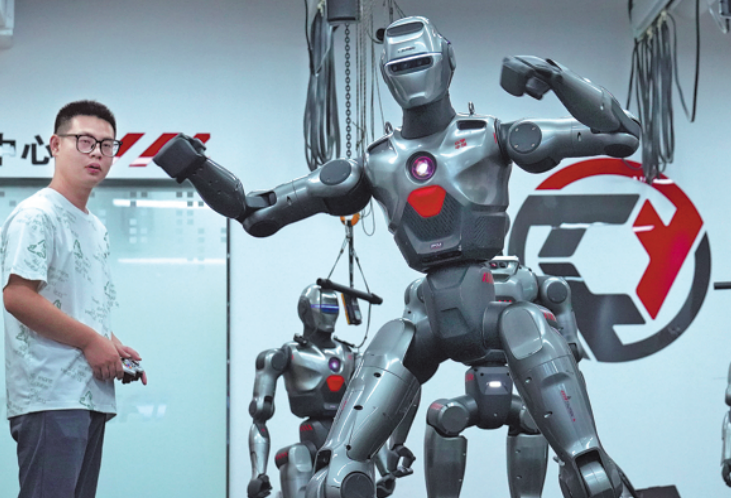
China is competitively positioned in the next phase of the artificial intelligence revolution, characterized by real-world application rather than computing power, as the country leads in the scale of its market, human resources and manufacturing ecosystem, said a white paper released on Tuesday.
Titled China and the Global AI Race, the paper was produced by the Cheung Kong Graduate School of Business and it explores the latest developments in AI, with a particular focus on the role of China in this technological frontier.
"The physical world will become the space of highest potential for AI development in the next few years," said Sun Tianshu, dean's distinguished chair professor of information systems at the school, in the paper, citing smart hardware, especially robotics, as an example of that integration.
As robots and other smart devices must be built, tested, refined and distributed in real-world settings, the vast size of China's domestic market offers not only diverse scenarios for experimentation and improvement but also a natural advantage for scaling up, the paper said.
The country's mass manufacturing capabilities also enable fast delivery of the products, as plants, labor force, components production lines, from sensors and actuators to circuit boards and servos, and the distribution centers are all in place, the paper said.
"From mega-factories and distribution centers to smart hospitals and elder care facilities, there is a ready-made landscape," it said.
"Algorithms can be developed anywhere, but the hardware and smart manufacturing required to embody AI in the physical world cannot easily be migrated elsewhere other than in China," Sun said. "The economy of scale in China, as well as the manufacturing ecosystems coordination, mean that while China is in a great position to empower countries to embrace AI, production will largely remain here."
Another catalyst driving China's AI development is "the open-source movement", led by a list of prominent players, including DeepSeek, Qwen and others, the paper said.
Speaking at an online session on Tuesday, marking the launch of the paper, Teng Bingsheng, a professor of strategic management and associate dean for strategic research at the Cheung Kong Graduate School of Business, said the rise of open-source has shifted the focus of Chinese tech firms from investing in large language models to developing their own applications, as they no longer need to "reinvent the wheel".
Empowering startups
The move has, in a way, empowered Chinese startups, as they now can have a bigger say in the AI revolution by right of their own innovation on top of existing codes, Teng said.
The giveaway could also foster international collaboration, with China acting as the "role model", the report said.
"Many developing countries are at a stage of 'what is next?'," said Edward Tse, founder and CEO of Gao Feng Advisory Company, in the paper. "Chinese models, particularly the open-source ones, have been doing well so far and are credible alternatives to the Western models. People are going to look to China more, and there will be more people choosing to go with the Chinese way."
Chinese companies are already exporting AI-powered manufactured goods, from electric vehicles and smart appliances to industrial equipment, while the future focus will be more on exporting intelligent services, with AI-as-a-service platforms, cloud computing solutions and autonomous systems all to come, the report said.
"From smart city projects in Southeast Asia to AI-driven logistics networks in Africa, China's AI footprint is expanding fast," it said.
Despite fierce tech competition gripping the world, the diffusion of open-source large language models has been "significantly enhanced", notably with Chinese and the United States open-source communities collaborating on many projects, the report noted.
At the online session, when asked whether the AI sector is viewed more as a sphere of collaboration or competition, Alex Roberts, head of China TMT at Linklaters, a British multinational law firm, said businesses are eager to seek a certain level of harmonization to allow technologies to flow as freely as possible.