300,000-year-old wooden tools found









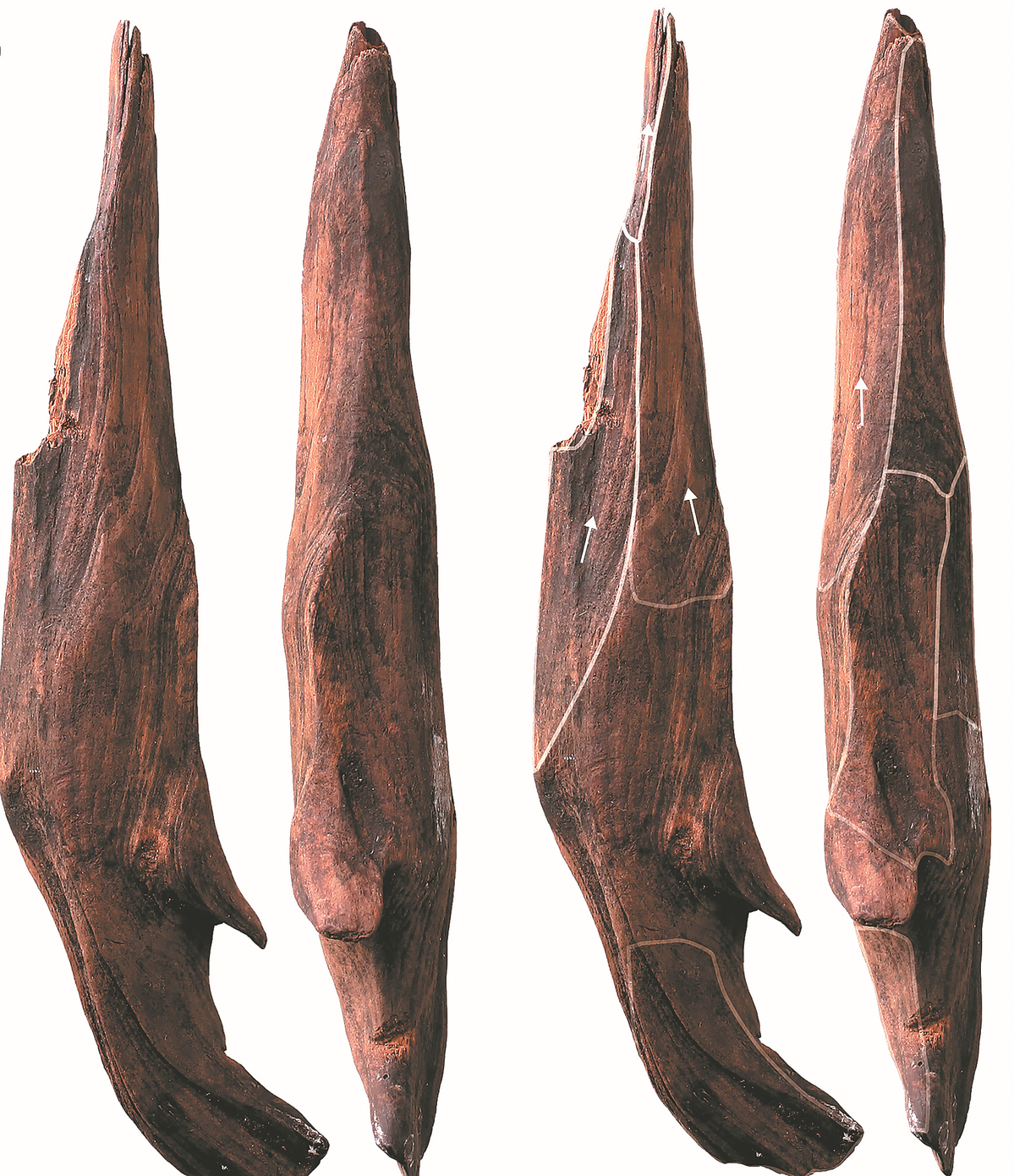
A multidisciplinary research team has announced the discovery of 300,000-year-old well-preserved wooden artifacts at the Gantangqing site in Southwest China's Yunnan province, presenting the earliest finding of this kind in East Asia.
The study, published in the journal Science on Friday, has provided empirical support for the longstanding bamboo and wooden tools hypothesis, which suggests a strong reliance of ancient East Asian populations on implements made from these materials in their daily lives, with basic stone tools primarily used for processing tasks.
First unearthed in 1984, the Gantangqing site, located 5 kilometers from the Fuxian Lake in Yuxi's Jiangchuan district, has been excavated three times: in 1989; from 2014 to 2015; and from 2018 to 2019. The last two excavations yielded a diverse collection of stone tools, animal fossils, wooden materials and plant seeds, forming the foundation of the materials presented in the paper.
"The site's discovery of a large number of exquisitely preserved wooden materials and plant seeds is a rarity among Paleolithic sites, because they are highly susceptible to decay and degradation, hindering their formation as archaeological specimens," said Gao Xing, a corresponding author of the study and a researcher from the Institute of Vertebrate Paleontology and Paleoanthropology, Chinese Academy of Sciences.
Noting that the wooden materials discovered at Paleolithic sites in Africa, Europe and West Asia are fragmented, he attributed the exceptional preservation of wooden artifacts at the Gantangqing site to its distinct location and environment.
Through comprehensive analysis of geomorphology, stratigraphy, paleobotany and taphonomy, the research team determined that the strata containing cultural relics are lacustrine and fluvial deposits from the ancient Fuxian Lake. The site was rapidly buried and preserved in a water-saturated, oxygen-deficient and stable environment, conditions highly conducive to the conservation of organic materials.
Moreover, animal and plant fossils indicate an optimal habitat for the ancient population, characterized by plentiful aquatic plants, dense forests and diverse animals thriving in tropical and subtropical environments.
To establish the artificial origin and functions of these wooden tools, the team conducted in-depth investigations through material analysis, trace analysis, residue analysis and experimental simulations. Through these methods, they identified 35 human-made wooden tools out of the nearly 1,000 unearthed wooden materials.
"The population showed a preference for the coniferous tree species, with 70 percent of the wooden tools primarily crafted from pine wood," Gao said, adding that macroscopic and microscopic examinations revealed evidence of usage, such as cutting and scraping marks indicative of branch pruning and shaping, as well as polished streaks and fractures at the tips.
Associated cultural relics, including the small stone implements and bone and antler tools, were found to be further proof of the human-made nature of the wooden tools. Raw material and technical analysis showed that the wooden implements replaced stone tools due to a scarcity of raw materials for the latter near the site, and experimental simulations replicated the process of using stone tools as scrapers to process wooden tools.
Notably, the antler tools unearthed at the Paleolithic site were also the first of their kind in East Asia. Known as soft hammers in archaeology, they were used in tool processing, serving as a significant indicator of mature stone tool technology. This suggests that East Asian stone tool technology during the early and middle Paleolithic periods was not as far behind that of the West as previously believed, Gao said.
The study found that some tool tips retained soil residues containing plant starch grains, indicating that these wooden tools were mainly used for digging up underground plant foods. In contrast to the abundant evidence of people hunting mammals during the Paleolithic period, the discovery of plant consumption is rare. In addition, individuals of that era were already aware that the edible components of plants encompass not just leaves and seeds, but also roots and stems, and they crafted specialized digging tools for it.






- 300,000-year-old wooden tools found
- China to strengthen disaster management
- TCM foodstuffs help to sweeten bitter pill
- Qingdao institute offers a new window to study, understand SCO states
- New scenic area in Shenyang opens in time for lotus blooming season
- Shanghai airports offer storage service for prohibited power banks