Japanese hitchhiker experiences China off the beaten path









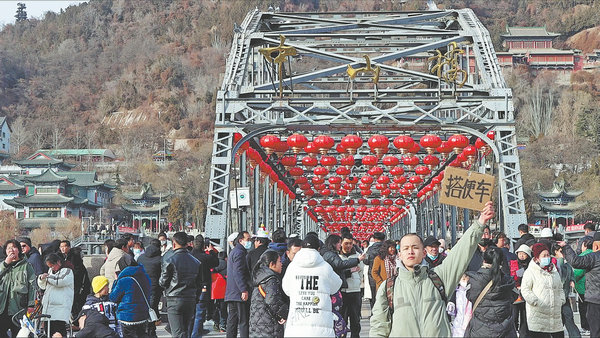
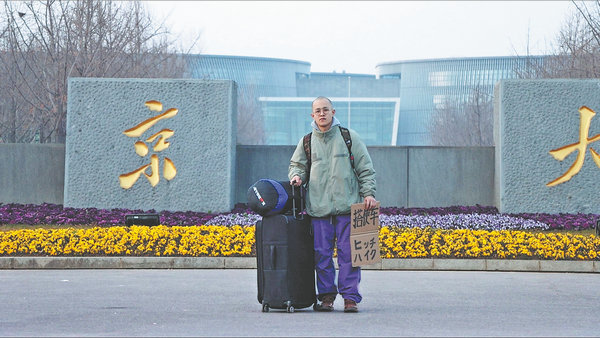
NANJING — Far from an impulsive decision, a Japanese student planned a well-thought-out route to experience the real China. With a tight budget and schedule, he hitchhiked over 3,000 kilometers from Nanjing, Jiangsu province, to Urumqi, Xinjiang Uygur autonomous region.
After discovering stereotypes about how Chinese and Japanese people perceive each other, Hibiki Tanikawa, 24, felt reality might tell a different story. "Only by communicating with Chinese people can one see the real China," he says.
With that belief, Tanikawa, a postgraduate student at the School of Journalism and Communication at Nanjing University, set out on a unique journey on Jan 21.
"I want to understand China through its people, not just as a foreigner," Tanikawa adds, noting that beyond this social exploration, he also wanted to discover more of the country and meet as many people as possible.
Before setting out on his hitchhiking journey, Tanikawa picked up a camera for the first time to document the lives of ordinary Chinese people.
In the beginning, he conducted a "social experiment" by asking drivers if they would give him a ride. If they said yes, he would then reveal that he was Japanese to see whether they would change their minds.
Traveling from Nanjing to Urumqi, Tanikawa's journey involved more than a dozen car rides. Of the 17 drivers he encountered, most exhibited kindness and offered help upon learning his nationality.
What impressed him most was a driver who openly admitted to having negative views about Japanese people but still offered help to Tanikawa simply because helping others had been a value he possessed since childhood. Tanikawa says this encounter made him rethink the true meaning of kindness.
Along the journey, Tanikawa encountered diverse and authentic experiences. He patiently adjusted to the accent of a northwestern couple, watched students returning to school aboard a slow green train, chatted with a young driver about cartoons, and listened to another driver in the city of Luoyang in Henan province explain how the city's architecture inspired Kyoto's. These moments — some new, some engaging, and some profoundly meaningful — helped shape Tanikawa's deeper understanding of China.
"The hardest part of the journey was not finding a ride and being stuck in one place," Tanikawa says. "Luckily, I could sometimes chat with passersby, and it felt like a recharge." Looking back on the challenges he encountered, he vividly remembers his emotions and feels grateful for having embraced a mindset that welcomed the journey's uncertainties.
On the second day of his adventure, while in Taihe County, Anhui province, Tanikawa was struck by severe stomach pain and abandoned his plan to stay in a tent, opting for a hotel instead. "I experienced the same in Xinjiang," he recalls. "I really enjoyed eating lamb skewers. The meat was cut into big, satisfying chunks. But my digestion couldn't keep up. At night, I felt uncomfortable and slept holding my stomach."
On the eighth day of his journey, Tanikawa celebrated his first truly memorable Chinese Spring Festival at a classmate's home in Luoyang. It was New Year's Eve, and sitting around the tea table with his classmate's family, he savored the homemade feast and heartfelt conversations about life. Tanikawa says he felt like he had become part of an ordinary Chinese family.
Coming from Japan, where personal space is highly valued and people tend to keep their distance, Tanikawa found himself immersed in China, filled with warmth and close, personal connections.
He speaks candidly about how this experience transformed his outlook. "At first, everyone thought I was shy because I wasn't used to such closeness. But gradually, as I communicated more, our bonds grew stronger. If I could speak to my past self, I'd say: "Don't worry so much. As long as you're not hurting others, it's okay to be more direct."
Throughout his 30-day hitchhiking journey, despite numerous challenges, Tanikawa experienced warmth and sincerity and was deeply touched by the countless kindhearted faces of ordinary Chinese people.
"What I experienced wasn't just a hitchhiking trip but a journey through the very fabric of a nation," he says.
Tanikawa adds that his journey is just beginning. He intends to continue savoring the most authentic sides of China with every step. "I'm planning to visit Yunnan, Guizhou and Sichuan provinces during the summer break. I'd love to go to Xizang (autonomous region) as well, but I need to save up for that trip."
Xinhua