Why multinationals choose China to connect with the world









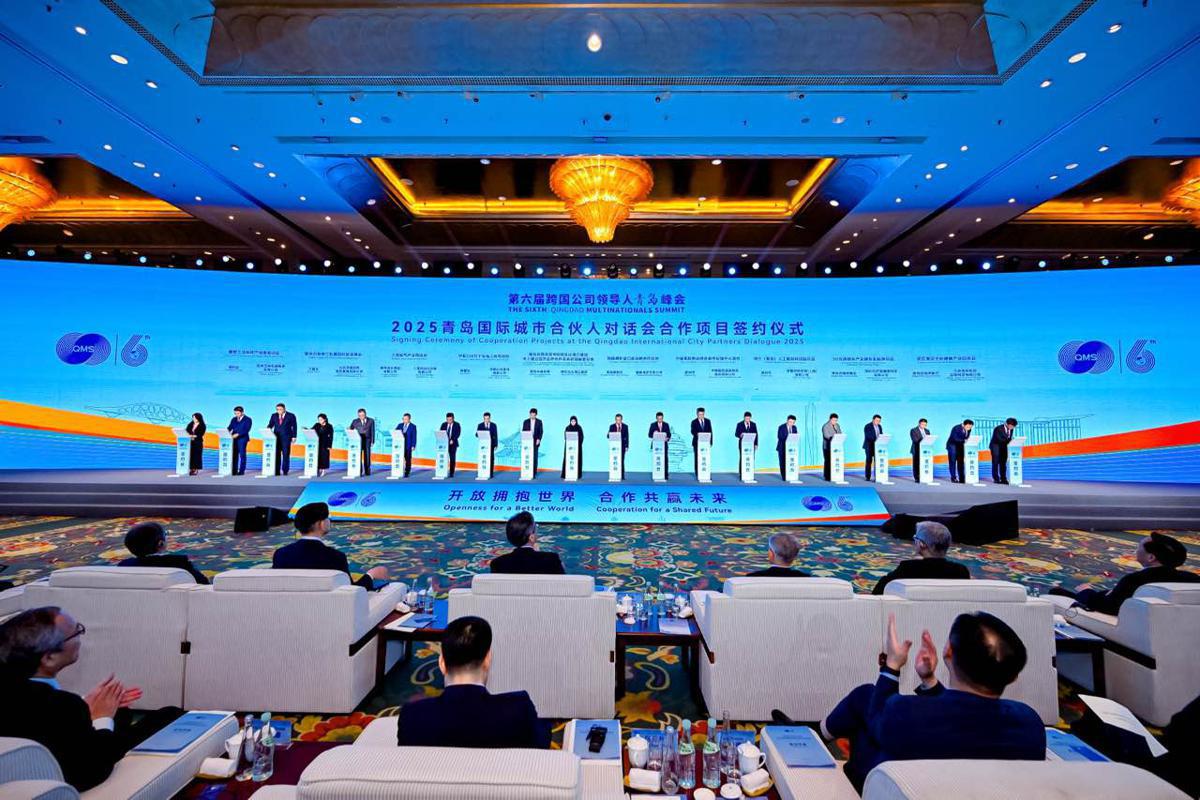
Against the backdrop of rising global unilateralism and protectionism, the Sixth Qingdao Multinationals Summit held from June 18 to 20 sent a clear and powerful message: China remains committed to opening its door wider to foreign investment.
Since its inception in 2019, the gathering has evolved into an important platform for multinational corporations to take the pulse of the Chinese economy and access its burgeoning opportunities. Its journey has also mirrored multinational corporations' expanding presence in China as key participants in the country's reform and modernization drive and main players in its integration into the world economy.
The summit's expanding circle of friends across diverse industries speaks volumes: 570 executives from 135 Fortune Global 500 companies and 330 industry-leading enterprises attended this year's event — a strong testament to multinational corporations' confidence in the Chinese economy.
With mounting uncertainties in the global economy, China stands out as a rare oasis of certainty. Its pursuit of high-quality development is offering high-value opportunities to businesses. Investing in China has proven crucial for multinational corporations to maintain a global competitive edge and reap substantial dividends. Profits of major foreign-invested industrial enterprises in China grew from 1.6 trillion yuan to 1.8 trillion yuan between 2019 and 2024, consistently outperforming China's industrial average, according to the summit's "Multinationals in China" report.
Building bridges, not walls
While others are building walls, China is building bridges. As the world faces growing tariff barriers, China is accelerating openness through concrete actions. This year alone, it launched the 2025 Action Plan for Stabilizing Foreign Investment, introducing 20 practical measures, and rolled out 155 pilot tasks nationwide to expand opening up in the service sector. China's economic and technological development zones and pilot free trade zones have continued to offer policy incentives. All this has created fertile ground for foreign investment, especially as global business confidence wanes.
The accelerated implementation of these opening-up measures is reinforcing multinational corporations' conviction that investing in China is investing in the future. The summit's theme, "Multinationals and China: Connecting the World for Win-Win Cooperation", aptly captures a new trend: Multinational corporations are increasingly seeing China not just as a market, but as a global hub to connect with worldwide markets. "In China for the world" has become a core consideration in their China strategy. As Jens Eskelund, president of the European Union Chamber of Commerce in China, succinctly put it, "European companies must have a foothold in the Chinese market if they want to maintain their global competitiveness."
Foreign enterprises initially came for market access, stayed for manufacturing efficiency, and are now repositioning themselves in China for global impact. As the Qingdao Multinationals Summit demonstrated, China's transformation into a high-quality development model generates compound value. With a unique convergence of long-term policy stability — a rarity in today's world, a super-large market, complete production and supply chains, and leading innovation capacity, China offers what no other economy can: a platform to compete locally while winning globally. That is why connecting with the world through China isn't just an option — it is becoming a business imperative in today's global economy.
In short, China has been and will continue to be a safe and promising investment destination. No matter how the international landscape changes, China's door will only open wider, and its business environment will continue to improve, which will bring even greater opportunities for foreign businesses to enhance competitiveness and unlock new growth trajectories.
The author is a commentator on international affairs, writing regularly for Xinhua News, Global Times, China Daily, CGTN etc. The views don't necessarily represent those of China Daily.
If you have a specific expertise, or would like to share your thought about our stories, then send us your writings at opinion@chinadaily.com.cn, and comment@chinadaily.com.cn.