Digital countryside fueling reverse urbanization









When people talk about the digital divide, they usually mean rural areas lagging hopelessly behind cities. But in China, that story is being rewritten. Instead of simply mimicking cities — slowly, expensively, half a step behind — rural areas in China are witnessing a kind of reverse urbanization, powered by technology that's not just copied but reinvented to suit rural conditions.
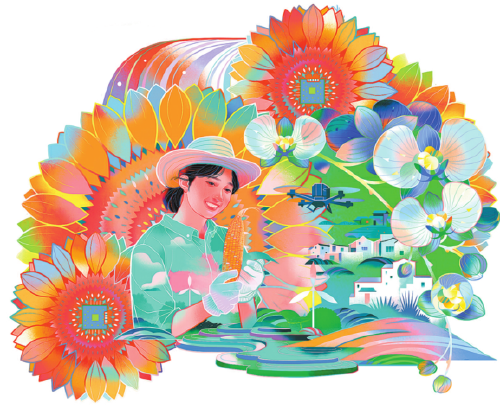
It's a transformation in which villages aren't at the end of the technological trickle-down point but on the starting line of cultural creativity and social innovation. Imagine drone pilots in cotton fields, livestreaming mushroom growers, virtual farms with AI-powered tractors, even smart eldercare systems linked by 5G. This is rural China 2.0.
Not so long ago, daybreak in the Chinese countryside meant farmers, carrying pesticide tanks, trudging through the fields. Today, you hear the hum of low-flying drones.
By 2024, China's fleet of crop-protection drones exceeded 251,000 units, slashing costs to about 10 yuan ($1.39) per mu (or about $20 per hectare) a year, while dramatically improving efficiency. The drones have also given rise to a new rural profession — drone pilot.
Take the vast cotton fields in the Xinjiang Uygur autonomous region, for example. A single pilot can spray pesticide on 27 hectares a day there, earning more than $160 a day. It's not backbreaking labor but skilled work, drawing young people to the countryside with screens in hand who are turning rural areas into a high-tech workplace.
Consider Fuxi farm clusters, an innovative form of smart farming, as another example. Named after a mythical cultural ancestor, Fuxi farms display futuristic agriculture. There are autonomous tractors for precision farming, gamma spectrometers for scanning soil — like an agricultural CT scan — AI breeding simulators for predicting seed performance, and digital twin systems for modeling crop growth in changing climate.
From aerial spraying to virtual farming, technology is changing who does farming and how it's done. And this digital transformation isn't confined to research farms or government programs. It is thriving across rural areas.
My friend Wang Jing was born in the 1990s in a Miao family in Tunshang village, Shibing county, Guizhou province. In the past, it used to take her a whole day to travel from her village to a city. Now, she's just a click away from a global audience.
Wang makes mushroom-growing substrates from corn cobs and uploads every step of the process on Douyin (the Chinese version of Tik-Tok), winning over 2.7 million followers. She teaches cultivation skills, shares market updates and even sells products live, apart from helping thousands of farmers to sell mushrooms, black fungus and day-lilies. Her videos have been translated into multiple languages, turning her into a poster child of China's "cloud-based countryside".
The impact of livestreaming has been such that farmers have hung banners between papaya and mango trees in the orchards of Bama county, Guangxi Zhuang autonomous region, that read, "Livestream Hosts Wanted". Near one such banner, farmers sitting on red plastic stools tell the world how they tend their fruits.
Digital technology has turned villagers into good storytellers, and entrepreneurs, too.
In Xiajiang village in Chun'an county of Zhejiang province, 5G-A networks, drone patrols, AI video recognition and image analysis have helped the villagers build an all-day rural eldercare safety net. Signs of any abnormal natural phenomena, including extreme weather events, can trigger alerts, prompting villagers and officials to take preemptive measures.
I've experienced this firsthand after installing a gas-leak detector in my hometown of Ma'anshan, Anhui province, as a safety measure for my elderly parents. The detector sends instant alerts to my phone in case of any emergency. The safety net isn't only a technological marvel; it feels like an extension of family care.
Then there's "Village BA" in Guizhou province — a basketball tournament that started as a humble event went viral after short videos were uploaded online, drawing hundreds of millions of views. It also prompted many, including youths, older villagers and families with children to return to their village, and become not only spectators but also commentators, cheerleaders and volunteers. What began as a sports tournament has become a community festival.
This is the magic of technology, the community and the cultural sector working together in harmony. Yet the "digital countryside" isn't about just services. It's about connecting people, emotions and shared identities — and quietly rebalancing the urban-rural relationship.
The countryside no longer supplies only farm products. It is becoming a wellspring of cultural products and emotional resonance. From the futuristic trials in Fuxi farm clusters to Wang Jing's down-to-earth livestreaming, and from smart eldercare networks to basketball tournaments that made villages into national talking points — the countryside today is not only a beneficiary of digitalization but also an exporter of creative, cultural products.
The countryside today is involved in not only one-way resource transfer but also two-way value exchanges. Cities need food, cultural elements, even aesthetic inspiration from rural areas. Attracting urban capital, technology and attention, villages have established an interdependent relationship with cities.
Digital tools don't just connect the countryside to the outside world but also give it the confidence to chart its own future, because China's rural digitalization isn't a top-down charity project, but a reinvention project guided by rationality and creativity.
This wave of reverse urbanization isn't about people moving back so much as about rethinking the structures that define the center and periphery. In an interconnected, intelligent world, the countryside isn't falling behind. It's helping redefine what "the center" actually means.
China's story is being written not only in the glare of office towers but also in the morning mist, digital orchards, data-driven farms, and ploughed rows of autonomous tractors. This is what China's rural vitalization is all about.
The author is a researcher at Rural Development Institute, Chinese Academy of Social Sciences. The views don't necessarily reflect those of China Daily.
If you have a specific expertise, or would like to share your thought about our stories, then send us your writings at opinion@chinadaily.com.cn, and comment@chinadaily.com.cn.