Transcontinental railway integrating Asia, Europe









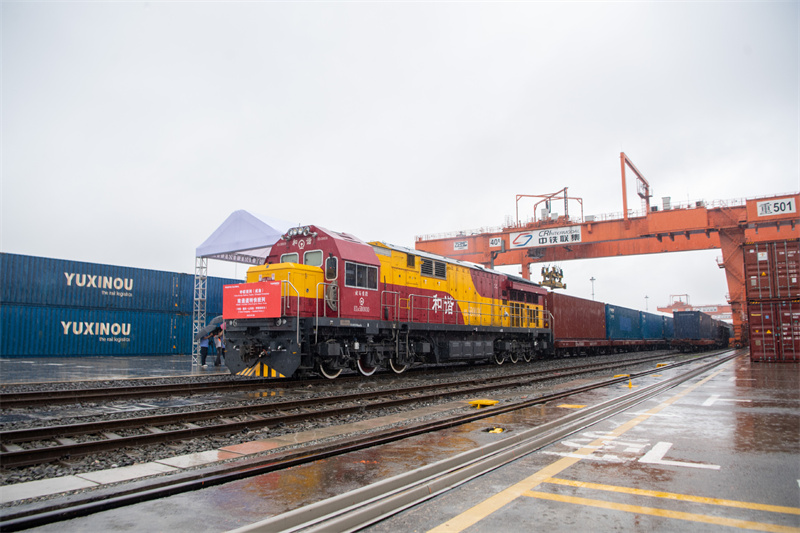
Since its inauguration in 2011, the China-Europe Railway Express has been a beacon of innovation and economic connectivity. Originally conceived as a trade land bridge between China and Europe, the railway has become a key driver of interstate economic relations, regional integration and geopolitical stability.
After China proposed the Belt and Road Initiative in 2013, the China-Europe Railway Express was incorporated into its structure, providing an essential logistics corridor between Asia and Europe.
The railway is an important infrastructure of the Eurasian economic nexus. The network has effectively advanced transcontinental transportation and logistics between China and Europe, helped develop regional economies, while upgrading human capital and infrastructure along its route, and introduced the concept of economic complementarity and collaborative advancement of joint goals across borders. The economic integration of Eurasia is based to a large extent on the development of this railway.
The railway has proven its worth by addressing geopolitical challenges, optimizing routes and connectivity, offering diverse freight solutions and reducing delivery time compared with sea transport.
The positive spillover effects involve not just national economies, but also cities along the route, which are evolving into major economic hubs and industrial agglomerations, attracting experts and contributing to technological innovation. Enterprises involved in the railway have also improved their production system and economic output.
The recent geopolitical turmoil in different regions affecting maritime transport, on routes such as the Red Sea, has only increased the importance of the China-Europe Railway Express for Eurasia's economic stability. With the cost of sea freight through the Red Sea soaring, the railway has been a key option for maintaining the supply chain between Asia and Europe.
In this sense, the railway has been functioning as a "land stabilizer" during the Red Sea crisis, ensuring the continuous vitality of the European economy.
The record-breaking departure frequency from Xi'an in Shaanxi province and other Chinese cities shows the effectiveness of a "land-sea parallel" method.
The increasing potential of land transportation is redefining the geopolitical value of the Eurasian economic passage, which materializes the goals of the BRI. The railway continues to steadily increase the number of trains and 20-foot equivalent units transported every year, proving its reliability.
The sustainable development of the railway is very important for promoting the growth of trade between China and Europe and meeting the ever-increasing demand for freight transportation in Asia and Europe. The railway has the potential to become the most sustainable mode of long-distance transportation for Eurasian connectivity, complementing maritime and air transportation. The expansion of the railway would make it more effective.
China-European Union economic relations are the bedrock of the Eurasian economic order and a major component of the global equilibrium. In terms of trade scale, China and the EU are the world's top and second-largest trading economies in goods respectively, and together account for almost 30 percent of global trade in goods and services and more than one-third of global GDP.
China-EU economic and trade relations have made great progress since the two sides established diplomatic relations in 1975, with two-way trade seeing a meteoric rise in the early 21st century. In this context, the China-Europe Railway Express is a focal part of their economic relationship, which remains steadfast and resilient. Indeed, China and the EU are natural economic partners, sharing a high degree of complementarity.
The two economies should be able to manage their industrial capacities and capitalize on their economic complementarity, rather than antagonizing each other, by carefully identifying areas of potential overlap in production and exports. China and the EU, through cooperation, can improve global economic governance and contribute to a stable and equitable global economic order.
Closer cooperation between the EU and China amid the growing global economic challenges can help safeguard the economic interests of both the EU and China, restore the credibility of the global economic system, ensure long-term global economic growth and stability, and turn the China-Europe Railway Express into the most lucrative and mutually beneficial trade route in the world.
The author is an adjunct lecturer in geopolitics at National and Kapodistrian University of Athens, Greece.