China, EU can shape climate governance









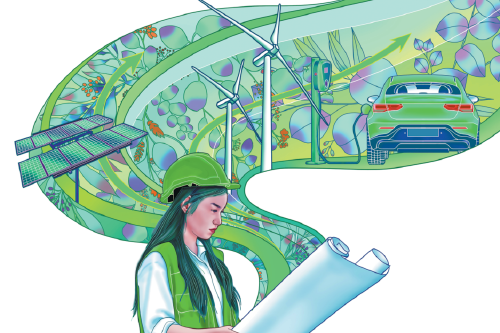
With the world facing escalating climate risks, the call for robust, cooperative climate governance has become even more urgent. With their complementary strengths in renewable development, technological innovation, and financial regulation, China and the European Union can act as twin anchors for green transition.
A supervisory approach, especially sustainable finance, is a vital tool in this transition. Central banks and financial regulators have emerged not just as risk managers, but also as enablers of industrial decarbonization. A deeper China-EU partnership, grounded in supervisory collaboration, offers a model of climate leadership marked by prudence, inclusiveness and institutional foresight. As a small but strategically located and innovation-oriented country, Hungary — through its central bank, the Magyar Nemzeti Bank (MNB) — can play the pivotal role of bridge in this process.
Global climate governance demands deep-rooted stability and long-term foresight. These qualities are precisely what China's ancient concept of tianxia ("all under heaven") embodies as an inclusive worldview grounded in harmony, continuity and responsible leadership. Much more than a historical idea, tianxia reflects China's unparalleled state continuity, offering a model of resilient governance that spans millenniums.
In an era of rising fragmentation and short-termism, China has sent a vital message to global climate governance: the importance of a civilization is steeped in continuity, stability and an enduring commitment to long-term stewardship.
As Xie Zhenhua, China's first special envoy on climate change, said, China and the EU can work together to promote global climate governance, advance global green transformation, explore diverse, just and inclusive transformation paths, mobilize and promote more climate actions and inject stability and certainty into a turbulent and uncertain international situation.
The EU and China have already laid a solid foundation for this partnership. Since the 1990s, the two sides have been working closely on environmental issues. Their cooperation gained momentum in 2020 with the creation of a high-level dialogue mechanism on climate and the environment, which has since held five annual meetings, consolidating their green partnership.
There are clear synergies as well as differences between the Chinese and European approaches to sustainable finance supervision. One of the most promising synergies is their shared goal in developing green taxonomies, conducting climate-related stress testing, and enhancing the quality and comparability of environmental, social and governance (ESG) disclosures. But the differences remain, especially on the emissions intensity benchmarks and sector-specific thresholds.
In this regard, the MNB stands out as a trend-setter in the region. As a pioneer in Central Europe, it has adopted a green mandate and, besides other innovations, launched green bond programs, conducted climate stress tests, and introduced green preferential capital requirements for the first time in the world. These initiatives offer useful reference points for building convergence between EU and Chinese supervisory regimes.
To foster a "common language of sustainability", it is recommended that targeted dialogue mechanisms, and a shared sustainable finance data hub be established. A notable best practice along this path is the MNB's accession to the Capacity-building Alliance of Sustainable Investment last year, the first such move in Central and Eastern Europe.
CASI is a Beijing- and Hong Kong-based international initiative aimed at ensuring the global availability of well-trained experts in sustainable investment. In a first, the MNB and CASI co-hosted a joint financial webinar focused on managing climate-related risks, marking the beginning of a promising partnership in international sustainable finance capacity-building.
The role of central banks is undergoing a fundamental transformation — from focusing solely on monetary and financial stability to embracing environmental stewardship as a core mandate. As key facilitators of industrial decarbonization, regulators in both China and the EU should collaborate in designing and deploying effective supervisory tools.
By integrating green aspects into supervisory practice, the MNB has shown how central banks can both safeguard financial stability and redirect capital toward low-carbon sectors, thereby influencing the broader trajectory of industrial transformation. This evolving process presents a valuable opportunity for China and the EU to deepen their collaboration by aligning their financial and regulatory instruments in support of climate-smart industrial growth. By co-developing innovative financial mechanisms, the two sides can help de-risk investments and accelerate the emergence of resilient, low-carbon industries.
This year is symbolic in that it marks the 50th anniversary of the establishment of China-EU diplomatic relations. With the shared goal and a growing legacy of cooperation, the two sides have the intellectual, institutional and financial capital to shape global climate governance. Through supervisory leadership and sustainable financing, and institutional diplomacy, China and the EU can co-build a sustainable future that is green, inclusive and resilient.
Sustainable financial diplomacy can foster regulatory trust and mutual understanding, and joint supervisory projects, shared training initiatives, and a commitment to data transparency can turn divergence into dialogue. The Hungarian central bank, with its CASI membership and commitment to knowledge exchange, can serve as a bridge between EU and Chinese regulatory systems. The upcoming Asian Financial Cooperation Association Financial Summit Forum in Budapest, Hungary, in August will be a landmark event, which can strengthen this role. The MNB is ready to act as a strategic middle point.


The views don't necessarily reflect those of China Daily.
If you have a specific expertise, or would like to share your thought about our stories, then send us your writings at opinion@chinadaily.com.cn, and comment@chinadaily.com.cn.