Prewar protectionism a lesson for world









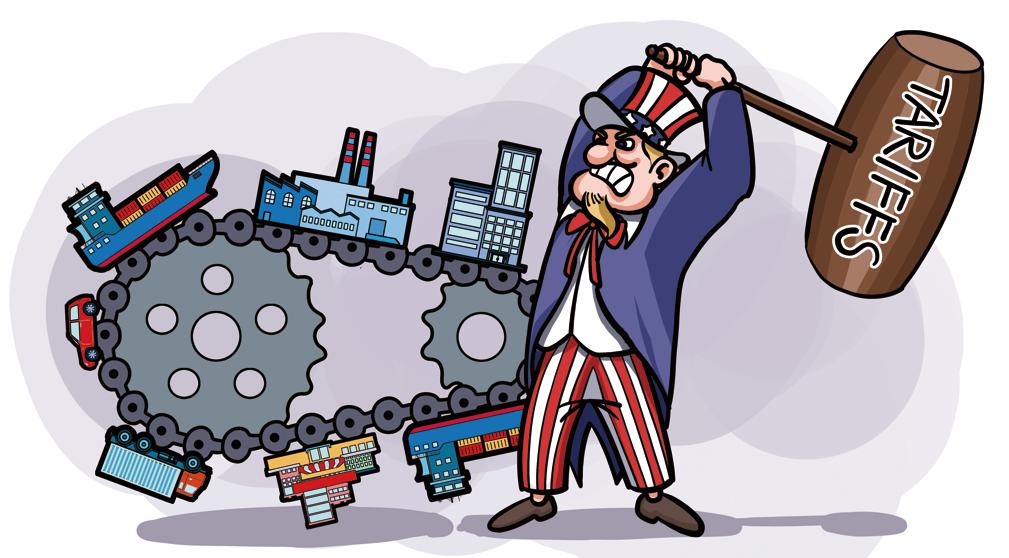
With its misguided tariff wars, the United States administration is not only fragmenting seven decades of globalization. It is also contributing to a geopolitical climate reminiscent of the tensions that preceded the rise of fascism in the 1930s.
Times are different today, as globalization is no longer at a crossroad. It is unraveling. And yet the White House has chosen an ominous path with a dark historical precedent.
After the "Roaring Twenties", the US economy drifted into the Great Depression. Presumably to protect American jobs and farmers, two Republicans, Reed Smoot and Willis C. Hawley, pushed for a major tariff increase. This led to the enactment of the Smoot-Hawley Tariff Act despite opposition by more than 1,000 leading US economists.
The ensuing tariffs were the second highest in US history. But instead of protecting American jobs and boosting the US economy, the effect of the act turned out to be precisely the opposite. Following the retaliatory tariffs of the US' major trading partners, it reduced US exports and imports by more than half during the Great Depression. On the other hand, in Germany, international friction paved the way for the rise of the Nazi party.
The US economy recovered only with the war efforts serving as a huge fiscal stimulus.
The Smoot-Hawley Tariff Act of 1930 was a grossly misguided response to the economic crash. What it gained in the short term, it lost in the long term. It resulted in neither the US' stability nor prosperity. Instead, it contributed to instability and worsened the economic malaise.
In short, the act worsened the Great Depression, compounding the chaotic global status quo that prolonged the lingering economic contraction, thus setting the stage for World War II.
The first round of tariffs of the incumbent US administration, built on traditional trade wars, focused mainly on Canada, Mexico and China. The tariffs will affect $1.4 trillion worth of goods, that is, about 3.5 times that of the goods affected during the 2017-18 tariffs.
The second round began with the White House's "reciprocal tariffs". It is an odd, Orwellian term for tariffs which are not multilateral. Conceptually, the US administration's tariffs are rather unilateral, flawed and wrongly calculated, that is, coercive, illicit and miscalculated.
Subsequently, the White House claimed that "every country in the world wants to make a deal with America". But that did not happen. Instead, the reciprocal tariffs were followed by a series of retaliations, which heralded the ongoing third round of tariff wars.
Nonetheless, under the US' tariff attacks, many economies have been compelled to make deals with Washington. In the short term, they may contribute tens of billions of dollars to the US economy. But in the long run, such intimidation tactics will cost the US economy hundreds of billions of dollars, fragment globalization, and erode the rules-based international trading regime.
Global economic prospects have been fragile since 2008. A decade later, in 2018, the then US administration's tariffs and deglobalization measures undermined a promising global economic recovery, with the US imposing punitive tariffs on nearly $400 billion worth of Chinese goods, which affected more than 90 percent of bilateral trade.
Instead of building a multilateral front against trade protectionism, Western powers sought to appease the first Donald Trump term, which emboldened US trade czars and contributed to the Joe Biden administration's fatal decision not to reverse his predecessor's decisions on tariffs.
Devoid of any meaningful economic rationale, the tariffs are set to erode what is left of the New Deal and the dream of "Great Society" of former US presidents Franklin D. Roosevelt and Lyndon B. Johnson respectively. Perversely, the new focus is on massive rearmament, a new Cold War, and destructive geopolitics, including US complicity in the humanitarian crisis in the Gaza Strip.
Once the tariffs' full impact is felt, global economic prospects will suffer more shocks. Worse, the White House is doing its best to obfuscate the destructive impact of its tariff strategy by firing federal economists dedicated to monitoring economic data, in order to replace them with ultra-conservative ideologues and data manipulators.
The result is a darkening economic picture which could lead to a "big correction" in the US market, as America's big investment banks are now warning their clients of.
Globalization fosters the flows of trade, investment and people. From 1950 to 2008, it promoted integration among economies, thanks to technological progress, reduced transport costs and off-shoring of value activities across countries. Also, it facilitated the rise of two Asian economic powers, China and India, and more broadly the Global South.
Conversely, deglobalization disrupts, if not altogether stopping, such flows between countries, leading to de-integration and fragmentation. During its first term, the Trump administration made serious deglobalization efforts to overcome the longstanding secular stagnation in the West, compounded by the US' tariff wars.
During Trump's second term, geoeconomic fragmentation efforts have intensified due to "a policy-driven reversal of global economic integration", as the International Monetary Fund put it. It is neither automatic nor inevitable, but a US policy choice, with horrible economic and human consequences. With the resulting trade war contributing to the weakest global growth prospects in decades, deglobalization is feeding into another Cold War, which the world cannot afford.
In the late 2010s, deglobalization translated to slowing growth in the Global South. Today, deglobalization-induced global economic fragmentation is curbing the rise of emerging and developing economies.
The author is founder of Difference Group and has served at the India, China and America Institute (US), Shanghai Institutes for International Studies (China) and the EU Centre (Singapore).
The views don't necessarily reflect those of China Daily.
If you have a specific expertise, or would like to share your thought about our stories, then send us your writings at opinion@chinadaily.com.cn, and comment@chinadaily.com.cn.