German carmakers pivot to China amid tariff impact









BERLIN — Since April, a sharp hike in US tariffs on EU-made vehicles has dealt a heavy blow to Europe's auto industry, causing steep declines in the profits of Germany's biggest carmakers and prompting them to seek opportunities in Asia.
A recent deal between the EU and the United States lowered the tariff rate from 25 percent to 15 percent, easing immediate tensions. But experts warn the reprieve may be short-lived, as high export costs and lingering policy uncertainty continue to weigh on Germany's manufacturing sector and erode industry confidence.
BMW, Mercedes-Benz and Volkswagen — Germany's three largest automakers — all reported steep declines in profits in the first half of 2025, citing US tariffs as a major drag on earnings.
BMW said group revenue fell 8.2 percent year-on-year, while net profit dropped 29 percent. The company pointed to elevated tariffs as a key factor behind weaker margins in its core auto business. Mercedes-Benz saw net income plunge from around 6.1 billion euros ($7.08 billion) a year ago to roughly 2.7 billion euros.
Volkswagen Group reported a marginal 0.3 percent decline in sales revenue. Its premium brand, Porsche, was hit especially hard, incurring around 400 million euros in additional tariff-related costs in the first half alone.
Despite the latest tariff cut, sentiment across the industry remains subdued. Several firms have already revised down their 2025 outlooks. Hildegard Mueller, president of the German Association of the Automotive Industry, or VDA, said the lower rate still leaves carmakers with billions of euros in added costs each year, a heavy burden as they navigate a pivotal transition toward electrification.
According to the VDA, Germany exported around 450,000 vehicles to the United States in 2024. Over the same period, German carmakers produced more than 840,000 vehicles at US facilities, roughly half of which were exported globally. This cross-border production model is especially vulnerable to abrupt policy shifts.
Since early 2024, several automakers and suppliers, including Ford, Stellantis, Volkswagen, ZF and Bosch, have announced layoffs or plant closures in Germany and other European countries.
At the same time, German carmakers continue to trail their US and Chinese rivals in the race to electrification.
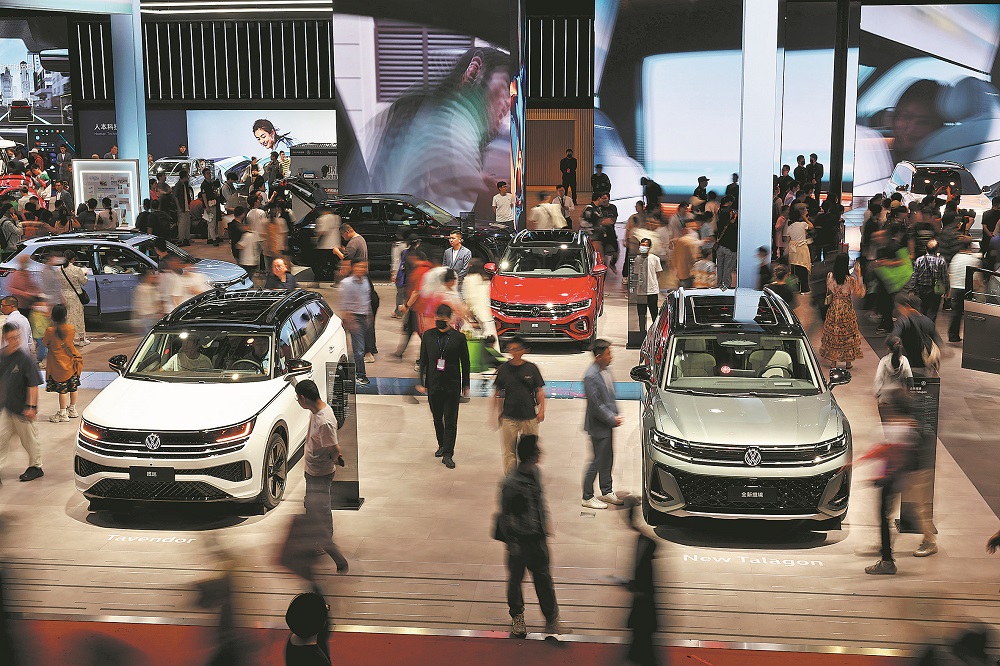
Amid growing uncertainty and shifting trade policies in transatlantic markets, a growing number of German companies are pivoting to China, drawn by its regulatory stability and clearer growth outlook. Through local production, technology partnerships and targeted investment, automakers are seeking to strengthen their position in Asia and accelerate structural transformation.
Arno Antlitz, Volkswagen's chief finance officer and chief operating officer, recently voiced strong confidence in expanding local platforms and battery partnerships in the Chinese market.
BMW also announced a collaboration with Chinese tech firm Momenta to co-develop next-generation driver assistance systems tailored for local consumers.
Joint innovation
"This powerhouse collaboration, with China's wisdom, underpins BMW's strategy of 'In China, for China and co-creation at China speed', taking it to new heights," said Sean Green, president and CEO of BMW Group Region China, while stressing the importance of using complementary strengths and joint innovation to achieve breakthrough progress.
"The future of the auto industry is in China," said Ferdinand Dudenhoeffer, a renowned German automotive expert. He urged expanding cooperation between German and Chinese players across the vehicle and supply chain landscape.
BMW and Porsche offer performance advantages, while Mercedes-Benz leads in design and comfort, and all three are increasingly relying on China's edge in battery technology and scaled production to stay competitive, said Dudenhoeffer.
As the recent US-EU tariff deal creates deep uncertainty for businesses, Michael Schumann, chairman of the German Federal Association for Economic Development and Foreign Trade, warned that the global trading system is under rising strain, with trade increasingly used as a geopolitical tool.
In a fragmented global landscape, China may represent one of the pillars of regulatory stability for international firms, he said.
Xinhua