Artificial intelligence goes to school









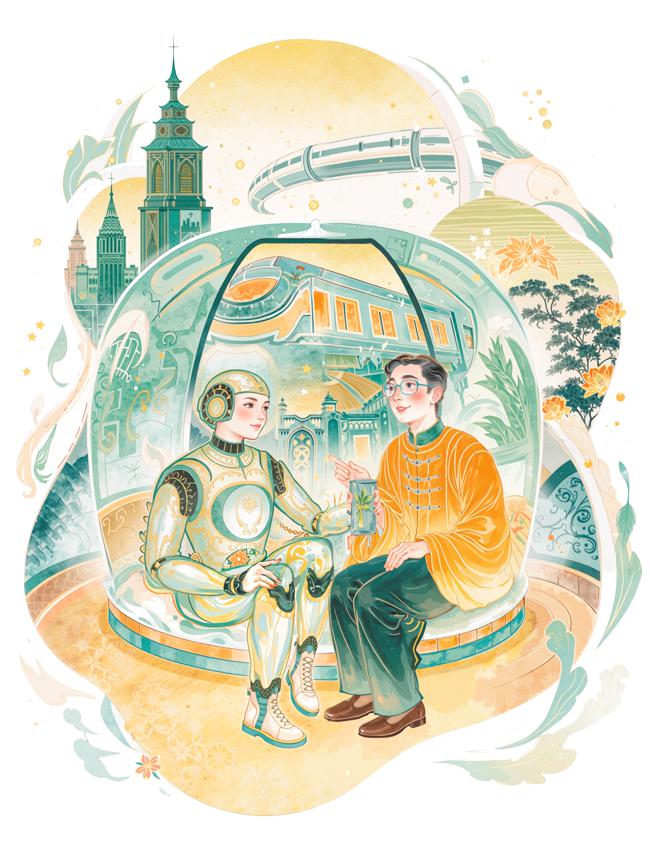
Artificial intelligence is no longer a distant concept from science fiction. It has become a force that can reshape industries, societies, and the very essence of human interaction. Education, the cornerstone of social progress, is increasingly becoming intertwined with AI. The way countries equip the next generation with AI skills could determine their technological edge in the future. In this area, China is quietly taking the lead.
While Western countries, especially the United States, have grabbed headlines for AI breakthroughs, their approach to K-12 (kindergarten through 12th grade) AI education is cautious, fragmented and largely pilot-driven. China's approach, in contrast, is a methodical, policy-driven blueprint, that lays a solid foundation for AI literacy from primary school level upward. Across the country, AI-themed summer camps and integrated curriculums are emerging, forming a burgeoning AI education ecosystem which, beyond coding, is nurturing broader cognitive skills and ethical reasoning.
China's rapid progress in AI education is no accident; it is the result of careful top-level planning, and coordinated action. National and local authorities have worked together to ensure that AI education is not just a novelty, but a structured part of students' learning journey. Schools across China now include AI courses as a regular part of the curriculum; teachers receive special training in AI and digital learning platforms support AI teaching in class. From bustling cities to smaller towns, this nationwide push has created a well-organized framework, ensuring every student gets a chance to learn foundational AI.
However, policy alone is not enough. China has established a collaborative mechanism involving enterprises, universities and research institutions. It integrates leading tech companies in codesigning curriculums, training teachers and building AI learning platforms. iFlytek's AI textbook, co-developed with Northwest Normal University, is now used across the country, reaching schools and students nationwide. This three-tiered approach — central policy, local execution and broad social participation — ensures AI education is not only conceptual but also operational.
China's AI education policy avoids reducing students to code-crunching machines. Instead, it embeds AI across traditional subjects such as the Chinese language, art, and comprehensive practice courses, creating a "discipline integration and technology empowerment" model. In many schools, art classes now incorporate AI image-generation tools, encouraging students to co-create with machines. In other areas, generative AI is integrated into writing courses, prompting students to critique, revise, and re-imagine AI-generated text. AI education is as much about reshaping cognitive and expressive abilities as it is about teaching technical skills.
Competitions further promote applied learning. Contests like the National Olympiad in Informatics and the China Adolescents Science and Technology Innovation Contest now include AI modules, giving students hands-on experience with algorithms and machine thinking. Tsinghua University's Qiuzhen College, for example, offers a youth mathematics and AI summer camp, blending AI fundamentals, Python programming, mathematical modeling and ethical reflection. Such programs create a smooth transition "from classroom knowledge to real-world project practice", moving students from passive understanding to active problem-solving.
China's AI education path contrasts with that of the US. While the US excels in AI research, its K-12 implementation is decentralized and uneven, largely dependent on local initiatives or partnerships with higher education institutions.
Besides, AI education in the US is promoted often through extracurricular clubs, summer camps or online courses. Yes, it is flexible and innovative, but it is also inconsistent in coverage, continuity and scale. Also, heightened concerns over ethics, safety and privacy sometimes restrict classroom usage of generative AI tools, creating a "tech enthusiasm, educational hesitation" paradox.
For China, on the other hand, AI literacy is about developing foundational competency, akin to reading, writing and arithmetic. Students are taught to view AI not only as a set of tools, but also as a digital language and medium for critical thinking, creativity and ethical awareness. In short, China's approach is "institution-driven and universal", aimed at ensuring every child develops core capabilities, while the US' approach is "market-driven and selective", letting individual interests determine engagement. Both paths have merits, but in a rapidly evolving AI landscape, early-structured cultivation of cognitive frameworks may prove decisive when it comes to nurturing the next generation of tech talents.
No system is perfect. For example, some Chinese schools still focus narrowly on tools, with shallow, homogenized curricula. Teachers' expertise varies, and evaluation methods to measure AI literacy levels are not yet fully developed. The bigger challenge is to prevent AI education from becoming a new form of exam-oriented competition.
How can students learn technical skills while cultivating ethical judgment, social responsibility and humanistic sensitivity? Some schools are already exploring AI ethics, algorithmic bias and socially impactful subjects, encouraging reflective thinking alongside technical mastery. To truly become AI literate, one needs to have technical understanding, collaborative capability and value-based judgment — a human-centered rather than purely technocratic approach.
China's push to integrate AI into foundational education echoes Deng Xiaoping's statement in 1984 in which he emphasized that "computer literacy should start with children". From top-level design to local execution, from curriculum reform to competitions, and from technical training to ethical literacy, China's AI education path is structural and gradual — a "slow-cooked" approach that builds deep roots rather than chasing short-term headlines.
In the era of global restructuring of education and rapid digital transformation, China is first reconstructing its young citizens' cognitive abilities and problem-solving skills in order to gain a decisive advantage. In this high-stakes race for talent, China has quietly moved ahead.
The author is professor at Faculty of Education, East China Normal University. The views don't necessarily represent those of China Daily.
If you have a specific expertise, or would like to share your thought about our stories, then send us your writings at opinion@chinadaily.com.cn, and comment@chinadaily.com.cn.