AI system helps doctors diagnose patients in community healthcare centers









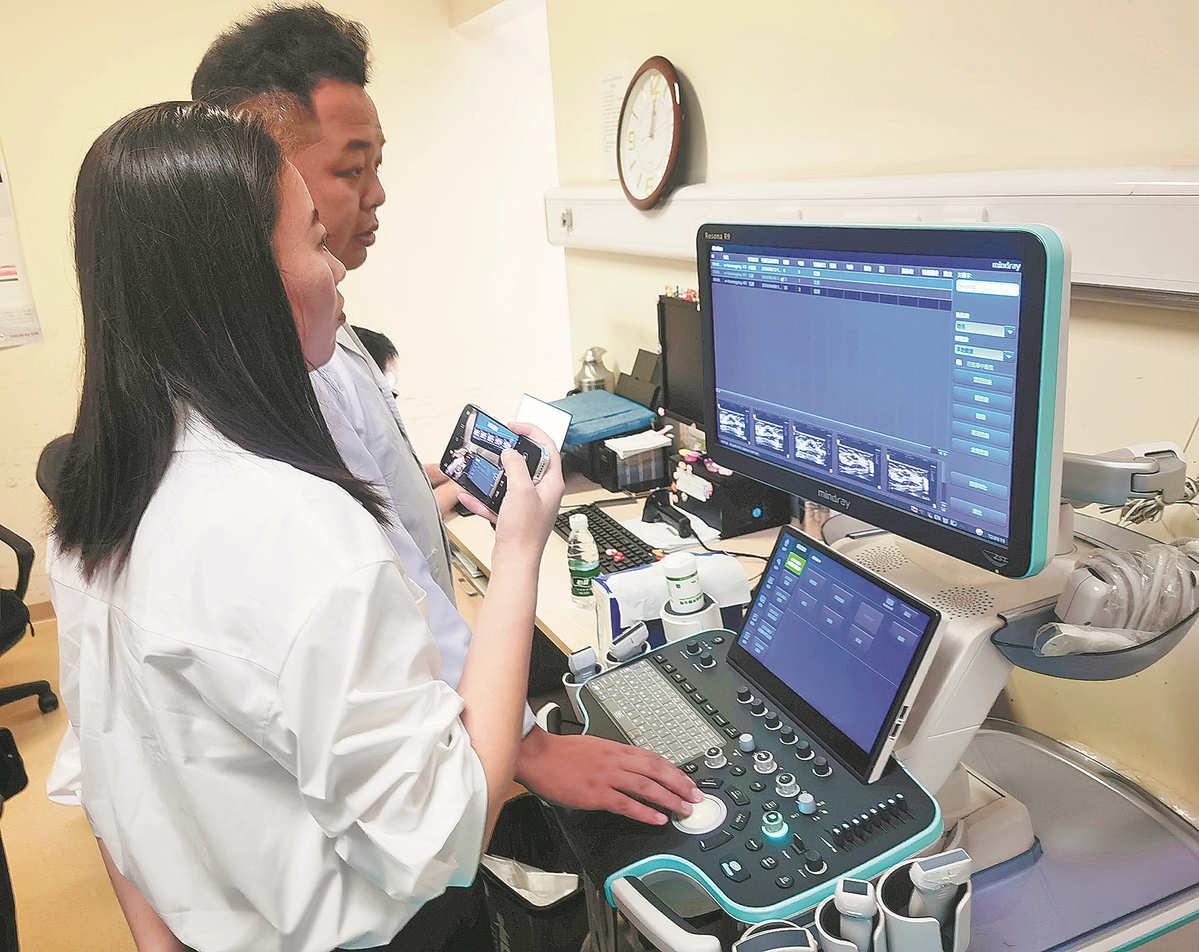
In the ultrasound room of a community hospital in Tianjin's Binhai New Area, suspicious lesions identified by artificial intelligence are highlighted on a monitor with bright orange boxes.
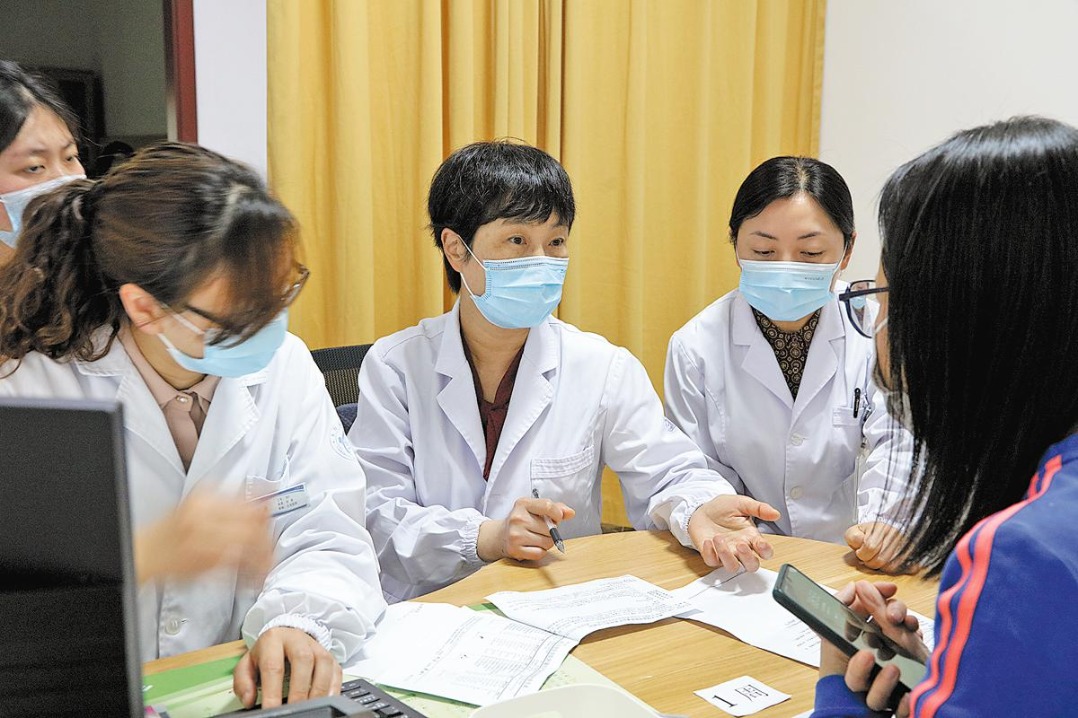
Connected remotely to the system, a chief physician from a toptier hospital provides real-time guidance and diagnostic opinions.
This Smart Ultrasound Remote Consultation System was implemented in community hospitals in Tianjin last year.
The system was developed by the Institute for Electronics and Information Technology in Tianjin, Tsinghua University and its incubated company, TasiTech.
The system not only improves diagnostic accuracy through remote consultation and eliminates the need for patients to travel back and forth to large hospitals, but also offers real-time AI diagnostic assistance, remote training, ultrasound learning and examination.
"Ultrasound diagnosis has long faced problems of missed diagnoses and misdiagnoses at the grassroots level. On the one hand, image quality is limited by technical conditions. On the other hand, grassroots doctors may not see more than one or two positive cases a year, lacking opportunities to accumulate experience," said Tong Guotong, project director at TasiTech.
"We hope to leverage Tsinghua University's AI technology to transfer the diagnostic experience of senior doctors from top-tier hospitals online to the grassroots level and further address the practical issues faced by grassroots medical care," he added.
Tong cited two examples when discussing feedback on the application of the smart ultrasound remote consultation system.
A chief physician at a community healthcare center in Binhai said that remote communication saved time and was "extremely convenient" after using the system.
Another example involved a patient at a community clinic who used a green channel to directly access a higher-level hospital, resolving the issue of "difficulty in registering for an appointment".
TasiTech has recently launched a fast-track referral service, enabling patients in need at the grassroots level to directly connect with Tianjin Fifth Central Hospital and receive timely treatment.
These front-line changes would not be possible without stable technical support and conversion mechanisms.
"We have established a closed-loop mechanism covering scientific research, verification, product development and industrialization," said Wang Pengfei, vice-president of the Institute for Electronics and Information Technology in Tianjin.
The institute was jointly established by Tsinghua University, Binhai New Area of Tianjin, and the Sino-Singapore Tianjin Eco-City.
Focused on the commercialization of scientific and technological achievements in the field of electronics and information technology, it has incubated and attracted 152 companies in Tianjin.
To create an environment conducive to the commercialization of research outcomes, all levels of government in Tianjin, particularly Binhai New Area and the Eco-City, provided the institute with free office space and apartments, and supported it in terms of funding, policies and business connections.
In recent years, China has continued to promote the deep integration of industry, academia and research, encouraging universities and research institutions to work with enterprises to advance the engineering and large-scale application of technologies.
Emphasis has been placed on establishing a smooth transition from scientific research to industrialization, promoting the deep integration of the innovation and industrial chains, and accelerating the development of new quality productive forces through the transformation of scientific and technological achievements, Wang said.
"In the past, we tended to convert whatever results we had," he said. "Now, we place greater emphasis on cultivating and converting whatever the market needs, with a focus on major national needs, local development priorities, and emerging fields."
Road revolution
In recent years, in the field of intelligent transportation and autonomous driving, the country has promoted a "vehicle-road-cloud" integration development strategy, marrying up intelligent connected vehicles with transportation infrastructure and cloud platforms.
Against this backdrop, another enterprise incubated by the research institute, Tianjin JHBF Optoelectronics Co, or Janhoo, has converted its research into applicable products.
Two years ago, it undertook the task of constructing the National No 1 Expressway Vehicle-Road Collaboration Pilot Demonstration Zone, deploying its independently developed fiber optic radar on a 10-kilometer pilot section of road.
This radar works in conjunction with lidar, millimeter-wave radar, and other equipment to form a roadside perception system covering the entire section of road. On this pilot section of road, fiber optics buried on both sides records the passage of every vehicle in real time.
Every time a wheel touches the road surface, it triggers a slight change in the optical signal, which is analyzed and processed by an optoelectronic integrated microsystem and converted into vehicle location information and operating status, enabling real-time traffic monitoring along the entire section of road.
"Due to monitoring distance limitations, if you want to monitor the entire road section with cameras alone, you need to install one every few hundred meters," said Chen Shuai, deputy general manager of Janhoo.
"But if you combine this technology, you only need to install cameras at the beginning and end of a road section to monitor the entire road section. This not only reduces construction costs, but also improves the coverage and accuracy of monitoring, providing stable data support for smart transportation and autonomous driving," he said.
Wang said that the institute intends to focus on semiconductors, computing power, healthcare-engineering convergence, the low-altitude economy and the marine economy.
Liu Zixuan contributed to this story.




- AI system helps doctors diagnose patients in community healthcare centers
- Tianjin data center's steel will to save energy
- Beef production hits its prime on grasslands
- Dugong spotted in waters near Nansha Islands
- Organic agriculture forum unites global experts in Datong
- Guangdong and Macao launch cross-border medical transfer services