China backs Africa's path to progress
Human rights must be linked to growth, dignity, not interference, seminar hears









When Antoine Roger Lokongo returned to the Democratic Republic of Congo after nearly 20 years in Europe and China, he brought back not only academic credentials but also a conviction that Africa could learn from China's resilience in advancing human rights through development.
"My journey has been shaped by two worlds," said Lokongo, director of the department of international relations at Joseph Kasa-Vubu University in DR Congo.
After spending 18 years in England, he moved to China to pursue a doctorate at Peking University. There, he first studied the Chinese language, completed his research and graduated in 2015 before heading home with a determination to contribute to his country's growth.
Speaking at the first China-Africa Human Rights Seminar in Addis Ababa, Ethiopia, late last month, Lokongo reflected on the contradictions of history. He recalled how former United States president Joe Biden once visited an Angolan museum, where Africans were baptized before being forced onto slave ships.
"Baptism means liberation, yet those newly baptized were put into bondage," he said. "That contradiction is symbolic of today, where Western powers preach human rights while perpetuating new forms of control."
For Lokongo, the memory of that contradiction — liberation preached, yet bondage imposed — illustrates why many Africans remain skeptical of Western narratives on human rights.
By contrast, he said, China presents Africa with a different model. "China has never colonized any African country," he said. "It offers partnership grounded in solidarity, experience-sharing and win-win cooperation."
Lokongo was among dozens of African voices gathered for the seminar, where officials and experts discussed how the continent could redefine human rights in ways that reflect its own priorities. For them, the debate was not about whether Africa needs human rights — but how human rights are achieved.
Crispin Kugiza Kaheru, a member of the Uganda Human Rights Commission, said Africa had long been subjected to one-sided interpretations.
"For too many years, human rights have been weaponized," he said. "They've been used to justify sanctions, embargoes and interference in sovereign matters."
Kaheru said China offered a different lens, one that ties rights to dignity through development.
"You can talk about modernization and still keep your identity, your culture, your norms. You don't have to import cultures to thrive," he said. He praised China's people-centered approach, which emphasizes subsistence and livelihoods rather than abstract ideals.
This was echoed by Mohamed El Hacen Lebatt, former foreign minister of Mauritania, who said Africa's most urgent rights are tied to daily needs, development, food, healthcare, education and access to technology. "The right to development is the human right Africa cannot ignore," he said.
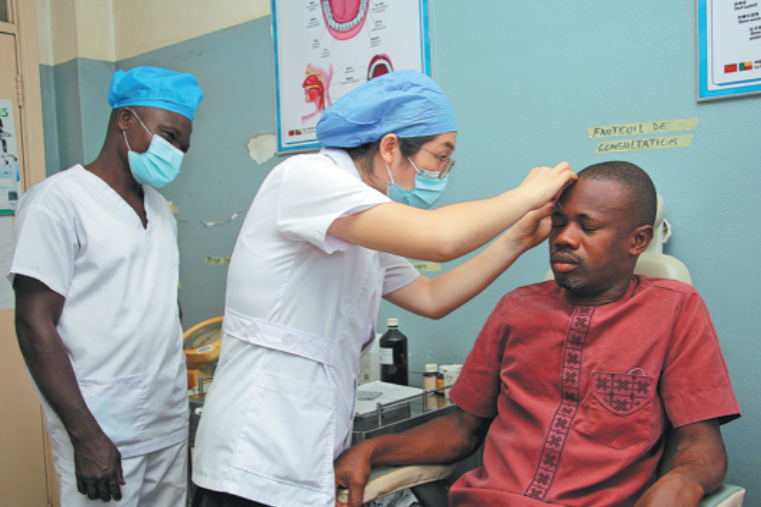
While comparing partners, he pointed to China's record of development, for instance, building of airports, hospitals and universities across the continent. "We compare the deeds, and China has delivered. While Africa remains open to all partnerships, China is the most helpful, most decisive and most efficient in supporting Africa."
History, several speakers said, continues to shape today's choices. Boniface Lezona, deputy director of the National Human Rights Commission of the Republic of Congo, said China, like Africa, had endured colonization and emerged stronger.
"With China, we are trying to share the same destiny on the right of development," he said. "We take China as a leader because we have a common history and we want to share our common future together."
Mutual respect
Fredrick Mutesa, secretary-general of the Zambia-China Friendship Association, warned of a "heightened campaign to discredit and undermine" China-Africa ties by Western governments. Yet, he said, China's engagement through infrastructure, mining and green development is "unlocking the potential of the African continent", giving it a rare chance to renegotiate its place in the international order on the basis of mutual respect and noninterference.
"The right to development is the most critical human right for Africa today, and China is at the forefront of helping us realize it," Mutesa said.
Jeddi Mowbray Armah, deputy minister for legal affairs at Liberia's Foreign Ministry, said China's human rights philosophy is rooted in practicality. He dismissed claims that China's engagement is political activism, calling it "a strategic partner" whose contributions are visible in development, education, food security and aid.
Armah also drew attention to the cultural dimension of rights. "Universality is not uniformity. Western definitions often come with impositions, but China's approach recognizes cultural diversity in how human rights are realized," he said.
"China believes that once development is taken care of, then human rights can be met. For the West, human rights are more about ideals and definitions. For China, it is about helping people meet their daily needs."
The discussions highlighted that Africa's engagement with China extends beyond trade and infrastructure. It is also about redefining human rights through a lens that ties dignity to development.
A consensus of the seminar affirmed that development is essential to improving the well-being of the people and advancing human dignity.