Beijing launches AI curriculum to empower students









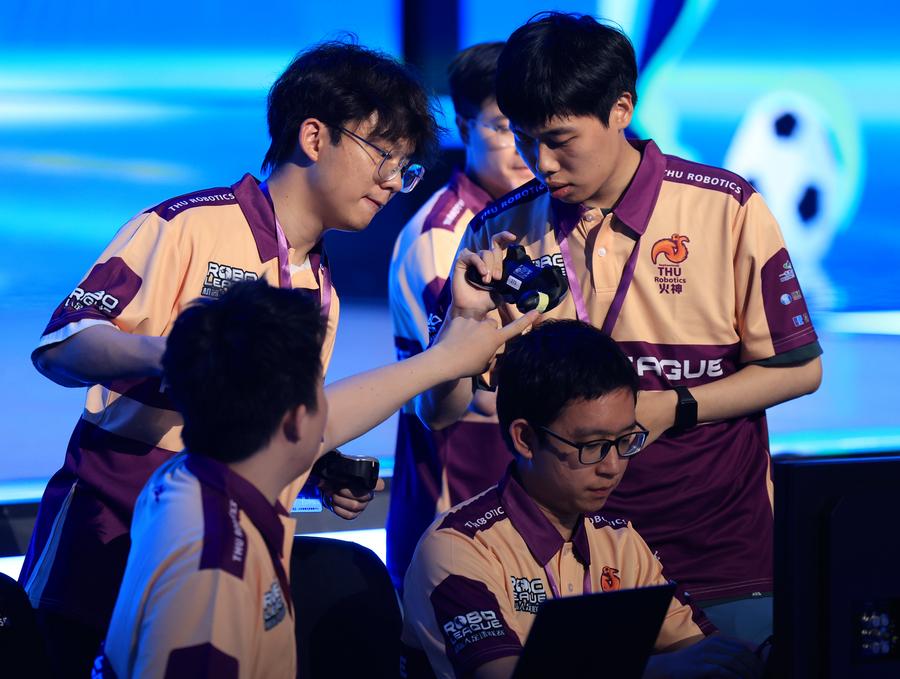
BEIJING -- At Beijing National Day School's First Branch, sixth-graders in an artificial intelligence (AI) class are learning to code, as they build their own intelligent agents with the enthusiasm of budding engineers.
Given the task of understanding the applied logic of AI and its real-world applications, the students, guided by their teacher, created an AI agent capable of conversing with Qian Xuesen, the pioneer of China's space program. "It makes my thinking more dynamic and creative," said Sun Yufeng, a student.
This inspiring scene reflects a broader shift unfolding across Beijing, where, starting this semester, AI courses have been added to general education in over 1,400 primary and secondary schools, marking a comprehensive effort to boost students' AI literacy.
These schools will provide at least eight AI classes per academic year, guiding students from understanding the basics of AI to using it responsibly and eventually applying it in innovative ways. The courses are designed to nurture creativity and strengthen problem-solving skills through practical projects, as reported by state broadcaster CCTV.
The move aligns with China's broader nationwide efforts to accelerate AI adoption across industries.
Earlier in August, the State Council released a policy document on advancing the "AI+" initiative, setting out China's AI development strategy for the next decade.
The policy calls for integrating AI into all aspects of education, innovating human-AI collaborative teaching models, and shifting education's focus from knowledge transfer to competency cultivation.
While improving children's AI literacy, equal emphasis should be placed on developing scenarios that allow them to explore, perceive, and apply AI, said Wang Pan, deputy director of the Beijing Municipal Education Commission.
Many schools in Beijing have adopted context-specific approaches to cultivate students' AI literacy in a focused and effective manner.
For instance, Beijing Hongzhi Middle School has organized its AI curriculum into three tiers. "The first tier consists of activities including corporate visits, interdisciplinary projects, and events like math and science festivals, with the primary goal of introducing students to AI. The second tier comprises courses that deeply integrate AI with academic subjects and industries. The third tier offers advanced courses tailored for students with particular strengths and interests," explained Peng Min, a school official.
Some schools are also exploring collaborations with enterprises to enhance AI education.
A branch of Beijing No 2 Middle School, based in the Beijing Economic-Technological Development Area, has partnered with local high-tech firms, enabling students to directly experience the latest AI technologies, including robots and simulated autonomous driving systems.
School teachers collaborate with corporate engineers to develop curriculum and teach AI courses.
"We maintain close collaboration with tech developers and also invite high-tech professionals and senior engineers from leading industries to instruct our students," said Niu Xiaohua, head of the school branch.
While AI offers opportunities for educational innovation, it also poses new challenges. Educators have expressed concerns that excessive reliance on AI may lead to intellectual dependency among students.
In response, the Ministry of Education released guidelines in May on AI education for primary and secondary schools. The guidelines stressed the need to prevent excessive reliance on technology, banning the direct submission of AI-generated work for assignments or exam answers, and preventing AI misuse in creative assignments.
Experts say AI education remains in its early experimental phase. There is a need for stronger top-level planning to ensure scientifically designed curricula, while helping students to develop a balanced understanding of AI and use it appropriately to enhance both their learning and daily lives.

- Beijing launches AI curriculum to empower students
- 2025 Policy Address accelerates HKSAR's advancement from stability to prosperity, various sectors say
- China shares decades of anti-desertification experience at intl forum
- China deepens, expands intl sci-tech cooperation: minister
- 6 dead, 3 injured in road accident in Northwest China's Gansu
- China, Australia vow to strengthen trade connections