Retiree's photos protect endangered species









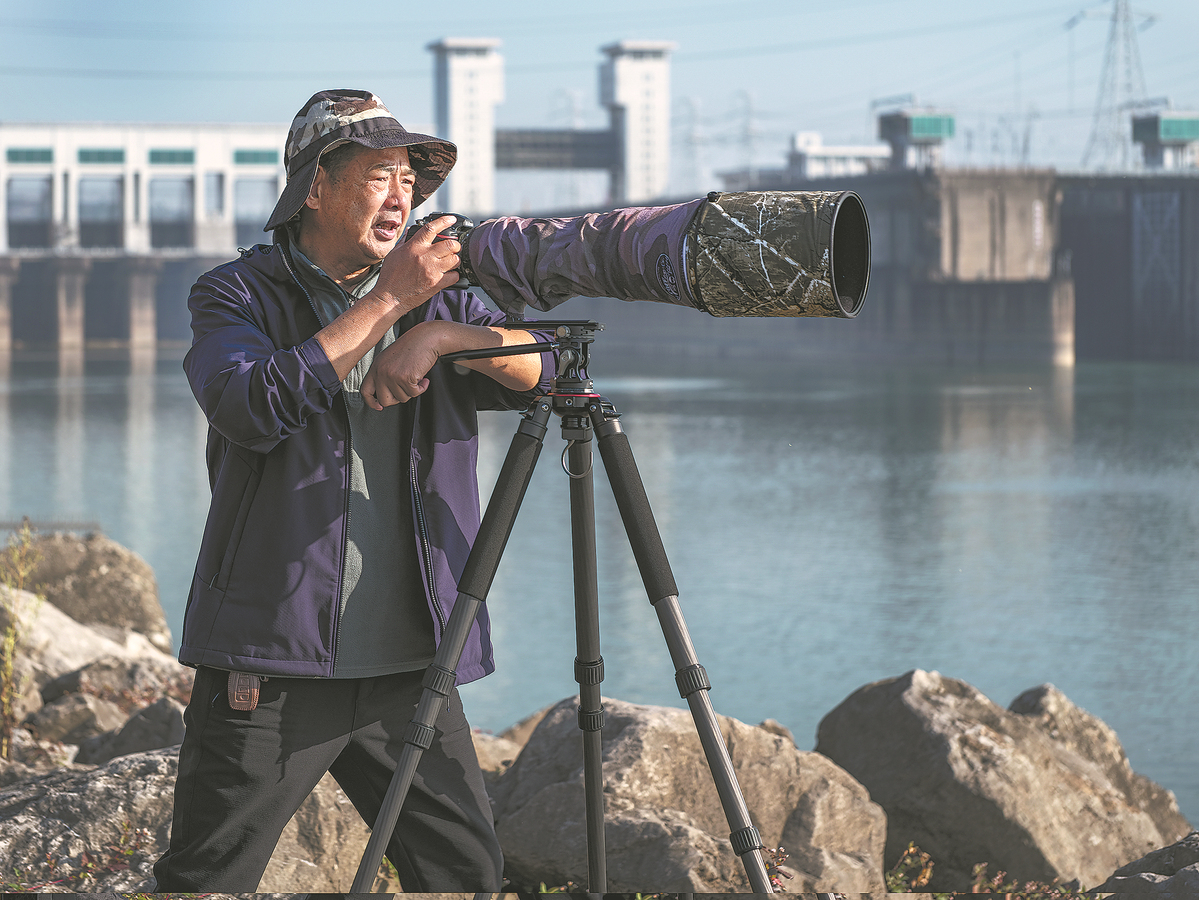
When Yang He was a child, the Yangtze finless porpoise was a common sight in the Yichang section of the Yangtze River. "Adults would scare us away from the river by saying that the 'jiangzhuzi' (the local term for the Yangtze finless porpoise) would push us into deep waters," recalls the 67-year-old Hubei native. But the spread of economic development and human activities have changed that. The population of the Yangtze finless porpoise has dwindled so much in the past 60 years that the apex predator of the Yangtze River ecosystem is now under first-level State protection.
Born and raised along the Yangtze River, Yang has devoted himself to the conservation of the Yangtze finless porpoise, using his camera to document their lives and facilitate research and study. In the past six years, Yang has taken more than 100,000 photos of finless porpoises, all of which have been provided for free use in scientific research. "Many of the photos Yang He took are of significant scientific value," said Wang Ding, secretary-general of the Chinese National Committee for the Man and the Biosphere Programme, UNESCO.
Interestingly, Yang took up photography only after retirement. In 2017, he saw a Yangtze finless porpoise swimming along with a person in the Yangtze River. For Yang, it illustrated the perfect harmony between humanity and nature. Inspired by the scene, Yang took up professional photography and embarked on a journey to capture images of finless porpoises. In the past seven years, he has upgraded his equipment without caring about how much it cost.
Even so, Yang doesn't want to be labeled a "photographer". Instead, he prefers the title "grassroots guardian" because he finds immense happiness and fulfillment in observing, protecting and rescuing finless porpoises.
Three years ago, when he was out photographing on the Yangtze River, he saw a Yangtze finless porpoise thrashing violently in the water. Its tail had gotten entangled in an abandoned string. Porpoises are mammals and must surface regularly to breathe. If trapped in a net, the animal faces the risk of physical injuries, sinking due to exhaustion and even death by suffocation.
Realizing the urgency, Yang immediately called the local fishery administration for help. A rescue team reached the site within 15 minutes, and the local maritime authority issued an emergency halt order to all vessels in the area to facilitate the rescue operation. Thanks to the rapid response, the Yangtze finless porpoise was saved, and experts confirmed it was healthy enough to be released back into the river.
Even though it was confirmed that the rescued porpoise was safe, Yang wanted to see for himself. He visited the area almost every day, looking for signs of the animal, and eventually identified it by the distinctive scars on its tail.
"It must have recognized me too, because though finless porpoises are very alert animals, this one allowed me to photograph it from a very close distance," he said. Two months later, Yang realized that he had saved not one but two porpoises on that fateful day. When it had been rescued, the Yangtze finless porpoise was pregnant and Yang photographed it with a calf two months later.
Wang Ding, who is also a researcher at the Institute of Hydrobiology of the Chinese Academy of Sciences, emphasized the challenges of individual identification in wildlife conservation. He said traditional observation methods often fail to reliably distinguish animals in the field. "However," he added, "practitioners like Yang He leverage their hands-on experience to overcome these limitations."
Yang said that thanks to the conservation efforts of patrol teams, scientists and volunteers, he has observed a noticeable improvement in the water quality and a significant increase in the population of the Yangtze finless porpoise. According to him, with the full implementation of the Yangtze River's 10-year fishing ban, the Yichang section of the Yangtze River has become "a nursery", with groups of finless porpoises coming for fertility preparation and childbirth. "Every citizen in Yichang is proud of the Yangtze finless porpoise conservation achievements, with the concept of comprehensive protection of the Yangtze River taking root," Yang said.
limenghan@chinadaily.com.cn





- Retiree's photos protect endangered species
- Vibrant China during holiday: Rural charms cast their magic
- Strong typhoon triggers safety measures in south
- 5 dead after entering abandoned mine in East China
- Andersson seizes victory in Shanghai F1H2O showdown
- Red alert as Typhoon Matmo makes landfall in South China