US doctor's legacy remembered after 80 yrs
US missionary doctor's courage in war against Japanese aggression hailed, her ties to ordinary Chinese revisited









Narrator and painter
Ruth developed her habit of documenting what she saw, heard, felt and thought in China through vivid writings and colorful paintings.
She left a series of papers that consist of a small amount of printed biographical material, an oil painting, photographs, and 20 original diaries dated from 1924 to 1941, which are now preserved by Smith College in Northampton of Massachusetts.
The diaries provide a detailed record of her 18 years as medical missionary to China and include photographs and drawings, and they describe medical and surgical cases, customs and rural culture, and the upheavals in the country.
"They are rich with poignant and perceptive pictures of Chinese village life in southeastern China, of modernized urban life in the Kuomintang-controlled Yangtze Valley on the eve of the (expanded) Japanese invasion of 1937, and the besieged wartime capital of Chunking in western China," said the Smith College website in a brief introduction.
In 1937, Ruth traveled to Wuhan, the capital of Hubei province, en route to Chongqing. In Wuhan, she witnessed a tragedy brought by Japan's air raid.
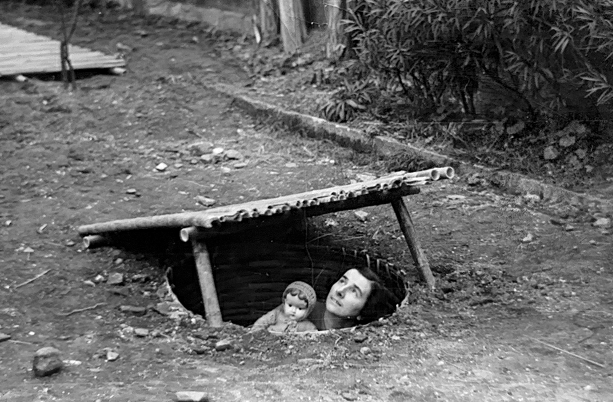
At that moment, she could only watch from afar behind sandbags in shelters. In her diary, she noted that the air raid claimed 200 lives.
Among the atrocities committed by Japanese forces after occupying Wuhan was that when the Japanese seized Hankou in Wuhan, they bombed ships carrying refugees and led to huge casualties.
She mentioned how a refugee train packed with women and children was bombed — as passengers fled the burning carriages, Japanese troops shot them down with machine guns.
Also evident in her narrations were scenes that the Japanese troops soaked captive Chinese soldiers and farmers with diesel or petroleum and burned them alive, while children were brutally slaughtered and young women raped.
From February 1938 to December 1944, the Japanese invaders bombed Chongqing and its surrounding cities for a span of six years and 10 months, an event known as the "Chongqing Bombing".
Her diary recounts one bombing during which she was on the phone inviting friends to dinner. Suddenly, air raid sirens blared, and the entire city plunged into terror and chaos: rickshaws dashed wildly through the streets, and people carrying children fled in tears.
In her later years, she put down these memories into watercolor paintings depicting Chongqing under bombardment, portraying the burning streets and weeping refugees.
Ruth indexed her diaries, and excerpts of her diaries were edited by Fred W. Drake in the book Ruth V.Hemenway, M.D.: A Memoir of Revolutionary China, 1924-1941, published by The University of Massachusetts Press in 1977.
John K. Fairbank, a renowned scholar on China studies and former professor of history at Harvard University, said "the memoir of Ruth Hemenway may well be a classic".
"She writes with extreme immediacy and creates a visual and personal impression in almost every paragraph. The content of her experience is both medical and Chinese, and the combination is a constant excitement if not shock to the reader," Fairbank said in a message prepared for the publication of her book.
"This particular story has more vitality, action and color than almost any I can remember," he added.
After Ruth returned to the US in 1941, she established a medical practice in her hometown of Williamsburg.
In 1974, just months before her death, she wrote about her thoughts on the future of the US and China.
"Yet even as a person must experience hardship, suffering, and bereavement to attain maturity, it may be that our own country, like China already, must be bathed in tears and blood in order to find itself in its rightful place of simple equality among the nations of the world."
"For it is through pain and heartbreak that humility is born; and it is from humility that wisdom and understanding come. Physical deprivation, hardship, bereavement — these may not be evils but blessings if they initiate constructive change," she added.
Yang Jie contributed to this story.
Contact the writers at zhangyunbi@chinadaily.com.cn