China's automakers drive Ecuador's transition toward electric mobility










As Chinese automakers move up the value chain and gain market share in Latin America, Ecuador, a small country of 18 million people, finds "Made in China" vehicles dominating streets and showrooms alike.
For many Ecuadorians, affordability and parts availability are key reasons to buy Chinese brands.
Taxi and Uber driver Alberto Sancho, 60, said he bought his Chinese-made car last year on advice from a friend.
"For this work, it's fine. I saved about $5,000 compared with other cars," Sancho said. "It runs very well."
Pablo Ramirez, who owns an autoparts shop in downtown Quito, said that the availability of spare parts can still vary even as more Chinese vehicles are visible on the streets.
"Sometimes many spares arrive, then after a while there aren't as many," Ramirez said. There aren't many workshops exclusive to Chinese brands, but clearly, there are more working on them now.
Juan Carlos Sanchez, who works for a car dealership after running his own auto shop, said a push to assemble Chinese cars locally has gone a long way toward lowering costs and improving the availability of replacement parts.
"One of the most important points is that spare parts for several Chinese vehicles are available in Ecuador, and some (vehicles) are assembled here," Sanchez said. "People's interest in buying affordable, good-looking cars has grown. The good thing is that China's automotive industry keeps improving year after year."
Sanchez said some of the country's bestselling models include the Chery Arrizo 5 sedan, affectionately called "Chinese rice" for its popularity and simplicity. Other popular cars include the South Korean Kia Soluto sedan, often used as a taxi, and the Chevrolet Groove SUV, originally a Chinese Baojun model rebadged under Chevrolet, which is now Ecuador's top-selling SUV.
Fastest-growing market
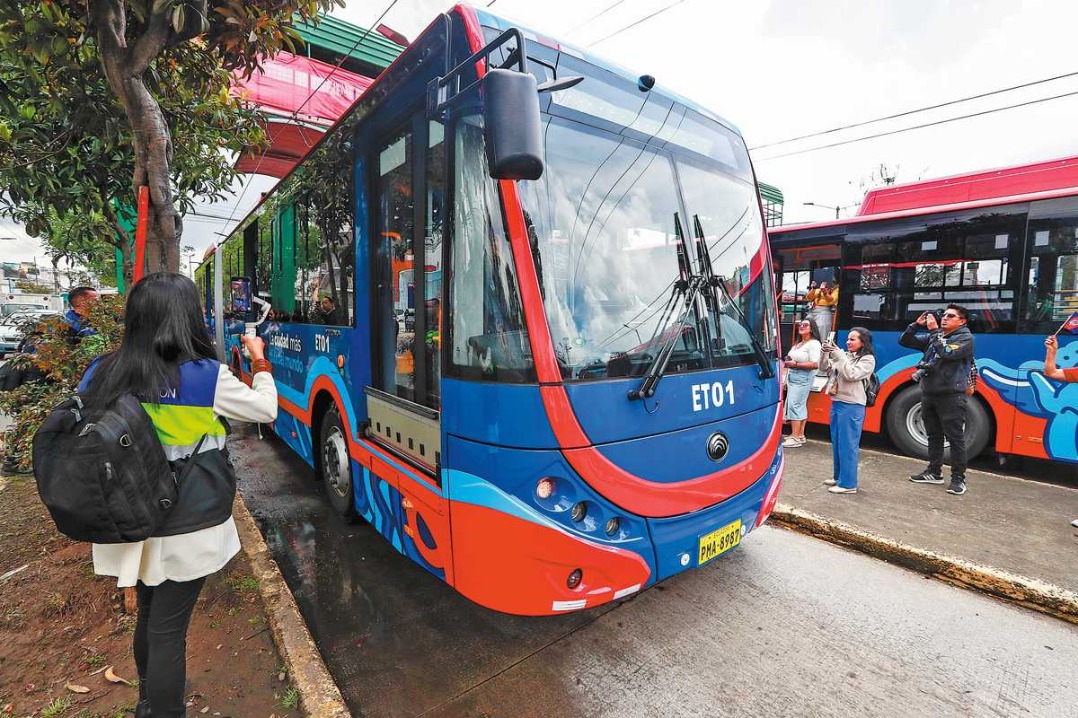
At this year's Automundo auto fair in Quito in late September, Chinese brands outnumbered all others, unveiling new generations of hybrid and electric models that are transforming one of the region's fastest-growing car markets.
Among the 200 models on display at the fair, about 75 were hybrids or electric vehicles. From January through August 2025, 11,210 hybrid cars were sold in the country, up 27.4 percent year-on-year, along with 2,234 fully electric vehicles, a 159 percent increase, according to the Association of Automotive Companies of Ecuador.
Chinese brand BYD leads EV sales with models such as the Yuan Pro, Seagull, Yuan Plus and Tang. Altogether, Chinese brands now account for nearly 40 percent of Ecuador's market, while all vehicles made in China, for Chinese brands or others, exceed 45 percent of total sales.
The rise of Chinese automakers comes amid a regional push for greener transport. The Latin American Energy Organization reported that the region's light electric vehicle fleet nearly tripled in 2024, driven by climate goals, lower costs and growing consumer awareness. Still, the International Council on Clean Transportation noted that Latin American countries face hurdles such as limited charging infrastructure and a lack of direct incentives for EV buyers.
In Ecuador, policy shifts have helped. A free-trade agreement with China that took effect in May 2024 eliminated tariffs on electric vehicles, batteries and chargers.
Ecuador's experience is part of a broader transformation underway across Latin America, where Chinese automakers are moving from niche players to market leaders thanks to a combination of competitive pricing and continuous improvements in quality and technology.
From Mexico to Argentina, Chinese brands such as BYD, Chery and Great Wall are gaining traction as governments push policies aimed at cutting emissions and modernizing fleets. In Brazil and Chile, local authorities have endorsed electric mobility targets and pilot programs to electrify public transport, creating opportunities for Chinese firms that already lead in EV production and battery technology. Colombia and Costa Rica have adopted national EV strategies and tax incentives.
The writer is a freelance journalist for China Daily.