Climate 'tipping points' to be crossed









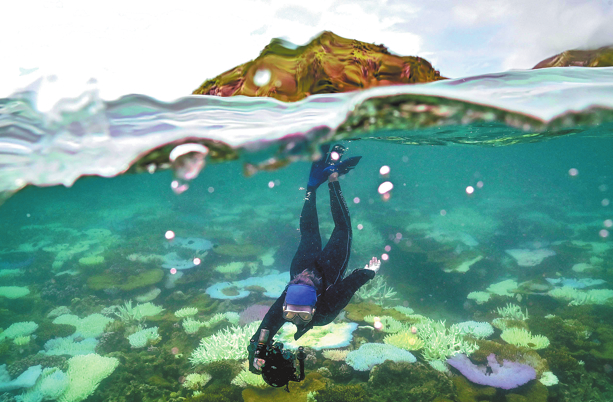
A new report including contributions from 87 institutions in 23 countries has highlighted coral reef damage as proof that the world has reached its first catastrophic tipping point, attributable to greenhouse gases.
"Sadly, we're now almost certain that we crossed one of those tipping points for warm water or tropical coral reefs," report lead Tim Lenton, a climate and Earth system scientist at the University of Exeter, said.
Tipping points are stages reached when it is generally agreed by experts that an ecosystem has reached a point of inevitable major degradation.
The study, called The Global Tipping Points report, is led by the University of Exeter in England, and says warm sea temperatures have put the long-term survival of the reefs in doubt, with huge consequences for millions of people.
Around one-quarter of marine life lives in coral reefs, which are themselves living things, and are particularly susceptible to the effects of rising sea temperatures, with a major environmental event known as bleaching, which is discoloration caused by the reef's ill health, having been observed over the last two years.
Rather than disappear completely, scientists say reefs will evolve into less diverse ecosystems as they are overtaken by algae, sponges and other simpler organisms better able to withstand hotter oceans.
Such a shift would be disastrous for the hundreds of millions of people whose livelihoods are tied to coral reefs, and the estimated one million species that depend on them.
"We can no longer talk about tipping points as a future risk," said Lenton. "The first tipping of widespread dieback of warm water coral reefs is already underway."
For coral reefs, profound and lasting changes are already in motion.
"Already at 1.4 degrees of global warming, warm water coral reefs are crossing their thermal tipping point and experiencing unprecedented dieback," said the report by 160 scientists from dozens of global research institutions.
Exceeding 1.5 degrees "puts the world in a greater danger zone of escalating risk of further damaging tipping points", Lenton said, including the collapse of vital ocean currents that could have "catastrophic" knock-on impacts.
The report's co-author, Mike Barrett, chief scientific advisor with the World Wide Fund for Nature-UK, added that the report showed "the game has changed and the response has to be really urgent … we have to make sure we have the seeds of recovery for a future world where we have managed to stabilize the climate".
However, the response from Australia, home to the world's most famous coral, the Great Barrier Reef, has been somewhat guarded, with a warning about how global data about temperature changes should be interpreted, and also cautioning against claims of the death of coral reefs becoming a self-fulfilling prophecy.
The Australian Institute of Marine Science said global data "should be taken with care", because of regional variability making generalized conclusions inadvisable.
'Aggressive' action needed
The lack of stability shown in the temperature readings, it noted, suggested "there remains a narrow window of opportunity to act", and Peter Mumby, from the University of Queensland, said that although reefs are in decline and would need "aggressive" action for help, he was concerned that people would interpret the report as meaning decline was inevitable and "give up" on helping them, when evolution and adaptation suggested otherwise.
Mumby was one of the authors of an article published on The Conversation website at the end of last year which said "our work … shows that adaptation via natural selection may be able to keep pace with ocean warming, but only if global warming is limited to a maximum of 2 degrees Celsius.
"Unfortunately, we are currently more likely to experience around 3 degrees Celsius of warming above pre-industrial levels by the end of the century."
Hou Chenchen and agencies contributed to this story.