Innovations needed for agricultural transformation









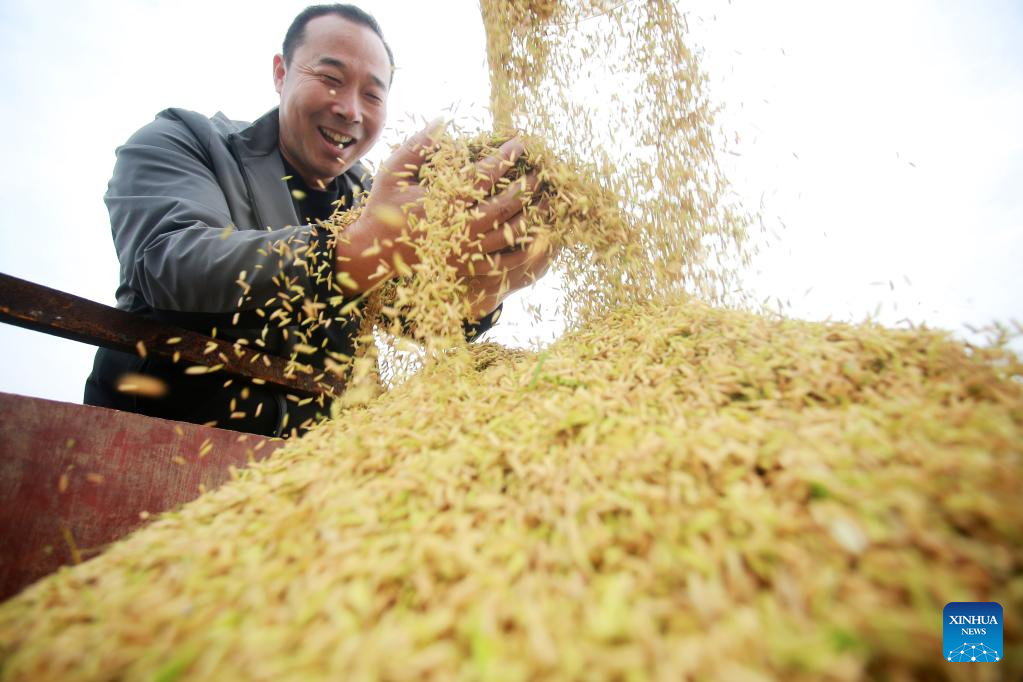
Editor's note: Thursday is World Food Day. Sun Qixin, president of China Agricultural University, told The Beijing News that the intensification of global climate change threatens food security. He said it is crucial to build resilience to address the challenges posed to the agricultural food system by global climate change. Below are excerpts from the interview. The views don't necessarily represent those of China Daily.
Climate change has subjected the already fragile food supply system to severe challenges. This is why China is committed to building a more resilient agricultural food system, which requires innovations in technology, policies and institutions.
Agriculture accounts for about 20 percent of the global increase in greenhouse gas emissions. Greenhouse gas emissions are not limited to carbon dioxide. Agriculture also produces methane and nitrous oxide. Methane primarily comes from livestock farming and paddy farming, while nitrous oxide is mainly the result of fertilizer use. Latest research shows that the greenhouse effect caused by methane is 30-40 times stronger than that of carbon dioxide, and nitrous oxide is 80 times more potent.
These emissions are inevitably generated to meet global food security needs. However, through technological innovation, China can reduce its emissions and achieve a green transformation. New technologies and farming methods not only ensure food security more comprehensively but also help reduce greenhouse gas emissions significantly.
The low-carbon green transformation of agriculture and the reduction of greenhouse gas emissions are therefore vital for mitigating global climate change. Like forests, agriculture serves as a massive carbon sink, giving it dual significance.
On the one hand, it is necessary to reduce emissions through technological innovations. On the other hand, it is important to increase carbon sequestration, which greatly helps to combat climate change. Smart agriculture is a key focus area in global agricultural development.
Building an agricultural powerhouse is a major goal for China. There are roughly three models of agricultural powerhouses in the world. The first includes countries with abundant resources, such as the United States and Canada, where large-scale farming with abundant land per capita is supported by high technology. The second has countries with limited resources, such as many European countries, which have large-scale, highly intensive operations supported by technology. The third model includes countries that lead in specific fields, such as Israel and the Netherlands.
China shares similarities with all three models but there are also some differences. The commonality lies in the need to continuously improve food production, while the difference is that China's farming scale is relatively small, with smallholder farming still the dominant model in the country. China's biggest challenge is the high production costs in agriculture.
To become an agricultural powerhouse, China needs to strengthen agriculture and improve productivity. This can be achieved by expanding the scale of operations or increasing the added value of agricultural products to improve their competitiveness.
Additionally, the country needs innovations in technology. It must foster agricultural enterprises, as they are key for innovation. The integration of artificial intelligence and agriculture is necessary for the transformation of agriculture. It is worth noting that becoming an agricultural powerhouse is not only an economic issue but also a social one. The income gap between urban and rural citizens must be reduced and the rural environment must be improved.
After World War II, under the new international governance system, international aid received widespread attention as a political and institutional commitment from developed countries to developing nations. In the early years, China was a recipient of aid. However, as the country developed, it was able to provide support to other underdeveloped countries, including technical, intellectual and financial assistance.
China should continue to maintain close cooperation with developed countries. As a responsible major power, it should also fulfill its commitment to aid other developing countries. Through cooperation in agricultural technology, China can help achieve food self-sufficiency in agriculture across the globe.