Soy sauce brews new innovations
Century-old brand balances tradition and tech to maintain traditional taste









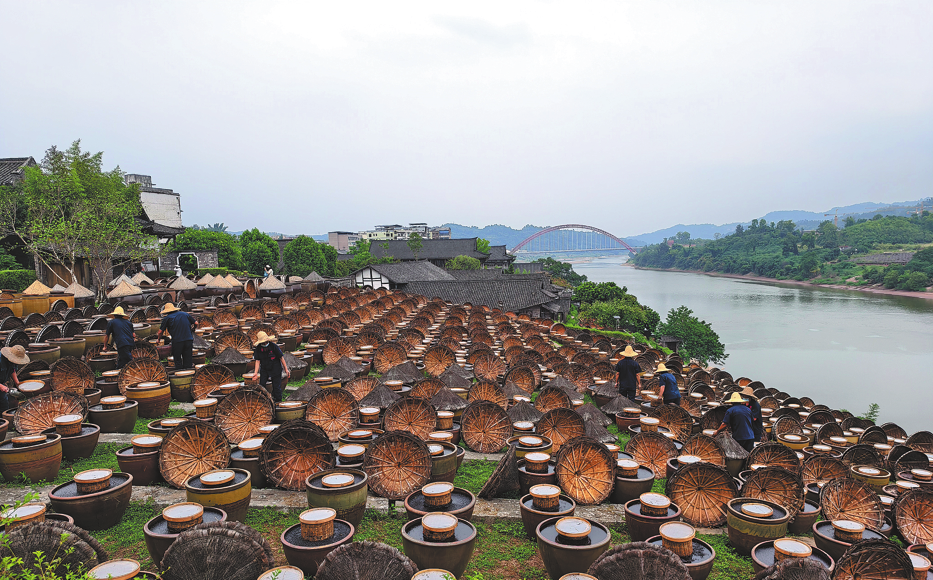
Visitors to the workshop of Xianshi Soy Sauce in Hejiang county, Sichuan province, are often surprised to find that this century-old brand now offers innovative products such as soy sauce-flavored ice cream, coffee and beer.
Lin Wei, a visitor from Beijing who tried the ice cream out of curiosity, said it tastes similar to regular ice cream but is less sweet and carries a subtle salty flavor of soy sauce.
"For someone like me who doesn't like overly sweet desserts, this is definitely a pleasant surprise," Lin said.
Pei Jingrong, a staff member at the Hejiang Xianshi Brewing Food, said the innovation in products is part of her company's efforts to introduce the traditional soy sauce brewing craft to the public — especially the younger generations.
Since 1893, the company has been brewing soy sauce at its original location on the bank of the Chishui River, running between Sichuan and Guizhou provinces. It is home to one of China's longest continuously used and best-preserved soy sauce brewing workshops and open-air fermentation fields.
As a living fossil of traditional Chinese soy sauce brewing, "Xianshi Traditional Soy Sauce Brewing Technique" was recognized as a national intangible cultural heritage in 2014.
Pei emphasized that unlike those produced in modern factories, the fully handcrafted Xianshi Soy Sauce uses only four ingredients — soybeans, wheat flour, salt and water — with no chemical additives at all.
"Our workshop uses a natural fermentation method. It involves 13 processes that take more than three years to complete, resulting in the Xianshi Soy Sauce's rich flavor and aroma," Pei said.
She added that the fully handcrafted processes and lengthy brewing cycle significantly increase production costs, resulting in high selling prices.
"While regular soy sauce typically sells for under 20 yuan ($2.8) per kilogram, our handcrafted soy sauce is priced from 120 to 600 yuan per kilogram," she said.
Hou Yunjing, deputy general manager of the Hejiang Xianshi Brewing Food, said the unique natural environment and microbial ecosystem along the Chishui River's banks provide ideal conditions for brewing premium-quality soy sauce.
"There is an old saying that goes, 'The Chishui River flows through the ages. Liquor is brewed in the upper reaches while soy sauce is brewed in the lower reaches,'" Hou said.
Nestled in a river bend, the company's open-air fermentation field houses over 6,000 jars on a 45-degree slope, which maximizes daytime sun exposure for the fermenting paste. At night, the river water that has evaporated into the air condenses into dew and falls into the jars, supplementing the moisture required for microbial fermentation.
To better preserve the traditional brewing technique, the workshop has been hosting various kinds of cultural and tourism activities in recent years, during which visitors cannot only observe the entire production process but also gain hands-on experience.
Hou said a more ambitious project — a new production base with an investment of 2 billion yuan — is currently under construction. Upon full operation, it is expected to achieve an annual output of over 200,000 metric tons of soy sauce, with an estimated output value of approximately 3 billion yuan, he added.
Chen Siwei, the only national-level inheritor of the Xianshi Traditional Soy Sauce Brewing Technique, said despite the adoption of industrial equipment, the core production processes in the new facility will remain consistent with the traditional brewing technique, ensuring that the taste remains identical to that produced using the traditional method.
The most significant upgrade is the use of advanced equipment to replace manual labor in koji-making, a step that is labor-intensive and has extremely strict requirements for temperature, humidity, and timing control, said the 62-year-old.
"At this old base, which annually produces 1,000 tons of soy sauce, the koji-making process alone requires more than 10 workers. The new facility, however, only needs two or three workers for this process," he said.
Chen said the company has employed over 30 university graduates, who will participate in the operation of the new base. All these graduates are required to spend more than a month to learn the entire process of the Xianshi Soy Sauce brewing technique.
"Traditional techniques must be preserved, but innovation is equally important," the inheritor said. "The entry of well-educated university students will inject new vitality into the inheritance and innovative development of Xianshi Soy Sauce."
Contact the writers at pengchao@chinadaily.com.cn