Reporter who told the world of Japan's war horrors









The greatest power of journalism is its power to tell the truth, something that has never been clearer to me than when I attended a history lecture in Sydney recently. There I encountered a man named Harold John Timperley.
On a projector screen a series of faded black-and-white photographs appeared one after another. In them stood Timperley, whose expression was calm, yet whose eyes seemed to carry a weight beyond words.
It was this Australian journalist who, during the 1930s as a foreign correspondent in China, documented the atrocities committed by the invading Japanese army in the city of Nanjing. Through his writing he brought into Western view a historical truth stained in blood.

In late 1937, as Nanjing fell and violence spread, Timperley chose not to flee. Remaining in his post as a correspondent, he gathered firsthand testimony — accounts from letters and reports — and recorded the massacres, looting and rapes carried out by Japanese soldiers in and around the city.
In his writing, Nanjing was turned from simply an exotic geographical name into a stage of human tragedy, one on which countless lives were extinguished.
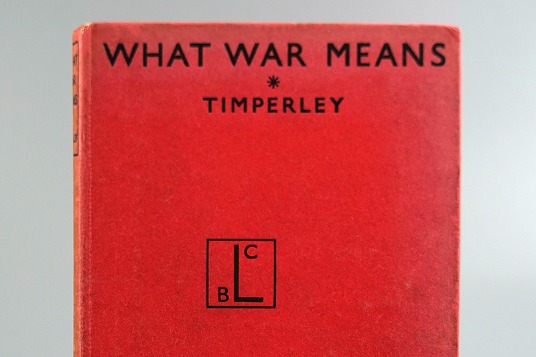
In 1938 Timperley took his accounts to London. He compiled his observations and evidence into a book, published in London as What War Means: The Japanese Terror in China, and later published in the United States. For the first time the horrors of Nanjing were revealed in full to the world.
On Dec 13, 1937, one of the most barbaric episodes of World War II took place in Nanjing, then Chinese capital, left more than 300,000 civilians and unarmed soldiers dead.
The book was like a stone thrown into a still lake, stirring waves across Western society. Countless Western readers were made aware of the suffering of the Chinese people, and their perception of China was transformed by the words of an Australian correspondent who refused to look away.
"Timperley likely did more than any other individual to shape public opinion of China in Britain, America and Australia during World War II," the Chinese Heritage Association of Australia has said.
As I leafed through Timperley's materials, I imagined those turbulent years. China and Australia, two nations separated by oceans, were bound by a shared commitment to justice.
On the Eastern Front, the Chinese people fought doggedly against Japanese militarism, making immense sacrifices. In the Pacific, Australia defended its homeland with equal determination. This bond across distance was not only a strategic alliance but also a shared moral conviction.
More than 80 years on, Timperley feels far from remote. He remains vivid: a man with warmth and conviction, as though he had just put down his pen, still carrying the smoke and ink of the battlefield he recorded.
Timperley's story was never an isolated legend. In the struggle against fascist aggression, countless ordinary Chinese and Australians stood shoulder to shoulder.
In Australia, the working class found their own ways to support China. In 1938 dockworkers in the port city of Wollongong, outraged by the atrocities in Nanjing, collectively refused to load crude iron onto ships bound for Japan. They risked their livelihoods but chose firmly to stand on the side of justice.
In Hainan island, China, a memorial still stands in honor of Australian prisoners of war and servicemen. From 1942 many Australian soldiers were transferred by the Japanese to prisoner-of-war camps there, and endured immense suffering and death.
After the war, China and Australia each erected "sister memorial plaques" — one in Darwin in Australia's Northern Territory, the other in the city of Dongfang, Hainan province — to commemorate the prisoners of war.
In my mind's eye, I can still see Timperley bent over his desk, writing — calm, yet with a quiet anger that could not be ignored. In those moments, ink was his weapon and paper his battlefield, casting a faint light into history's darkest night.
Timperley wrote down the truth, allowing the world to witness the suffering of the Chinese people in their war of resistance. More than 80 years later, his words continue to remind us: Truth is not only the property of history — it belongs to the present as well.