Global experts gather in Shanghai to address urban resilience









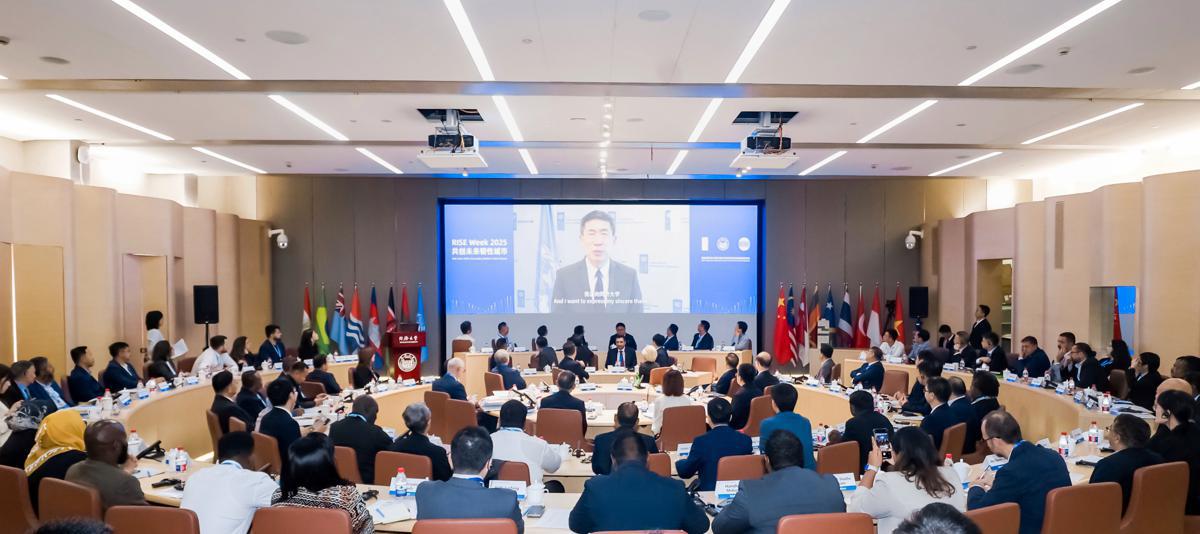
The inaugural RISE Week 2025 opened on Sunday in Shanghai, bringing together more than 100 participants — including global experts, policymakers, and practitioners — from 15 countries to explore innovative solutions for building low-carbon, inclusive, and resilient cities.
The event, themed "co-creating resilient urban futures", was organized under the UNDP—Tongji SDG Innovation Lab on Climate and Disaster Resilience (RISE Lab) and cohosted by UNDP and Tongji University, with support from the China International Center for Economic and Technical Exchanges.
Starting on Oct 17, RISE Week opened with technical workshops and peer-learning sessions on risk assessment, resilient infrastructure, and digital innovation for disaster preparedness. It will continue until Wednesday with policy dialogues, leadership training, and field visits — connecting science, technology, policy, and governance to help cities turn innovation into action for stronger climate and disaster resilience.
"This gathering comes at a critical time," Xu Haoliang, UNDP associate administrator and acting administrator, said in a video message at the opening ceremony. "Globally, cities stand on the front lines of both development progress and vulnerability. They are critical drivers of innovation and economic growth, yet at the same time face increasing risks from climate change, natural disasters, and social inequalities."
"RISE Week provides a unique opportunity to bridge research, policymaking, and practice," Lyu Peiming, executive vice-president of Tongji University, said. "By combining Tongji's technical expertise and UNDP's global development network, we aim to create a space where innovation, science, and policy converge to advance resilience building."
"Urban resilience is a multidimensional challenge, and building effective resilience solutions requires collective inputs, mutual learning, and collaboration between cities and across sectors — everyone has a role to play," Beate Trankmann, UNDP resident representative in China, said. "That's why RISE Week is so valuable — it is a platform bringing together voices from across disciplines and borders."
"The real meaning behind 'co-create' is that it's not doing it for the countries, but really teaching them to fish," Ronald Jackson, head of UNDP's disaster risk reduction and recovery for building resilience team, said. He stressed the significance of digital technology and collaborative approaches. "Digital technologies are crucial for leapfrogging development, Jackson said. "Along with financing solutions, they are two enablers in UNDP's urban resilience program."
International participants shared their experiences and challenges. Paula Coelho da Nobrega, director of Brazil's ministry of cities, highlighted her country's struggle with an assortment of environmental hazards. "In Brazil, we face diverse challenges from wildfires and droughts to landslides and floods. Here we expect to learn from peer-to-peer exchanges, get some insights from technical experts on how we can be better prepared to face this challenge," she said.
Wiwandari Handayani, from Indonesia's Diponegoro University, praised the technical depth of the presentations. "I'm particularly impressed by the advanced research from Tongji University's college of civil engineering on disaster response. Their ongoing research progress is remarkable, and I hope it can be further developed," she said.
Gordon Otieno Muga, senior deputy secretary at Kenya's National Disaster Operation Center, emphasized the value of learning from Shanghai's development. "While scale and affordability may be issues, the key is translating these approaches to specific contexts," Muga said. "There's much to learn from both technical engineering approaches and how Shanghai has evolved into a livable, resilient city."
Zhou Ying, dean of Tongji University's college of civil engineering and director of RISE Lab, emphasized three key priorities: strengthening international cooperation to build resilient cities amid rapid global urbanization; cultivating the next generation of global resilience leaders through education and cross-cultural exchange; and advancing engineering-driven innovation to reduce disaster risks.
She also affirmed that RISE Lab will continue to serve as a pivotal platform for co-creation with experts, urban development and management officials, industry partners, and international organizations.





- Global experts gather in Shanghai to address urban resilience
- Hainan suspends transport as Typhoon Fengshen approaches
- Liuyang fireworks set Guinness World Records
- Blue alert issued for Fengshen, 24th typhoon of the year
- China's AIMS telescope in mid-infrared band operational
- Global mayors visit China Ceramics Museum in Jingdezhen