China becomes first to transmute thorium into uranium for nuclear fission









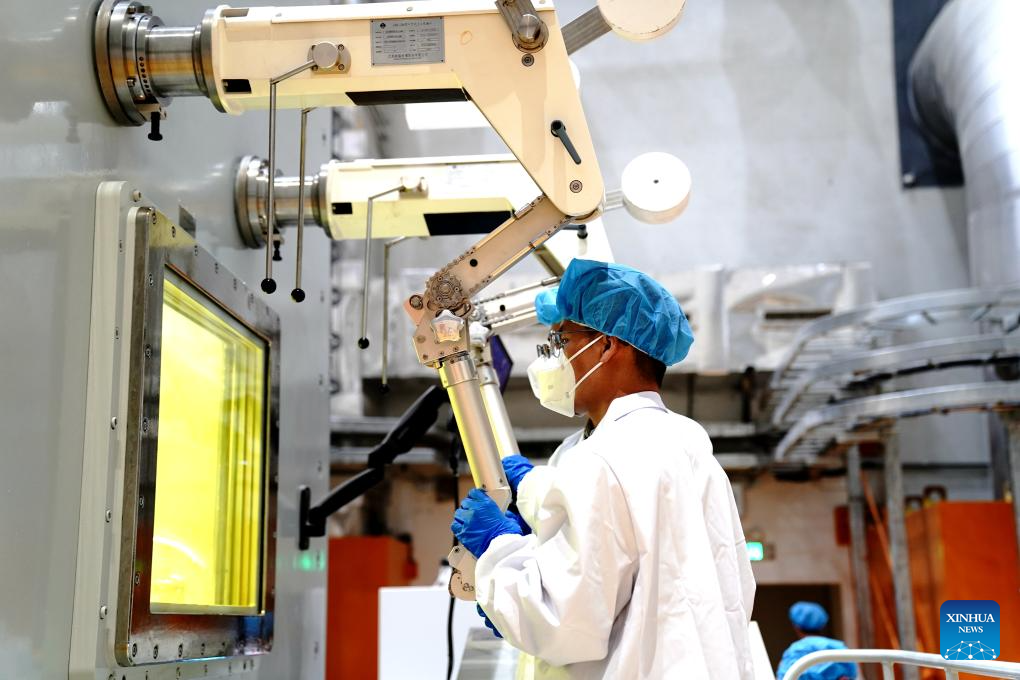
China's thorium molten salt reactor has become the first in the world to transmute thorium fuel into uranium fuel for nuclear fission.
Key physical parameter data of protactinium-233 confirms the successful establishment of a nuclide conversion chain from thorium-232 to uranium-233 within the reactor. The milestone preliminarily verifies the technical feasibility of the thorium fuel cycle and further consolidates China's leading position in molten salt reactor research.
The 2-megawatt thermal liquid-fueled thorium molten salt reactor, led by the Shanghai Institute of Applied Physics of the Chinese Academy of Sciences, is situated in the Hongshagang industrial cluster in Minqin county, administered by Wuwei city, Gansu province.
"Nuclear energy, characterized by high energy density, near-zero carbon emissions and independence from seasonal variations, is a safe, clean, efficient and low-carbon energy source. It plays a crucial role in safeguarding energy security and advancing large-scale commercialization goals," said Cai Xiangzhou, deputy director of the Shanghai Institute of Applied Physics.
Cai highlighted that China has witnessed consistent growth in newly installed nuclear power capacity each year. However, the country faces sustainability challenges due to its heavy reliance on imported uranium — the most widely used nuclear fuel. The issue underscores the critical importance of a stable nuclear fuel supply for sustainable development.
Dai Zhimin, director of the Shanghai Institute of Applied Physics, said that thorium fuel is widely regarded as a promising alternative to uranium, citing two key advantages: China's abundant thorium reserves and its negative temperature coefficient of reactivity, which effectively mitigates the risks of radioactive release. In addition, thorium-fueled reactors generate spent fuel with reduced volume and shorter radioactive half-lives, significantly simplifying waste disposal.
"As a fourth-generation nuclear power reactor type, molten salt reactors use high-temperature molten salt as a coolant. Endowed with inherent safety features, water-free cooling, low-pressure operation and high-temperature output, they are internationally recognized as the most suitable reactor type for thorium resource utilization," Dai said.
He added that the technology facilitated deep integration with industries such as solar energy, wind power, high-temperature molten salt energy storage, high-temperature hydrogen production, and coal, oil and gas chemical engineering.
In response to the national strategic demands for energy security and sustainable development, the CAS launched a program in 2011 to enhance core technological capabilities and develop a thorium-based molten salt reactor system.
Construction of the reactor commenced in 2020, with equipment installation completed in 2022. By June 2024, it reached full-power operation at 650 C. In September, it obtained the world's first experimental license for thorium loading in a molten salt reactor. Last October, the first thorium loading was successfully completed, establishing the world's only research platform dedicated to molten salt reactors and thorium-uranium fuel cycle studies.
"The program brought together nearly 100 domestic research institutions, universities and industrial companies. The collaborative team overcame key challenges in reactor design, the development of critical materials and equipment, reactor safety, and installation and commissioning," Cai said.
Cai emphasized that the team had pioneered technologies for controlling oxygen content in thorium fluoride and established a preparation process for nuclear-grade thorium-based fuel salt.
"Over 90 percent of the reactor's components are domestically produced, with 100 percent localization of key parts and a fully independent supply chain. This achievement marks the initial establishment of an industrial ecosystem for thorium molten salt reactor technologies in China," he added.
Dai said: "The Shanghai Institute of Applied Physics will collaborate with leading energy enterprises, including the State Power Investment Corporation, to build a comprehensive industrial and supply chain ecosystem for the thorium molten salt reactors.
"Our goal is to complete the construction and demonstration operation of a 100-megawatt thermal prototype by 2035 and realize commercial-scale application. This will accelerate technological innovation and engineering transformation, ultimately providing China with a safe, reliable and domestically controlled thorium-based energy generation solution."
Contact the writers at limenghan@chinadaily.com.cn






- China becomes first to transmute thorium into uranium for nuclear fission
- Delivery rider has no arms, but grit drives him to greater effort
- China lays out pitch to lure world's consumers
- AI transforming experience for foreign travelers in China
- Pilot to build top-tier shopping hubs
- Beijing seeks closer collaboration with Pacific Island countries