Resurgence of milu deer population receives praise









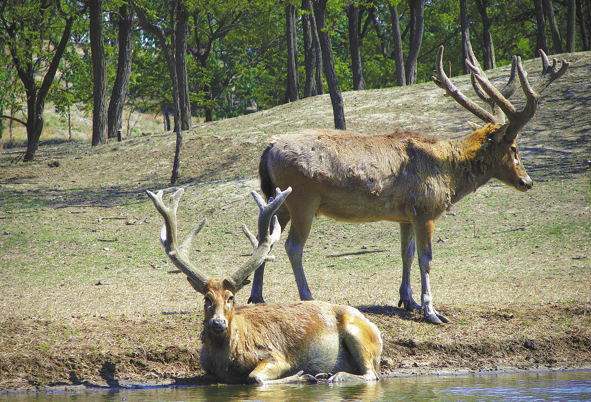
China's decades-long efforts to restore the population of milu deer, also known as Pere David's deer, were praised by international conservationists as a global benchmark for wildlife recovery at a dedicated symposium last month.
The milu has one of the most remarkable conservation histories.
The deer is commonly referred to as "sibuxiang" in China, meaning "like none of the four", for its tail like a donkey, head like a horse, hooves like a cow, and antlers of a deer.
With a fossil history in China dating back to 2 million years, the milu has great cultural significance, and appears in Chinese mythology as the mount of legendary strategist Jiang Ziya.
The milu's conservation story begins with its "discovery" by the West in 1865, when French missionary Pere David encountered the animals in an imperial park in Beijing.
In around 1900, due to poaching, habitat losses and natural disasters, milu deer were declared officially extinct in China. However, a number of the deer had been introduced to Europe. In 1985, the 14th Duke of Bedford from the United Kingdom donated 22 milu to China, and this is where the nation's conservation story begins.
"The reintroduction of milu deer to China has become the most successful species reintroduction example in the world," said Razan Al Mubarak, president of the International Union for Conservation of Nature. "The IUCN has hailed it as the 'Chinese Paradigm for Wildlife Reintroduction'."
She made the remarks at the 2025 International Symposium on Milu and Ecological Conservation, held in Beijing from Oct 24 to 25, which drew more than 100 zoologists, ecologists and conservationists from nine countries.
From 1985 to today, the number of milu deer in China both in the wild and in captivity has risen to 15,000 individuals, a 200-fold increase. The way that China has been able to achieve the remarkable feat is by methodically moving between ex-situ (captive) conservation to in-situ (wild) re-establishment, all underpinned by rigorous scientific management and habitat restoration.
China established two parks for the deer, one in Beijing and another in Jiangsu province.
The Beijing Milu Ecological Research Center serves primarily as a breeding and research center (ex-situ conservation) and a genetic resource bank. While in Jiangsu, Dafeng Milu National Nature Reserve mirrors the milu's original historical habitat. This was earmarked as the main site for eventual reintroduction to the wild (in-situ conservation).
An additional more than 100 breeding populations have been established in 27 provinces.
Efforts to restore wild populations have also made massive strides, with six herds thriving in various regions and numbering over 6,000.
Experts said during the event that the network is the world's largest and most comprehensive system for milu conservation.
Astrid Schomaker, executive secretary of the United Nations Convention on Biological Diversity, said that the achievements in milu deer conservation reflected persistent scientific efforts and international collaboration.
Among the participants, John Mackinnon, a professor at the University of Kent in the UK and a longtime biodiversity researcher in China, emphasized the importance of public awareness in sustaining conservation progress. "The milu story still needs to reach the wider public so that people truly recognize and value this animal," he said.
During the event, researchers announced the completion of the first complete gapless sequence of the milu deer genome, a breakthrough that provides a critical resource for studying the species' genetics and health.
A key outcome of the symposium was the release of the Report on the Effectiveness of Milu Deer Conservation in China, which systematically documents the lessons learned over the past 40 years and outlines future directions for the program.
"We aim to make milu protection a model for global wildlife conservation," said Bai Jiade, director of the Beijing Milu Ecological Research Center.
"In the coming years, we will further promote the reintroduction of milu into the wild and enhance population management networks through modern technologies," he added.
Contact the writers at shenwendi@chinadaily.com.cn





- Resurgence of milu deer population receives praise
- Hong Kong senior retraces Long March
- Deaf children's choir finds rhythm in verse
- 'Field poetry' gives voice to rural children's hopes, fears
- Chinese cities dominate global science hub rankings
- Taiwan tea maker seeks mainland ties at cross-Strait expo