Study explains why Chang'e 6 moon soil is unexpectedly sticky









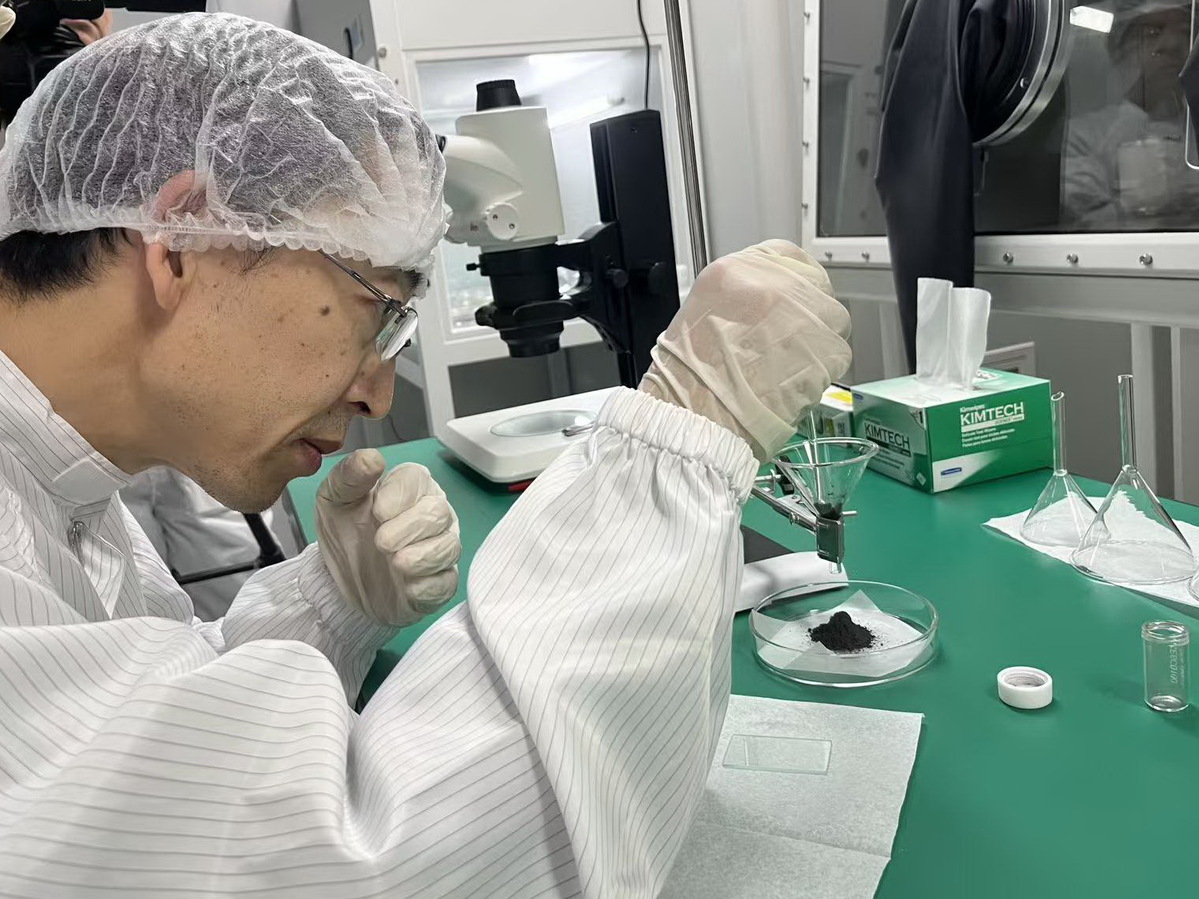
When China's Chang'e 6 probe returned from the far side of the moon in 2024, scientists noticed something peculiar about the lunar soil: It was unexpectedly sticky.
While moon dust collected from the near side by previous missions was loose and sandy, the samples from the far side — the face of the moon that never turns toward Earth — were clumpy and viscous. Now, a team of Chinese researchers says they have solved the mystery.
In a study published Monday in the journal Nature Astronomy, scientists from the Chinese Academy of Sciences reported that the soil's "stickiness" stems from a combination of extremely fine particles and jagged, irregular shapes — a finding that could influence how future lunar bases are built.
The investigation began after Hu Hao, chief designer of the Chang'e 6 mission, noted in June 2024 that the soil collected from the South Pole-Aitken Basin appeared "slightly more viscous and somewhat clumpier" than samples from the near side.
To understand why, a team led by Qi Shengwen at the Institute of Geology and Geophysics subjected the soil to a series of tests. They performed an "angle of repose" test, essentially pouring the soil through a funnel to see how steep a pile it could form without sliding.
The results showed that the far-side soil could hold a much steeper slope, behaving more like damp garden soil on Earth than dry beach sand.
Microscopic physics at work
Researchers first checked for obvious culprits such as moisture or magnetism. They found neither. The soil contained no clay and only trace amounts of magnetic minerals.
Instead, the answer lay in the geometry of the dust itself.
Using high-resolution CT scans of more than 290,000 individual grains, the team found that particles from the far side are extremely small — averaging 48.4 microns in diameter — yet unusually jagged and sharp.
Qi said this creates a "perfect storm" for stickiness. The roughness increases friction between the grains, locking them together. And because the particles are so small, they are subject to weak forces that are negligible on human scales: static electricity and Van der Waals forces, in which molecules are naturally attracted to one another.
"This is unusual," Qi said. "Typically, finer particles are more spherical. Yet, the Chang'e 6 soil, despite being fine, has a more complex shape."
The researchers attribute this to the violent history of the moon's far side. The region is subject to intense space weathering — constant bombardment by micrometeoroids and solar wind. The soil is also rich in feldspar, a mineral that tends to fracture into jagged pieces rather than wearing down smoothly.
Paving the way for 2030
Understanding the texture of moon dust is more than scientific curiosity; it is a critical engineering challenge for future exploration.
Sticky, abrasive soil can clog machinery, coat solar panels and jam the joints of space suits. But knowing these properties helps engineers design better rovers and landing pads.
"These research results will provide a key theoretical basis for the construction of lunar bases and the development of lunar resources," Qi said, adding that whether the sticky soil can feasibly be used as a construction material still needs further verification.
The findings come as China accelerates its space program. The country has announced plans to land astronauts on the moon before 2030. To achieve that, engineers are developing the Long March 10 carrier rocket, a new generation of manned spacecraft and a "moon mobile lab" capable of long-term unmanned operations and short-term human stays.



- Study explains why Chang'e 6 moon soil is unexpectedly sticky
- Rare Sapria himalayana once again enters blooming period in Yunnan
- China to launch Shenzhou XXII spaceship on Nov 25
- Students practice restoring Yuan Dynasty mural details at Shanxi University
- Ministry crackdown dismantles counterfeiting criminal industrial chains
- Explainer: How will China peak coal, oil use in its climate push