Taiwan stance could become Takaichi regime's Achilles' heel









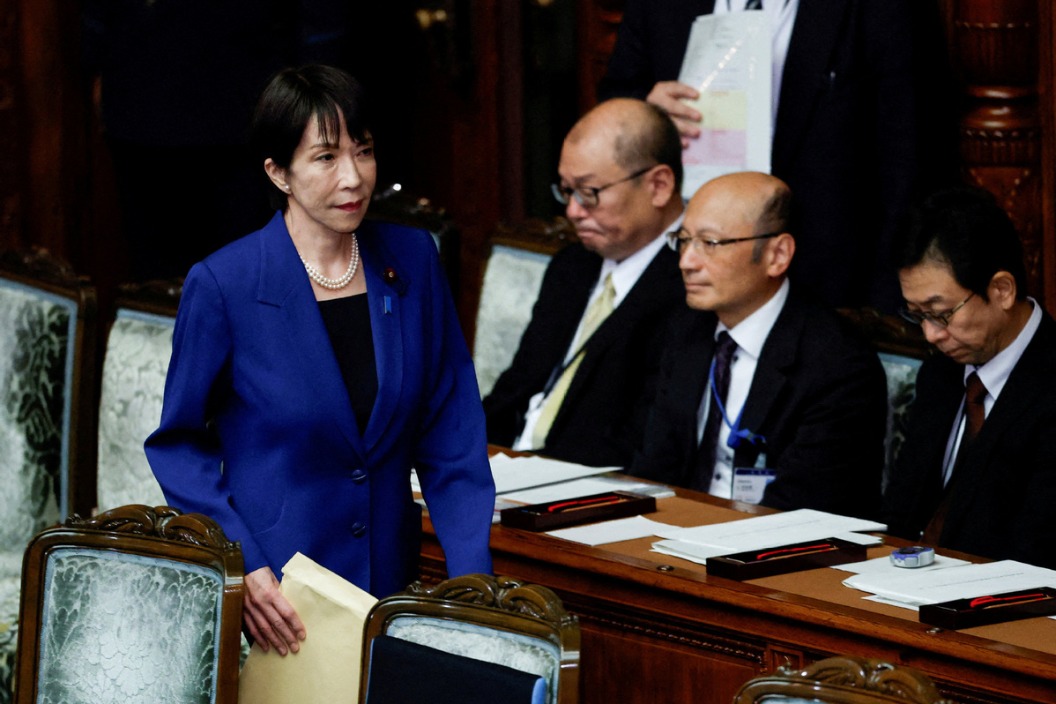
When Japanese Prime Minister Sanae Takaichi stated in the Diet that a "Taiwan contingency" could constitute a "survival-threatening situation" for Japan and potentially justify the so-called right to collective self-defense, she was opening the door for military intervention by Japan in the Taiwan Strait.
Takaichi's erroneous remarks are tantamount to a declaration of war against China. They have severely impacted Japan-China relations, marking the most serious deterioration in bilateral ties since the tensions following Japan's "nationalization" of the Diaoyu Islands in 2012. Preventing further damage is now a diplomatic priority.
For several decades, successive governments in Japan refrained from endorsing the exercise of the "right to collective self-defense" and stuck to the "exclusively defense-oriented policy" under Japan's "pacifist" Constitution. But in 2015, the Shinzo Abe government pushed through a new security legislation in parliament and approved the exercise of this "right to collective self-defense".
However, this security legislation faced widespread criticism from opposition parties and constitutional scholars in Japan who pointed out that it violated the country's Constitution. Since then, successive prime ministers including Abe, Yoshihide Suga, Fumio Kishida, and Shigeru Ishiba have avoided specifying what might constitute "a survival-threatening situation" for Japan.
Takaichi has recklessly crossed the line established by previous administrations on the Taiwan question. Her suggestion that Japan could intervene militarily in the Taiwan Strait is in blatant disregard of the one-China principle. A responsible prime minister should not make such erroneous statements.
But prudence is not exactly something Takaichi is known for. On Oct 31, during the 32nd APEC meeting in the Republic of Korea, she had met Chinese President Xi Jinping, where both sides agreed to advancing a mutually beneficial relationship and building stable bilateral relations between the two countries. However, just the very next day, Takaichi posted photos on social media about her meeting with personnel from China's Taiwan region on the sidelines of the APEC meeting, and referred to the individual as the so-called "senior advisor to the Presidential Office of Taiwan". This also went against the one-China principle, disrespected China and undermined the outcome of her meeting with President Xi.
Even before the repercussions of that incident had subsided, Takaichi made the wrongful remarks on Nov 7 in the Diet. These back-to-back misjudgements show that the Japanese prime minister lacks knowledge of diplomacy and is ignorant of the intricacies of China-Japan relations.
Since she was sworn in, I have warned that the Takaichi government's distorted historical view — such as the denial of the war of aggression against the Chinese people and advocating for visits to the Yasukuni Shrine — along with its stance on the Taiwan question, would prove to be its Achilles' heel.
Many Cabinet members and senior figures in the Liberal Democratic Party are key members of a so-called "Diet members' consultative council" with China's Taiwan island. Their understanding of China and Japan-China relations is shallow and they have limited personal connections in China. The absence of seasoned advisors capable of guiding the government through this delicate relationship and maintaining the necessary distance from the Taiwan question is deeply concerning.
Equally disturbing is the hesitancy of foreign affairs officials to offer substantive advice to the prime minister. As under Abe, the prime minister's office has tightened its control over decisions on personnel, prompting officials to align with the prime minister's hawkish stance rather than provide frank and useful counsel.
On Nov 4, I led a delegation of journalists to Beijing, where we had extensive discussions with some government officials and experts from the Chinese Academy of Social Sciences. Our Chinese hosts were clearly wary of the new prime minister's right-wing stance, yet they hoped that she might adopt a pragmatic approach. However, Takaichi's social media post about her meeting with an official from Taiwan during the APEC meeting was barely tolerable. But her provocation in the Diet must have dashed any remaining hope harbored by the Chinese side.
Having studied Japan-China relations for several decades, I am concerned about the impact of the prime minister's remarks on bilateral relations. The remarks have already drawn widespread criticism from China. In a very unusual move, the Chinese Vice-Foreign Minister Sun Weidong summoned the Japanese ambassador to China late at night to demand a retraction of the prime minister's remarks.
China considers the Taiwan question as one of its core interests and the country brooks no compromise in this regard. The Takaichi administration should keep this in mind and handle the situation carefully, rather than recklessly seek confrontation.
The author is an emeritus professor at Nagoya University of Foreign Studies and vice-president of the Japan-China Relations Society.
The views don't necessarily represent those of China Daily.
If you have a specific expertise, or would like to share your thought about our stories, then send us your writings at opinion@chinadaily.com.cn, and comment@chinadaily.com.cn.