Sept trade surplus reveals further fall
Updated: 2011-10-14 10:13
By Lan Lan (China Daily)
|
|||||||||||


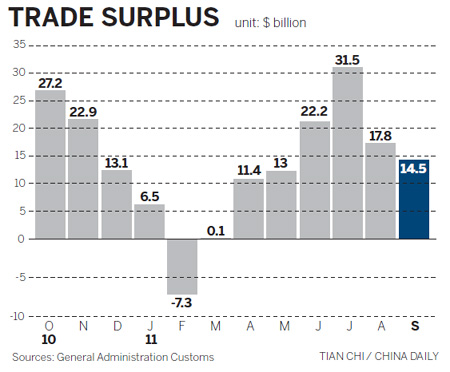
BEIJING - China's trade surplus shrank for a second straight month in September, as the world's second-largest economy faces challenges ranging from a rising yuan to weakening external demand.
The trade surplus dropped 12.4 percent year-on-year in September to $14.5 billion, with both imports and exports lower than expected, according to the General Administration of Customs (GAC) on Thursday.
Sluggish demand from the major economies, currency appreciation and rising protectionism will hit trade prospects, GAC deputy chief Lu Peijun said.
The trade surplus is predicted to be around $170 billion this year, compared to $183.1 billion in 2010.
However, total trade volume is likely to reach $3.5 trillion in 2011, up 19 percent year-on-year, with exports expected to leap 18 percent and imports to surge by 21 percent.
Zhang Zhiwei, chief China economist at Nomura Securities, said China is close to achieving a trade balance.
"The smaller trade surplus in September and next year will ease pressure on yuan appreciation, and help lower risks of a trade war," he said.
The US Senate on Tuesday passed a bill that would allow the US government to slap retaliatory tariffs on imports from China for alleged currency manipulation. China has warned that the proposed legislation risks sparking a trade war.
Lu said that the rising yuan has weakened the competitiveness of Chinese exports.
"This has added to exporters' costs and hit growth in exports," he said.
"Trade conditions are also deteriorating."
Li Yong, deputy general-manager of Xiamen Overseas Chinese Electronic Co Ltd, a TV manufacturer whose markets are mainly in the US and Japan, said export-oriented companies are facing more pressure because of the rising costs of labor and materials, yuan appreciation and tight credit.
But Du Zhengzheng, an analyst at China Development Bank Securities, said that the smaller surplus may help reduce some pressure on China to appreciate its currency.
"With exports growing slower than expected, the government could slow the pace of yuan appreciation in the coming months to avoid hurting exports too much, especially when external demand is weakening," he said.
Stephen Joske, director of the Economist Intelligence Unit's China Forecasting Service, also said a smaller trade surplus is good for the economy.
The government, which is under pressure to revalue the currency, will be comforted by the latest data, he said.
Exports in September went up by 17.1 percent year-on-year, compared with 24.5 percent in August, and imports increased by 20.9 percent year-on-year, down from 30.2 percent in August.
Nomura Securities said in a report on Thursday that export growth in September reflects weaker external demand, and forecast the trend will continue in the months to come.
"It is now certain that external demand is falling. Chinese export growth will continue to slow in the rest of the year," said Shi Lei, an analyst for Ping'an Securities in Beijing, but added that the latest figures were unlikely to prompt swift policy shifts.
Domestic inflation stood at 6.2 percent in August, and the government has made tackling it a priority.
"As falling external demand is expected, any broad-based loosening of monetary policy is unlikely in the short term until we see a clear fall in inflation," Shi said. "The window for possible policy easing is around November and December."
The data also showed China's reliance on the major markets, including the European Union, the United States and Japan, continues to decline.
Exports to these markets accounted for 43.7 percent of China's total exports in the first three quarters, 2 percentage points lower than for the same period last year.
The Association of Southeast Asian Nations overtook Japan to become China's third-largest trading partner.
Exports to the other countries that make up the BRICS, Brazil, Russia, India, and South Africa, remained strong in the first three quarters.
Chery Automobile Co Ltd, a Chinese automaker that exports mainly to emerging markets, said demand in Russia and South Africa remained strong.
Jin Yibo, a spokesman for Chery, said that the company exported more than 120,000 vehicles in the first nine months, up 80 percent on the previous year.
Reuters contributed to this story.