BIZCHINA> Review & Analysis

|
BIZCHINA> Review & Analysis
|
|
High gas prices good for economy, ecology
By William Daniel Garst (China Daily)
Updated: 2009-07-15 15:56 Gas prices have gone up yet again in China. While rising fuel prices are bound to upset motorists, it is a good public policy both from the economic and environmental points of view. The increase in fuel prices will address two of Beijing's biggest problems: chronic traffic congestion and air pollution. We expatriates have a standing joke that the Third Ring Road is the capital's longest parking lot. On a more serious note, the continued increase in the number of vehicles in Beijing threatens to offset the recent improvement in air quality after factories were moved outside the city. Beijing's municipal government has sought to address the problem by re-imposing the odd-even system of driving introduced before the Beijing Olympic Games. But the system doesn't seem to have had much effect on the commuting behavior of families with two cars with odd- and even-numbered license plates. For example, a Chinese colleague in the State-owned enterprise - a subsidiary of China National Petroleum Company (CNPC) - where I work in Beijing has a car with an odd-number plate, while her husband has one with an even number. She told me recently that they drove to work every day by switching their cars to comply with the odd-even traffic regulation during the Olympic Games. The economic theory that people respond to price incentives, along with empirical evidence, shows there is only one surefire way to get people to drive less and use more fuel-efficient vehicles. And that can be achieved by raising the cost of driving. The US experience clearly bears this out. After the first oil price shock of the 1970s, the US government mandated average fuel-efficiency standards for automobiles (CAFE levels) to reduce gas consumption. The result: during the late 1970s, when oil prices were still high and gasoline was relatively expensive, US automobiles' fuel efficiency improved markedly.
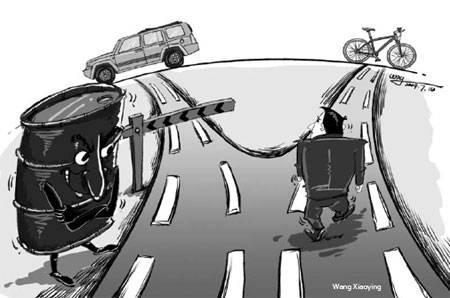 But during the 1980s when energy prices hit historic lows after being adjusted for inflation, the sales of gas-guzzling SUVs, exempted from CAFE standards, soared. Growing suburban sprawls in US cities led people to drive more, increasing traffic congestion and commuting time for motorists. The recent increase in gasoline prices in the US, which jumped to above $3 a gallon in 2007 - gas was below $2 a gallon in 2005 - has helped reverse these trends.
Since car ownership is a new phenomenon in China, I suspect many Chinese drive to work or other places not because traveling by car is the only or best way to get from point A to B, but because they want to drive their newly bought vehicles as much as possible. For instance, one day a foreign colleague visited CNPC's research facility just beyond the Sixth Ring Road in southeast Beijing. On his way back, a Chinese colleague offered to give him a ride in his car and drop him off at Dongzhimen, from where he could take a bus back home to Shunyi.
While their car was stuck in one of the many jams, my foreign colleague wondered why would a person spend more money to drive a car and still reach half an hour later than what a much cheaper public transport would take. He got his answer from the Chinese colleague who said he wanted to drive as much as possible because he liked having a new car and using it -- and he wanted to do all the driving before gas prices rose. Thus fuel prices should be raised if we want to reduce the number of vehicles on the roads. Rising fuel prices will not do any harm to people who use public transport. Besides, unlike most American urban-dwellers, Beijingers have access to a pretty good transport system, and it is improving rapidly. The increase in fuel prices should prompt more and more people to take advantage of such a system. That will be good not only for the city's traffic, but also its air quality. The author is a Sinologist, and teaches at Jintai Academy and Peking University. (For more biz stories, please visit Industries)
|
|||||
主站蜘蛛池模板: 吉木萨尔县| 泸溪县| 杂多县| 克拉玛依市| 博白县| 来凤县| 瑞金市| 蓬莱市| 南汇区| 剑川县| 中方县| 交城县| 仁化县| 会昌县| 承德县| 锡林浩特市| 龙山县| 桃园市| 同德县| 湘西| 福清市| 正镶白旗| 斗六市| 普安县| 新余市| 嵩明县| 牡丹江市| 筠连县| 泾川县| 五家渠市| 嘉善县| 闽清县| 苍山县| 漳州市| 永丰县| 丁青县| 闵行区| 苗栗县| 娱乐| 无为县| 万山特区| 龙胜| 广宗县| 定远县| 淮滨县| 从江县| 登封市| 仪陇县| 六盘水市| 永嘉县| 玉山县| 敖汉旗| 喀什市| 西华县| 肃南| 海原县| 抚顺县| 东明县| 中山市| 鄂托克前旗| 和静县| 库伦旗| 睢宁县| 宣化县| 宜宾市| 曲阜市| 临湘市| 汾西县| 军事| 西丰县| 通州区| 南昌县| 靖远县| 罗源县| 汕尾市| 尼玛县| 疏勒县| 任丘市| 昆山市| 梁山县| 铜陵市| 江口县|



