Converting food waste is not a rubbish idea
Updated: 2012-01-30 09:57
By Diao Ying (China Daily)
|
|||||||||


 |
|
Is there anything useful in all this garbage? A scavenger, working through a Beijing landfill earlier this month, is one of many who live on the waste they can recycle. [Photo / China Daily] |
Leftovers can be easily transformed into fertilizer, animal feed and energy, Diao Ying reports in Beijing.
Sheep wander amid mountains of rubbish as collectors dump garbage from carts. Pigs swarm as people put cooking waste in front of them. Dogs yelp when outsiders approach stoves where used cooking oil simmers.
Those are scenes in Besieged by Waste, a documentary made by artist Wang Jiuliang, who spent two years shooting landfills surrounding Beijing. As the city expands so does its volume of waste. Beijing's 20 million residents generate 11,000 tons of cooking waste every day.
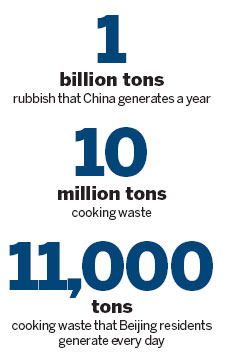
Not all of it ends up in landfills. Some becomes feed for livestock. Some is processed and used again in restaurants. With food safety dominating headlines, government agencies vowed to check sources of cooking oil and work on quality standards.
Meanwhile, entrepreneurs see opportunity in the table scraps and orange rinds, bones and congealed oil you see - and smell - late at night along Guijie, the city's most popular street for gourmets.
"The treatment of food waste is a flourishing industry," said Ren Lianhai, a scholar with Beijing Technology and Business University.
Some companies are working on technologies to generate electricity with rubbish. Others plan to turn food scraps into fertilizer or animal feed.
In Gao'antun, northeast of Beijing, barrels of food waste are delivered to treatment facilities. The waste is fed into a machine with an enzyme, is heated to 75-80 degrees Celsius for 10 hours, and emerges as a brownish powder that can be used in soil as fertilizer. A few bones and toothpicks might remain, but the gutter smell is gone.
Beijing Goldenway Bio-Tech operates about 10 such facilities as it tries to tap into the field of rubbish treatment. When put into full operation, the company says, this one factory could deal with 400 tons of waste a day.
The company sees those millions of bits of food as raw material for organic fertilizers. "They are actually raw materials of abundant supply and extremely low cost," said Yu Jiayi, Goldenway's CEO.
The company was founded eight years ago, before food safety and rubbish treatment grew into the issues they are today, but Yu saw the potential. She had studied animal nutrition in China, had headed State-owned agriculture companies, and then had studied international commerce and globalization in the United Kingdom.
Natural balance
Yu, 49, sees the world as a constant recycling of chemical elements. Nature works through the interaction of animals, plants and microbes, she said. Ideally, the three work consistently and reach a natural balance. But the natural process has been disrupted in China by the expanding gap between urban and rural areas, she said.
Consumption by urban dwellers increases rapidly as cities expand. Trash treatment facilities can't keep pace, so rubbish is transferred to outlying areas. As a result, huge cities are surrounded by rubbish landfills, as Wang's documentary shows.
But it's not just a useless mess. Yu said about 70 percent of China's urban trash is rich in organic compounds. The challenge is to distill the nutritious elements from them and put them to use.
The abundance of rich garbage material in urban areas contrasts with the poor soil in some rural areas, where peasants turn to chemical fertilizers to boost agricultural production. Such fertilizers can increase output in the short term; in the long term, they damage the soil and make it more barren.
Further, too much of certain elements in those synthetic fertilizers, such as nitrogen, enters the water supplies and becomes a source of pollution in the ecosystem. Some chemicals also can go into the vegetables and fruits, making them decay easily and harming people's health.
For Yu, the solution is to reconnect the ecological chain. The company collects the garbage in urban areas, processes it, makes it into organic fertilizers and sells them to the rural areas.
Related Stories
Govt to burn 40% of household waste 2011-09-02 07:57
Waste not, want not 2012-01-19 07:59
A magic pill for e-waste's ills? 2011-11-16 07:59
Construction waste surges as recycling stagnates 2011-10-20 20:18
- Real estate down under is very attractive
- Sino-US trade tensions may increase
- Surging new loans calls for another RRR cut
- Top auditor warns of fiscal, financial risks
- Call to adjust interest rates
- Real estate funds expected to rise
- Cadmium pollution contained in river
- Festival holiday boosts retail sales